





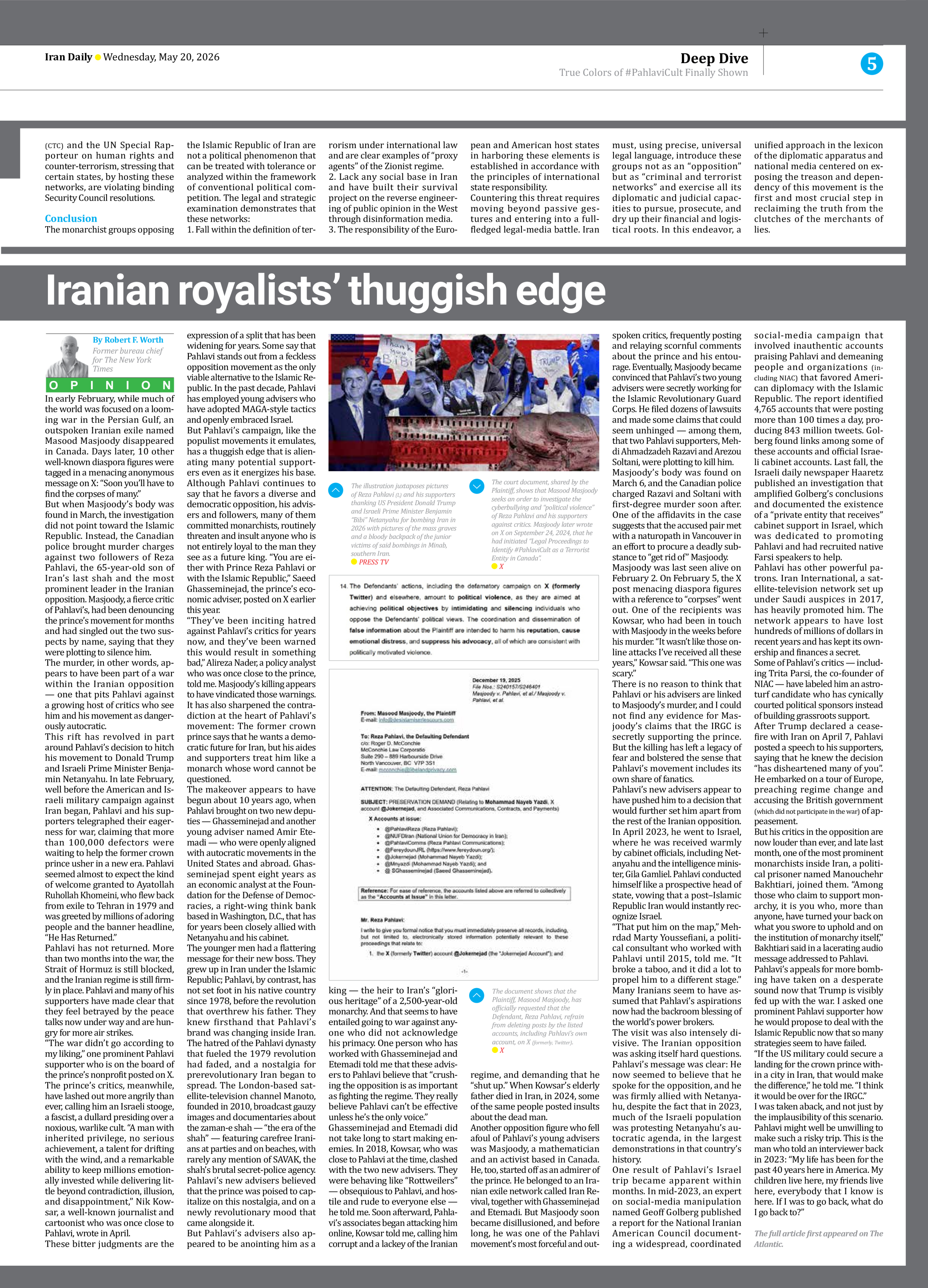


Iranian royalists’ thuggish edge
By Robert F. Worth
Former bureau chief for The New York Times
In early February, while much of the world was focused on a looming war in the Persian Gulf, an outspoken Iranian exile named Masood Masjoody disappeared in Canada. Days later, 10 other well-known diaspora figures were tagged in a menacing anonymous message on X: “Soon you’ll have to find the corpses of many.”
But when Masjoody’s body was found in March, the investigation did not point toward the Islamic Republic. Instead, the Canadian police brought murder charges against two followers of Reza Pahlavi, the 65-year-old son of Iran’s last shah and the most prominent leader in the Iranian opposition. Masjoody, a fierce critic of Pahlavi’s, had been denouncing the prince’s movement for months and had singled out the two suspects by name, saying that they were plotting to silence him.
The murder, in other words, appears to have been part of a war within the Iranian opposition — one that pits Pahlavi against a growing host of critics who see him and his movement as dangerously autocratic.
This rift has revolved in part around Pahlavi’s decision to hitch his movement to Donald Trump and Israeli Prime Minister Benjamin Netanyahu. In late February, well before the American and Israeli military campaign against Iran began, Pahlavi and his supporters telegraphed their eagerness for war, claiming that more than 100,000 defectors were waiting to help the former crown prince usher in a new era. Pahlavi seemed almost to expect the kind of welcome granted to Ayatollah Ruhollah Khomeini, who flew back from exile to Tehran in 1979 and was greeted by millions of adoring people and the banner headline, “He Has Returned.”
Pahlavi has not returned. More than two months into the war, the Strait of Hormuz is still blocked, and the Iranian regime is still firmly in place. Pahlavi and many of his supporters have made clear that they feel betrayed by the peace talks now under way and are hungry for more air strikes.
“The war didn’t go according to my liking,” one prominent Pahlavi supporter who is on the board of the prince’s nonprofit posted on X.
The prince’s critics, meanwhile, have lashed out more angrily than ever, calling him an Israeli stooge, a fascist, a dullard presiding over a noxious, warlike cult. “A man with inherited privilege, no serious achievement, a talent for drifting with the wind, and a remarkable ability to keep millions emotionally invested while delivering little beyond contradiction, illusion, and disappointment,” Nik Kowsar, a well-known journalist and cartoonist who was once close to Pahlavi, wrote in April.
These bitter judgments are the expression of a split that has been widening for years. Some say that Pahlavi stands out from a feckless opposition movement as the only viable alternative to the Islamic Republic. In the past decade, Pahlavi has employed young advisers who have adopted MAGA-style tactics and openly embraced Israel.
But Pahlavi’s campaign, like the populist movements it emulates, has a thuggish edge that is alienating many potential supporters even as it energizes his base. Although Pahlavi continues to say that he favors a diverse and democratic opposition, his advisers and followers, many of them committed monarchists, routinely threaten and insult anyone who is not entirely loyal to the man they see as a future king. “You are either with Prince Reza Pahlavi or with the Islamic Republic,” Saeed Ghasseminejad, the prince’s economic adviser, posted on X earlier this year.
“They’ve been inciting hatred against Pahlavi’s critics for years now, and they’ve been warned this would result in something bad,” Alireza Nader, a policy analyst who was once close to the prince, told me. Masjoody’s killing appears to have vindicated those warnings.
It has also sharpened the contradiction at the heart of Pahlavi’s movement: The former crown prince says that he wants a democratic future for Iran, but his aides and supporters treat him like a monarch whose word cannot be questioned.
The makeover appears to have begun about 10 years ago, when Pahlavi brought on two new deputies — Ghasseminejad and another young adviser named Amir Etemadi — who were openly aligned with autocratic movements in the United States and abroad. Ghasseminejad spent eight years as an economic analyst at the Foundation for the Defense of Democracies, a right-wing think bank based in Washington, D.C., that has for years been closely allied with Netanyahu and his cabinet.
The younger men had a flattering message for their new boss. They grew up in Iran under the Islamic Republic; Pahlavi, by contrast, has not set foot in his native country since 1978, before the revolution that overthrew his father. They knew firsthand that Pahlavi’s brand was changing inside Iran. The hatred of the Pahlavi dynasty that fueled the 1979 revolution had faded, and a nostalgia for prerevolutionary Iran began to spread. The London-based satellite-television channel Manoto, founded in 2010, broadcast gauzy images and documentaries about the zaman-e shah — “the era of the shah” — featuring carefree Iranians at parties and on beaches, with rarely any mention of SAVAK, the shah’s brutal secret-police agency. Pahlavi’s new advisers believed that the prince was poised to capitalize on this nostalgia, and on a newly revolutionary mood that came alongside it.
But Pahlavi’s advisers also appeared to be anointing him as a king — the heir to Iran’s “glorious heritage” of a 2,500-year-old monarchy. And that seems to have entailed going to war against anyone who did not acknowledge his primacy. One person who has worked with Ghasseminejad and Etemadi told me that these advisers to Pahlavi believe that “crushing the opposition is as important as fighting the regime. They really believe Pahlavi can’t be effective unless he’s the only voice.”
Ghasseminejad and Etemadi did not take long to start making enemies. In 2018, Kowsar, who was close to Pahlavi at the time, clashed with the two new advisers. They were behaving like “Rottweilers” — obsequious to Pahlavi, and hostile and rude to everyone else — he told me. Soon afterward, Pahlavi’s associates began attacking him online, Kowsar told me, calling him corrupt and a lackey of the Iranian regime, and demanding that he “shut up.” When Kowsar’s elderly father died in Iran, in 2024, some of the same people posted insults about the dead man.
Another opposition figure who fell afoul of Pahlavi’s young advisers was Masjoody, a mathematician and an activist based in Canada. He, too, started off as an admirer of the prince. He belonged to an Iranian exile network called Iran Revival, together with Ghasseminejad and Etemadi. But Masjoody soon became disillusioned, and before long, he was one of the Pahlavi movement’s most forceful and outspoken critics, frequently posting and relaying scornful comments about the prince and his entourage. Eventually, Masjoody became convinced that Pahlavi’s two young advisers were secretly working for the Islamic Revolutionary Guard Corps. He filed dozens of lawsuits and made some claims that could seem unhinged — among them, that two Pahlavi supporters, Mehdi Ahmadzadeh Razavi and Arezou Soltani, were plotting to kill him.
Masjoody’s body was found on March 6, and the Canadian police charged Razavi and Soltani with first-degree murder soon after. One of the affidavits in the case suggests that the accused pair met with a naturopath in Vancouver in an effort to procure a deadly substance to “get rid of” Masjoody.
Masjoody was last seen alive on February 2. On February 5, the X post menacing diaspora figures with a reference to “corpses” went out. One of the recipients was Kowsar, who had been in touch with Masjoody in the weeks before his murder. “It wasn’t like those online attacks I’ve received all these years,” Kowsar said. “This one was scary.”
There is no reason to think that Pahlavi or his advisers are linked to Masjoody’s murder, and I could not find any evidence for Masjoody’s claims that the IRGC is secretly supporting the prince. But the killing has left a legacy of fear and bolstered the sense that Pahlavi’s movement includes its own share of fanatics.
Pahlavi’s new advisers appear to have pushed him to a decision that would further set him apart from the rest of the Iranian opposition. In April 2023, he went to Israel, where he was received warmly by cabinet officials, including Netanyahu and the intelligence minister, Gila Gamliel. Pahlavi conducted himself like a prospective head of state, vowing that a post–Islamic Republic Iran would instantly recognize Israel.
“That put him on the map,” Mehrdad Marty Youssefiani, a political consultant who worked with Pahlavi until 2015, told me. “It broke a taboo, and it did a lot to propel him to a different stage.” Many Iranians seem to have assumed that Pahlavi’s aspirations now had the backroom blessing of the world’s power brokers.
The visit was also intensely divisive. The Iranian opposition was asking itself hard questions. Pahlavi’s message was clear: He now seemed to believe that he spoke for the opposition, and he was firmly allied with Netanyahu, despite the fact that in 2023, much of the Israeli population was protesting Netanyahu’s autocratic agenda, in the largest demonstrations in that country’s history.
One result of Pahlavi’s Israel trip became apparent within months. In mid-2023, an expert on social-media manipulation named Geoff Golberg published a report for the National Iranian American Council documenting a widespread, coordinated social-media campaign that involved inauthentic accounts praising Pahlavi and demeaning people and organizations (including NIAC) that favored American diplomacy with the Islamic Republic. The report identified 4,765 accounts that were posting more than 100 times a day, producing 843 million tweets. Golberg found links among some of these accounts and official Israeli cabinet accounts. Last fall, the Israeli daily newspaper Haaretz published an investigation that amplified Golberg’s conclusions and documented the existence of a “private entity that receives” cabinet support in Israel, which was dedicated to promoting Pahlavi and had recruited native Farsi speakers to help.
Pahlavi has other powerful patrons. Iran International, a satellite-television network set up under Saudi auspices in 2017, has heavily promoted him. The network appears to have lost hundreds of millions of dollars in recent years and has kept its ownership and finances a secret.
Some of Pahlavi’s critics — including Trita Parsi, the co-founder of NIAC — have labeled him an astroturf candidate who has cynically courted political sponsors instead of building grassroots support.
After Trump declared a cease-fire with Iran on April 7, Pahlavi posted a speech to his supporters, saying that he knew the decision “has disheartened many of you”. He embarked on a tour of Europe, preaching regime change and accusing the British government (which did not participate in the war) of appeasement.
But his critics in the opposition are now louder than ever, and late last month, one of the most prominent monarchists inside Iran, a political prisoner named Manouchehr Bakhtiari, joined them. “Among those who claim to support monarchy, it is you who, more than anyone, have turned your back on what you swore to uphold and on the institution of monarchy itself,” Bakhtiari said in a lacerating audio message addressed to Pahlavi.
Pahlavi’s appeals for more bombing have taken on a desperate sound now that Trump is visibly fed up with the war. I asked one prominent Pahlavi supporter how he would propose to deal with the Islamic Republic now that so many strategies seem to have failed.
“If the US military could secure a landing for the crown prince within a city in Iran, that would make the difference,” he told me. “I think it would be over for the IRGC.”
I was taken aback, and not just by the implausibility of this scenario. Pahlavi might well be unwilling to make such a risky trip. This is the man who told an interviewer back in 2023: “My life has been for the past 40 years here in America. My children live here, my friends live here, everybody that I know is here. If I was to go back, what do I go back to?”
The full article first appeared on The Atlantic.