







Reverse engineering of national identity
Role of monarchist groups in overthrow project, frameworks of int’l responsibility
Strategic affairs analyst
In today’s complex international order, threats to national security have moved beyond the classic conventional form (hard war between states) and entered the realm of hybrid warfare. Within this context, one of the most intricate and insidious layers is the exploitation of apparently political opposition groups by a hostile regime (in this case, the Zionist regime) to advance subversive, terrorist, and ultimately overthrow-oriented objectives against the Islamic Republic of Iran.
Monarchist groups, which claim to be the heirs of an extinct political system, have transformed from a marginal phenomenon within the Iranian diaspora into a transnational network performing intelligence-operative functions for Israel’s Mossad. This substantive shift necessitates a legal redefinition of these groups from “opposition group” to “terrorist network under foreign patronage”. This piece demonstrates that these networks lack any popular legitimacy inside Iran and merely serve the interests of the regime occupying Al-Quds (Jerusalem) in the heart of Europe and the United States.
Historical genealogy and paradigmatic shift
To understand today’s phenomenon, one must review the historical evolution of these groups. The monarchist movement in the diaspora suffered a rupture in legitimacy following the Islamic Revolution. In the first decades, these groups largely relied on low-impact propaganda activities and political lobbying. However, repeated failures to attract public opinion inside Iran and frustration with the project of a “miraculous return” propelled them towards a dangerous paradigmatic shift.
This shift occurred in three stages:
1. The stage of accepting foreign tutelage: Frustration with domestic mobilization led them to conclude that only by relying on a foreign power could they preserve their existence.
2. The stage of integration into the Zionist regime’s security apparatus: Shared interests in “anti-Iranianism” and “anti-Islamism” prompted Mossad to identify and recruit these groups as cheap contractors, equipped with Persian language and social cover, for its infiltration and psychological operations projects.
3. The stage of direct action: At this stage, certain radicalized offshoots of these groups, receiving financial and logistical support from Israel, moved beyond mere propaganda and specifically engaged in designing and executing sabotage operations inside Iran or attacking Iran’s diplomatic missions, its diplomats, and patriotic Iranians in Europe.
The outcome of this shift is the birth of a “proxy force” from a pre-existing entity, which reduces Israel’s operational costs and mitigates the risk of direct attribution.
Int’l legal framework: establishing the terrorist character
From the perspective of international law, the terrorist character of these networks can be proven using three legal rationales:
a. The broad definition of terrorism in Security Council resolutions:
UN Security Council Resolution 1373 (2001) and subsequent resolutions define terrorism as any criminal act with political motives that aims to create terror among the population, compel a government to do or abstain from doing something, or destabilize the political structures of a state. Monarchist networks fall within this framework on the following grounds:
• Financing of terrorism: Receiving direct funding from entities affiliated with the Zionist regime, which itself has been repeatedly accused of state terrorism.
• Incitement to violence: The media outlets of these groups have repeatedly engaged in direct incitement to assassinate scientists, destroy public property, and create armed unrest.
• Links with operational elements: Intelligence reports from the Islamic Republic of Iran and some independent Western sources have documented the logistical connections of these networks with sabotage teams inside Iran.
b. Violation of the right to self-determination and the “non-intervention” doctrine:
These groups, by presenting a false image of the Islamic Establishment’s lack of legitimacy and claiming to represent the Iranian nation, effectively provide Western powers with a narrative cost-justification for “humanitarian intervention” or R2P. This act is a manifest violation of Article 2(7) of the UN Charter (the principle of non-intervention in internal affairs) and Article 1 of the two Covenants (the right of peoples to self-determination). Ignoring the will of millions of Iranians expressed in rallies and elections and labeling a structure with religious democracy a “dictatorship” constitutes a clear violation of this fundamental right.
c. The doctrine of State Responsibility of the host state:
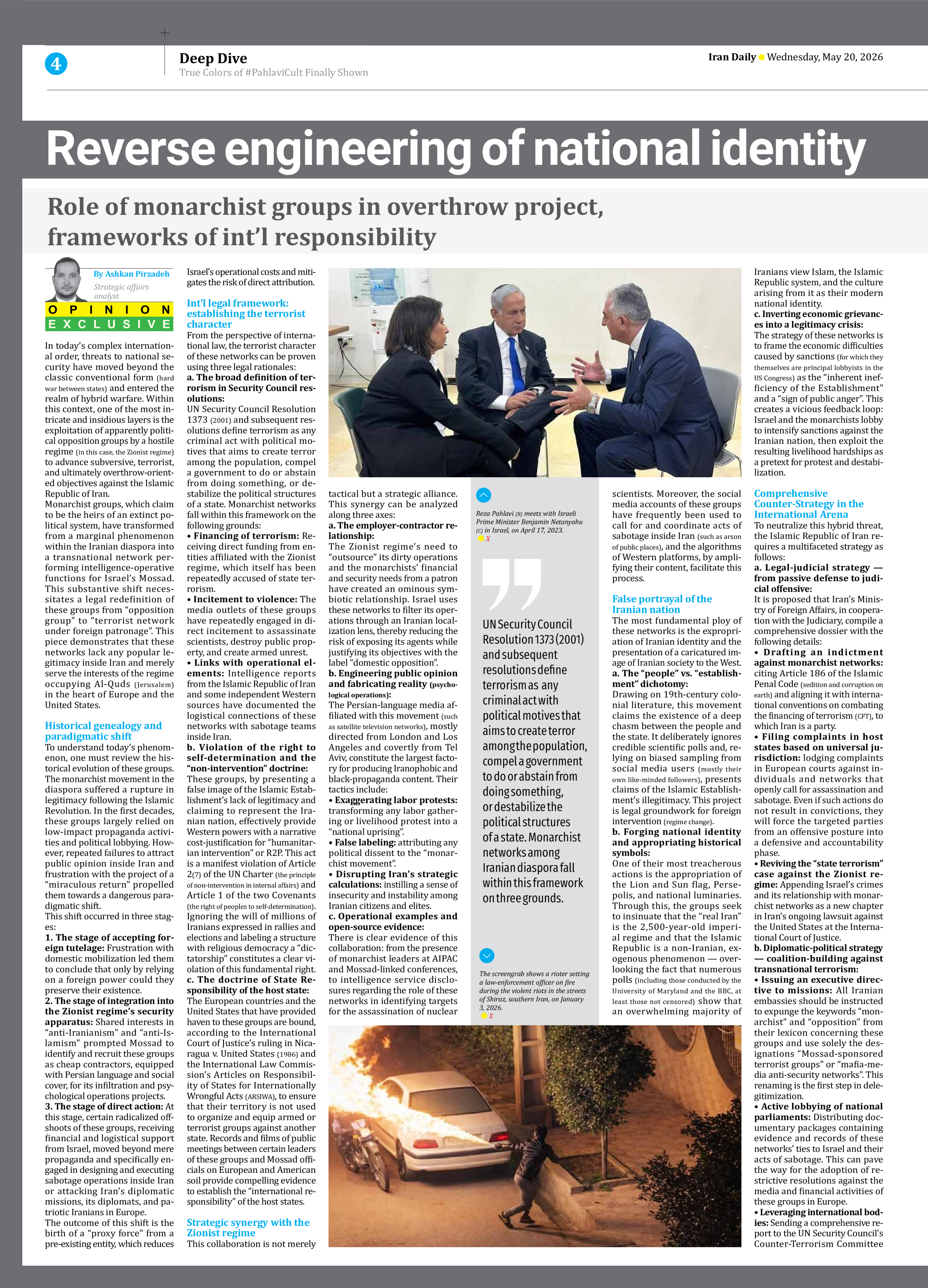
The European countries and the United States that have provided haven to these groups are bound, according to the International Court of Justice’s ruling in Nicaragua v. United States (1986) and the International Law Commission’s Articles on Responsibility of States for Internationally Wrongful Acts (ARSIWA), to ensure that their territory is not used to organize and equip armed or terrorist groups against another state. Records and films of public meetings between certain leaders of these groups and Mossad officials on European and American soil provide compelling evidence to establish the “international responsibility” of the host states.
Strategic synergy with the Zionist regime
This collaboration is not merely tactical but a strategic alliance. This synergy can be analyzed along three axes:
a. The employer-contractor relationship:
The Zionist regime’s need to “outsource” its dirty operations and the monarchists’ financial and security needs from a patron have created an ominous symbiotic relationship. Israel uses these networks to filter its operations through an Iranian localization lens, thereby reducing the risk of exposing its agents while justifying its objectives with the label “domestic opposition”.
b. Engineering public opinion and fabricating reality (psychological operations):
The Persian-language media affiliated with this movement (such as satellite television networks), mostly directed from London and Los Angeles and covertly from Tel Aviv, constitute the largest factory for producing Iranophobic and black-propaganda content. Their tactics include:
• Exaggerating labor protests: transforming any labor gathering or livelihood protest into a “national uprising”.
• False labeling: attributing any political dissent to the “monarchist movement”.
• Disrupting Iran’s strategic calculations: instilling a sense of insecurity and instability among Iranian citizens and elites.
c. Operational examples and open-source evidence:
There is clear evidence of this collaboration: from the presence of monarchist leaders at AIPAC and Mossad-linked conferences, to intelligence service disclosures regarding the role of these networks in identifying targets for the assassination of nuclear scientists. Moreover, the social media accounts of these groups have frequently been used to call for and coordinate acts of sabotage inside Iran (such as arson of public places), and the algorithms of Western platforms, by amplifying their content, facilitate this process.
False portrayal of the Iranian nation
The most fundamental ploy of these networks is the expropriation of Iranian identity and the presentation of a caricatured image of Iranian society to the West.
a. The “people” vs. “establishment” dichotomy:
Drawing on 19th-century colonial literature, this movement claims the existence of a deep chasm between the people and the state. It deliberately ignores credible scientific polls and, relying on biased sampling from social media users (mostly their own like-minded followers), presents claims of the Islamic Establishment’s illegitimacy. This project is legal groundwork for foreign intervention (regime change).
b. Forging national identity and appropriating historical symbols:
One of their most treacherous actions is the appropriation of the Lion and Sun flag, Persepolis, and national luminaries. Through this, the groups seek to insinuate that the “real Iran” is the 2,500-year-old imperial regime and that the Islamic Republic is a non-Iranian, exogenous phenomenon — overlooking the fact that numerous polls (including those conducted by the University of Maryland and the BBC, at least those not censored) show that an overwhelming majority of Iranians view Islam, the Islamic Republic system, and the culture arising from it as their modern national identity.
c. Inverting economic grievances into a legitimacy crisis:
The strategy of these networks is to frame the economic difficulties caused by sanctions (for which they themselves are principal lobbyists in the US Congress) as the “inherent inefficiency of the Establishment” and a “sign of public anger”. This creates a vicious feedback loop: Israel and the monarchists lobby to intensify sanctions against the Iranian nation, then exploit the resulting livelihood hardships as a pretext for protest and destabilization.
Comprehensive Counter-Strategy in the International Arena
To neutralize this hybrid threat, the Islamic Republic of Iran requires a multifaceted strategy as follows:
a. Legal-judicial strategy — from passive defense to judicial offensive:
It is proposed that Iran’s Ministry of Foreign Affairs, in cooperation with the Judiciary, compile a comprehensive dossier with the following details:
• Drafting an indictment against monarchist networks: citing Article 186 of the Islamic Penal Code (sedition and corruption on earth) and aligning it with international conventions on combating the financing of terrorism (CFT), to which Iran is a party.
• Filing complaints in host states based on universal jurisdiction: lodging complaints in European courts against individuals and networks that openly call for assassination and sabotage. Even if such actions do not result in convictions, they will force the targeted parties from an offensive posture into a defensive and accountability phase.
• Reviving the “state terrorism” case against the Zionist regime: Appending Israel’s crimes and its relationship with monarchist networks as a new chapter in Iran’s ongoing lawsuit against the United States at the International Court of Justice.
b. Diplomatic-political strategy — coalition-building against transnational terrorism:
• Issuing an executive directive to missions: All Iranian embassies should be instructed to expunge the keywords “monarchist” and “opposition” from their lexicon concerning these groups and use solely the designations “Mossad-sponsored terrorist groups” or “mafia-media anti-security networks”. This renaming is the first step in delegitimization.
• Active lobbying of national parliaments: Distributing documentary packages containing evidence and records of these networks’ ties to Israel and their acts of sabotage. This can pave the way for the adoption of restrictive resolutions against the media and financial activities of these groups in Europe.
• Leveraging international bodies: Sending a comprehensive report to the UN Security Council’s Counter-Terrorism Committee (CTC) and the UN Special Rapporteur on human rights and counter-terrorism, stressing that certain states, by hosting these networks, are violating binding Security Council resolutions.
Conclusion
The monarchist groups opposing the Islamic Republic of Iran are not a political phenomenon that can be treated with tolerance or analyzed within the framework of conventional political competition. The legal and strategic examination demonstrates that these networks:
1. Fall within the definition of terrorism under international law and are clear examples of “proxy agents” of the Zionist regime.
2. Lack any social base in Iran and have built their survival project on the reverse engineering of public opinion in the West through disinformation media.
3. The responsibility of the European and American host states in harboring these elements is established in accordance with the principles of international state responsibility.
Countering this threat requires moving beyond passive gestures and entering into a full-fledged legal-media battle. Iran must, using precise, universal legal language, introduce these groups not as an “opposition” but as “criminal and terrorist networks” and exercise all its diplomatic and judicial capacities to pursue, prosecute, and dry up their financial and logistical roots. In this endeavor, a unified approach in the lexicon of the diplomatic apparatus and national media centered on exposing the treason and dependency of this movement is the first and most crucial step in reclaiming the truth from the clutches of the merchants of lies.