







Tehran Stock Exchange reopens after 80-day war closure, indices post rise
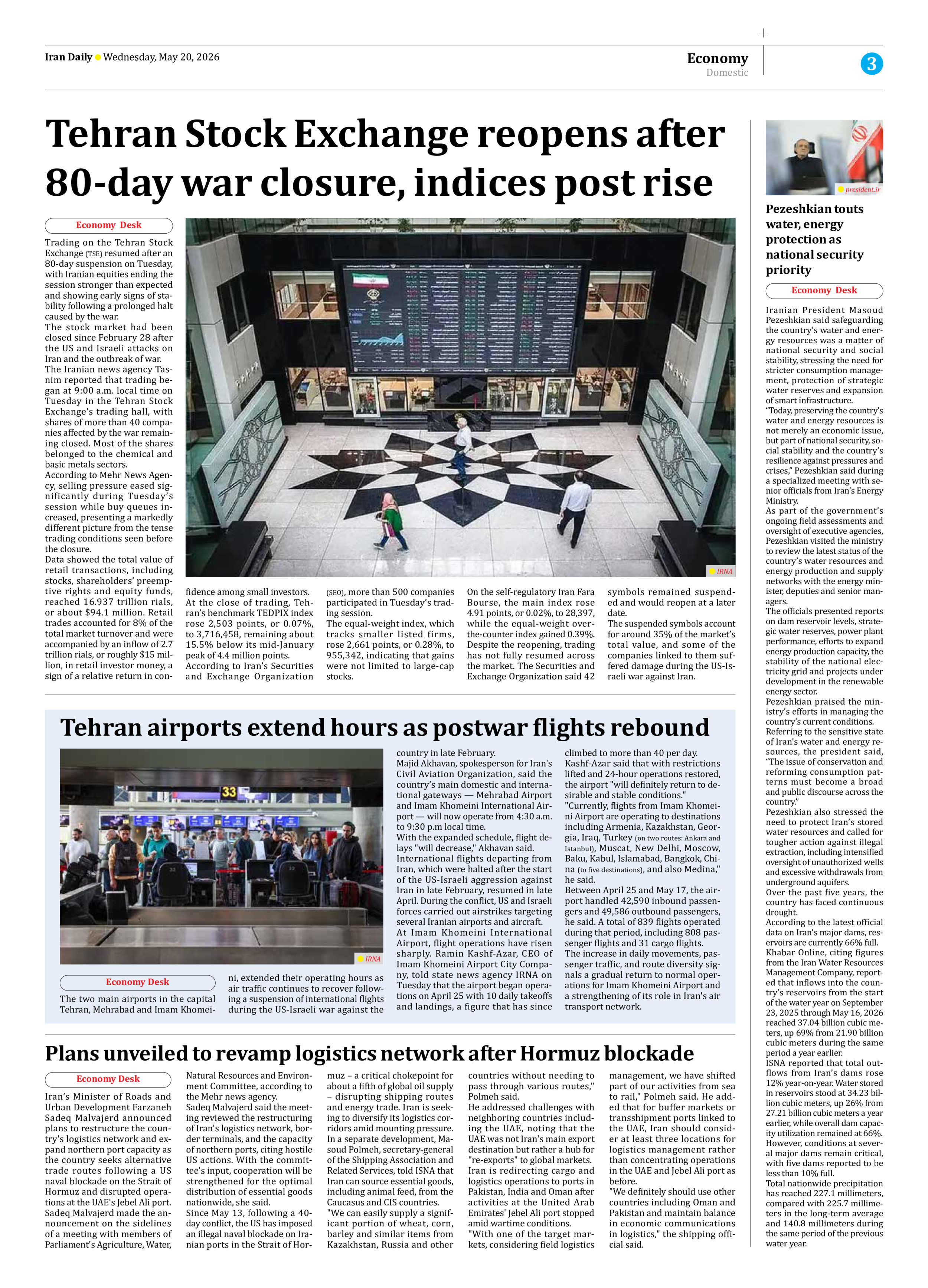
Trading on the Tehran Stock Exchange (TSE) resumed after an 80-day suspension on Tuesday, with Iranian equities ending the session stronger than expected and showing early signs of stability following a prolonged halt caused by the war.
The stock market had been closed since February 28 after the US and Israeli attacks on Iran and the outbreak of war.
The Iranian news agency Tasnim reported that trading began at 9:00 a.m. local time on Tuesday in the Tehran Stock Exchange's trading hall, with shares of more than 40 companies affected by the war remaining closed. Most of the shares belonged to the chemical and basic metals sectors.
According to Mehr News Agency, selling pressure eased significantly during Tuesday’s session while buy queues increased, presenting a markedly different picture from the tense trading conditions seen before the closure.
Data showed the total value of retail transactions, including stocks, shareholders’ preemptive rights and equity funds, reached 16.937 trillion rials, or about $94.1 million. Retail trades accounted for 8% of the total market turnover and were accompanied by an inflow of 2.7 trillion rials, or roughly $15 million, in retail investor money, a sign of a relative return in confidence among small investors.
At the close of trading, Tehran’s benchmark TEDPIX index rose 2,503 points, or 0.07%, to 3,716,458, remaining about 15.5% below its mid-January peak of 4.4 million points.
According to Iran’s Securities and Exchange Organization (SEO), more than 500 companies participated in Tuesday’s trading session.
The equal-weight index, which tracks smaller listed firms, rose 2,661 points, or 0.28%, to 955,342, indicating that gains were not limited to large-cap stocks.
On the self-regulatory Iran Fara Bourse, the main index rose 4.91 points, or 0.02%, to 28,397, while the equal-weight over-the-counter index gained 0.39%.
Despite the reopening, trading has not fully resumed across the market. The Securities and Exchange Organization said 42 symbols remained suspended and would reopen at a later date.
The suspended symbols account for around 35% of the market’s total value, and some of the companies linked to them suffered damage during the US-Israeli war against Iran.