





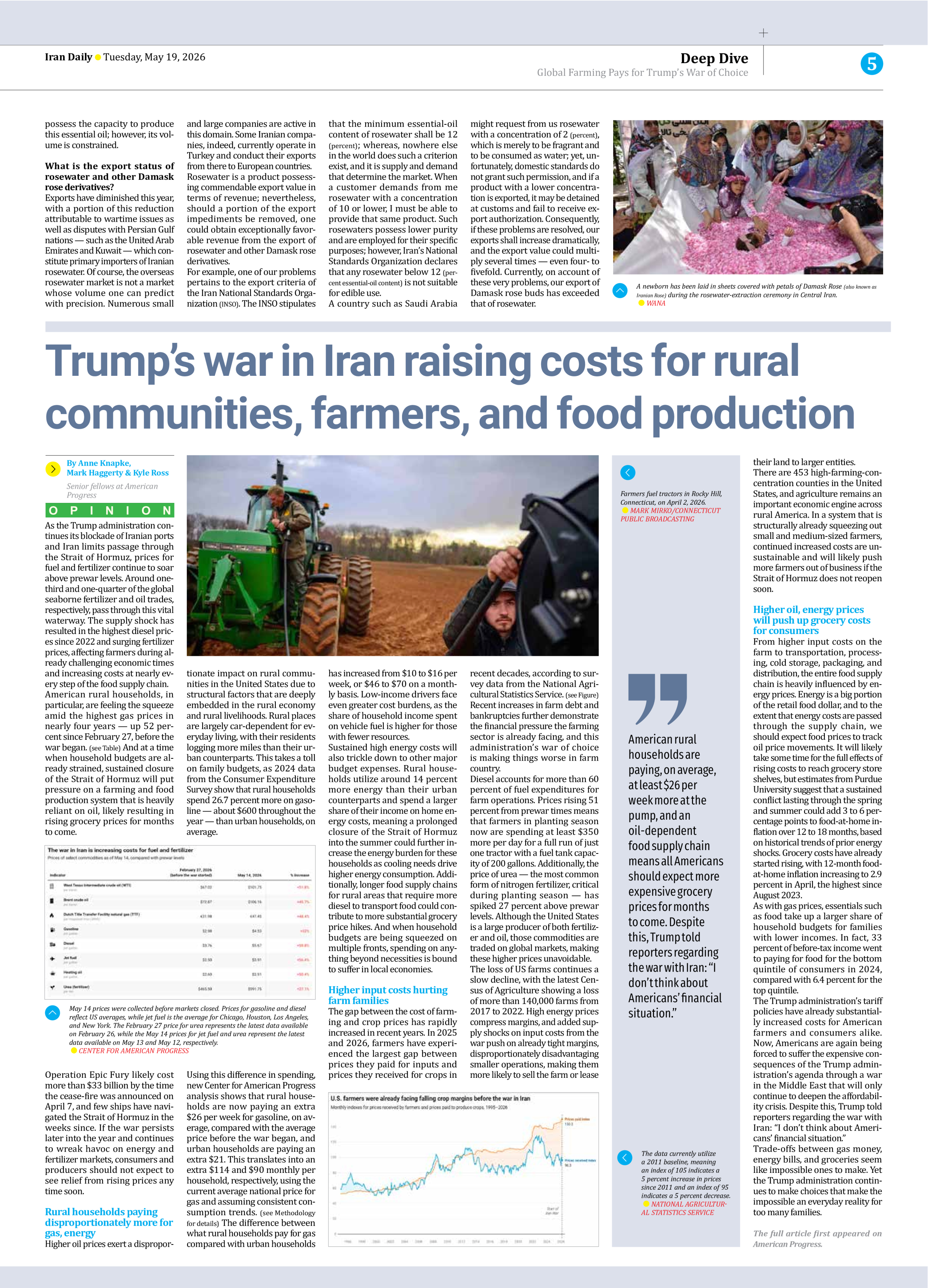


Trump’s war in Iran raising costs for rural communities, farmers, and food production
By Anne Knapke,
Mark Haggerty & Kyle Ross
Senior fellows at American Progress
As the Trump administration continues its blockade of Iranian ports and Iran limits passage through the Strait of Hormuz, prices for fuel and fertilizer continue to soar above prewar levels. Around one-third and one-quarter of the global seaborne fertilizer and oil trades, respectively, pass through this vital waterway. The supply shock has resulted in the highest diesel prices since 2022 and surging fertilizer prices, affecting farmers during already challenging economic times and increasing costs at nearly every step of the food supply chain.
American rural households, in particular, are feeling the squeeze amid the highest gas prices in nearly four years — up 52 percent since February 27, before the war began. (see Table) And at a time when household budgets are already strained, sustained closure of the Strait of Hormuz will put pressure on a farming and food production system that is heavily reliant on oil, likely resulting in rising grocery prices for months to come.
Operation Epic Fury likely cost more than $33 billion by the time the cease-fire was announced on April 7, and few ships have navigated the Strait of Hormuz in the weeks since. If the war persists later into the year and continues to wreak havoc on energy and fertilizer markets, consumers and producers should not expect to see relief from rising prices any time soon.
Rural households paying disproportionately more for gas, energy
Higher oil prices exert a disproportionate impact on rural communities in the United States due to structural factors that are deeply embedded in the rural economy and rural livelihoods. Rural places are largely car-dependent for everyday living, with their residents logging more miles than their urban counterparts. This takes a toll on family budgets, as 2024 data from the Consumer Expenditure Survey show that rural households spend 26.7 percent more on gasoline — about $600 throughout the year — than urban households, on average.
Using this difference in spending, new Center for American Progress analysis shows that rural households are now paying an extra $26 per week for gasoline, on average, compared with the average price before the war began, and urban households are paying an extra $21. This translates into an extra $114 and $90 monthly per household, respectively, using the current average national price for gas and assuming consistent consumption trends. (see Methodology for details) The difference between what rural households pay for gas compared with urban households has increased from $10 to $16 per week, or $46 to $70 on a monthly basis. Low-income drivers face even greater cost burdens, as the share of household income spent on vehicle fuel is higher for those with fewer resources.
Sustained high energy costs will also trickle down to other major budget expenses. Rural households utilize around 14 percent more energy than their urban counterparts and spend a larger share of their income on home energy costs, meaning a prolonged closure of the Strait of Hormuz into the summer could further increase the energy burden for these households as cooling needs drive higher energy consumption. Additionally, longer food supply chains for rural areas that require more diesel to transport food could contribute to more substantial grocery price hikes. And when household budgets are being squeezed on multiple fronts, spending on anything beyond necessities is bound to suffer in local economies.
Higher input costs hurting farm families
The gap between the cost of farming and crop prices has rapidly increased in recent years. In 2025 and 2026, farmers have experienced the largest gap between prices they paid for inputs and prices they received for crops in recent decades, according to survey data from the National Agricultural Statistics Service. (see Figure) Recent increases in farm debt and bankruptcies further demonstrate the financial pressure the farming sector is already facing, and this administration’s war of choice is making things worse in farm country.
Diesel accounts for more than 60 percent of fuel expenditures for farm operations. Prices rising 51 percent from prewar times means that farmers in planting season now are spending at least $350 more per day for a full run of just one tractor with a fuel tank capacity of 200 gallons. Additionally, the price of urea — the most common form of nitrogen fertilizer, critical during planting season — has spiked 27 percent above prewar levels. Although the United States is a large producer of both fertilizer and oil, those commodities are traded on global markets, making these higher prices unavoidable.
The loss of US farms continues a slow decline, with the latest Census of Agriculture showing a loss of more than 140,000 farms from 2017 to 2022. High energy prices compress margins, and added supply shocks on input costs from the war push on already tight margins, disproportionately disadvantaging smaller operations, making them more likely to sell the farm or lease their land to larger entities.
There are 453 high-farming-concentration counties in the United States, and agriculture remains an important economic engine across rural America. In a system that is structurally already squeezing out small and medium-sized farmers, continued increased costs are unsustainable and will likely push more farmers out of business if the Strait of Hormuz does not reopen soon.
Higher oil, energy prices will push up grocery costs for consumers
From higher input costs on the farm to transportation, processing, cold storage, packaging, and distribution, the entire food supply chain is heavily influenced by energy prices. Energy is a big portion of the retail food dollar, and to the extent that energy costs are passed through the supply chain, we should expect food prices to track oil price movements. It will likely take some time for the full effects of rising costs to reach grocery store shelves, but estimates from Purdue University suggest that a sustained conflict lasting through the spring and summer could add 3 to 6 percentage points to food-at-home inflation over 12 to 18 months, based on historical trends of prior energy shocks. Grocery costs have already started rising, with 12-month food-at-home inflation increasing to 2.9 percent in April, the highest since August 2023.
As with gas prices, essentials such as food take up a larger share of household budgets for families with lower incomes. In fact, 33 percent of before-tax income went to paying for food for the bottom quintile of consumers in 2024, compared with 6.4 percent for the top quintile.
The Trump administration’s tariff policies have already substantially increased costs for American farmers and consumers alike. Now, Americans are again being forced to suffer the expensive consequences of the Trump administration’s agenda through a war in the Middle East that will only continue to deepen the affordability crisis. Despite this, Trump told reporters regarding the war with Iran: “I don’t think about Americans’ financial situation.”
Trade-offs between gas money, energy bills, and groceries seem like impossible ones to make. Yet the Trump administration continues to make choices that make the impossible an everyday reality for too many families.
The full article first appeared on American Progress.