







Iran ranks foremost in rosewater production: Union president
Our ‘liquid gold’ in pursuit of int’l markets
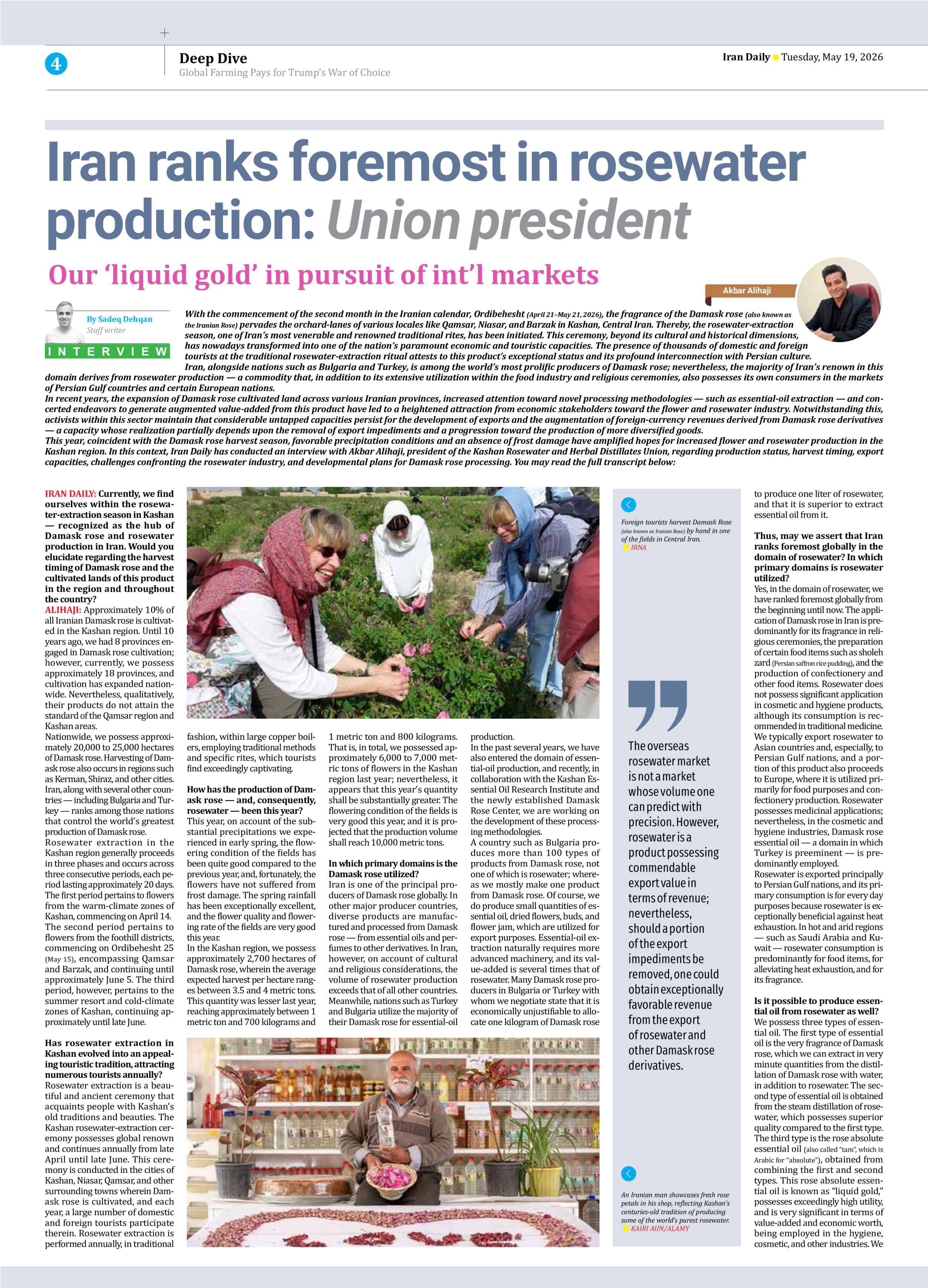
With the commencement of the second month in the Iranian calendar, Ordibehesht (April 21–May 21, 2026), the fragrance of the Damask rose (also known as the Iranian Rose) pervades the orchard-lanes of various locales like Qamsar, Niasar, and Barzak in Kashan, Central Iran. Thereby, the rosewater-extraction season, one of Iran’s most venerable and renowned traditional rites, has been initiated. This ceremony, beyond its cultural and historical dimensions, has nowadays transformed into one of the nation’s paramount economic and touristic capacities. The presence of thousands of domestic and foreign tourists at the traditional rosewater-extraction ritual attests to this product’s exceptional status and its profound interconnection with Persian culture. Iran, alongside nations such as Bulgaria and Turkey, is among the world’s most prolific producers of Damask rose; nevertheless, the majority of Iran’s renown in this domain derives from rosewater production — a commodity that, in addition to its extensive utilization within the food industry and religious ceremonies, also possesses its own consumers in the markets of Persian Gulf countries and certain European nations. In recent years, the expansion of Damask rose cultivated land across various Iranian provinces, increased attention toward novel processing methodologies — such as essential-oil extraction — and concerted endeavors to generate augmented value-added from this product have led to a heightened attraction from economic stakeholders toward the flower and rosewater industry. Notwithstanding this, activists within this sector maintain that considerable untapped capacities persist for the development of exports and the augmentation of foreign-currency revenues derived from Damask rose derivatives — a capacity whose realization partially depends upon the removal of export impediments and a progression toward the production of more diversified goods. This year, coincident with the Damask rose harvest season, favorable precipitation conditions and an absence of frost damage have amplified hopes for increased flower and rosewater production in the Kashan region. In this context, Iran Daily has conducted an interview with Akbar Alihaji, president of the Kashan Rosewater and Herbal Distillates Union, regarding production status, harvest timing, export capacities, challenges confronting the rosewater industry, and developmental plans for Damask rose processing. You may read the full transcript below:
By Sadeq Dehqan
Staff writer
IRAN DAILY: Currently, we find ourselves within the rosewater-extraction season in Kashan — recognized as the hub of Damask rose and rosewater production in Iran. Would you elucidate regarding the harvest timing of Damask rose and the cultivated lands of this product in the region and throughout the country?
ALIHAJI: Approximately 10% of all Iranian Damask rose is cultivated in the Kashan region. Until 10 years ago, we had 8 provinces engaged in Damask rose cultivation; however, currently, we possess approximately 18 provinces, and cultivation has expanded nationwide. Nevertheless, qualitatively, their products do not attain the standard of the Qamsar region and Kashan areas.
Nationwide, we possess approximately 20,000 to 25,000 hectares of Damask rose. Harvesting of Damask rose also occurs in regions such as Kerman, Shiraz, and other cities. Iran, along with several other countries — including Bulgaria and Turkey — ranks among those nations that control the world’s greatest production of Damask rose.
Rosewater extraction in the Kashan region generally proceeds in three phases and occurs across three consecutive periods, each period lasting approximately 20 days. The first period pertains to flowers from the warm-climate zones of Kashan, commencing on April 14.
The second period pertains to flowers from the foothill districts, commencing on Ordibehesht 25 (May 15), encompassing Qamsar and Barzak, and continuing until approximately June 5. The third period, however, pertains to the summer resort and cold-climate zones of Kashan, continuing approximately until late June.
Has rosewater extraction in Kashan evolved into an appealing touristic tradition, attracting numerous tourists annually?
Rosewater extraction is a beautiful and ancient ceremony that acquaints people with Kashan’s old traditions and beauties. The Kashan rosewater-extraction ceremony possesses global renown and continues annually from late April until late June. This ceremony is conducted in the cities of Kashan, Niasar, Qamsar, and other surrounding towns wherein Damask rose is cultivated, and each year, a large number of domestic and foreign tourists participate therein. Rosewater extraction is performed annually, in traditional fashion, within large copper boilers, employing traditional methods and specific rites, which tourists find exceedingly captivating.
How has the production of Damask rose — and, consequently, rosewater — been this year?
This year, on account of the substantial precipitations we experienced in early spring, the flowering condition of the fields has been quite good compared to the previous year, and, fortunately, the flowers have not suffered from frost damage. The spring rainfall has been exceptionally excellent, and the flower quality and flowering rate of the fields are very good this year.
In the Kashan region, we possess approximately 2,700 hectares of Damask rose, wherein the average expected harvest per hectare ranges between 3.5 and 4 metric tons. This quantity was lesser last year, reaching approximately between 1 metric ton and 700 kilograms and 1 metric ton and 800 kilograms. That is, in total, we possessed approximately 6,000 to 7,000 metric tons of flowers in the Kashan region last year; nevertheless, it appears that this year’s quantity shall be substantially greater. The flowering condition of the fields is very good this year, and it is projected that the production volume shall reach 10,000 metric tons.
In which primary domains is the Damask rose utilized?
Iran is one of the principal producers of Damask rose globally. In other major producer countries, diverse products are manufactured and processed from Damask rose — from essential oils and perfumes to other derivatives. In Iran, however, on account of cultural and religious considerations, the volume of rosewater production exceeds that of all other countries. Meanwhile, nations such as Turkey and Bulgaria utilize the majority of their Damask rose for essential-oil production.
In the past several years, we have also entered the domain of essential-oil production, and recently, in collaboration with the Kashan Essential Oil Research Institute and the newly established Damask Rose Center, we are working on the development of these processing methodologies.
A country such as Bulgaria produces more than 100 types of products from Damask rose, not one of which is rosewater; whereas we mostly make one product from Damask rose. Of course, we do produce small quantities of essential oil, dried flowers, buds, and flower jam, which are utilized for export purposes. Essential-oil extraction naturally requires more advanced machinery, and its value-added is several times that of rosewater. Many Damask rose producers in Bulgaria or Turkey with whom we negotiate state that it is economically unjustifiable to allocate one kilogram of Damask rose to produce one liter of rosewater, and that it is superior to extract essential oil from it.
Thus, may we assert that Iran ranks foremost globally in the domain of rosewater? In which primary domains is rosewater utilized?
Yes, in the domain of rosewater, we have ranked foremost globally from the beginning until now. The application of Damask rose in Iran is predominantly for its fragrance in religious ceremonies, the preparation of certain food items such as sholeh zard (Persian saffron rice pudding), and the production of confectionery and other food items. Rosewater does not possess significant application in cosmetic and hygiene products, although its consumption is recommended in traditional medicine.
We typically export rosewater to Asian countries and, especially, to Persian Gulf nations, and a portion of this product also proceeds to Europe, where it is utilized primarily for food purposes and confectionery production. Rosewater possesses medicinal applications; nevertheless, in the cosmetic and hygiene industries, Damask rose essential oil — a domain in which Turkey is preeminent — is predominantly employed.
Rosewater is exported principally to Persian Gulf nations, and its primary consumption is for every day purposes because rosewater is exceptionally beneficial against heat exhaustion. In hot and arid regions — such as Saudi Arabia and Kuwait — rosewater consumption is predominantly for food items, for alleviating heat exhaustion, and for its fragrance.
Is it possible to produce essential oil from rosewater as well?
We possess three types of essential oil. The first type of essential oil is the very fragrance of Damask rose, which we can extract in very minute quantities from the distillation of Damask rose with water, in addition to rosewater. The second type of essential oil is obtained from the steam distillation of rosewater, which possesses superior quality compared to the first type. The third type is the rose absolute essential oil (also called “tam”, which is Arabic for “absolute”), obtained from combining the first and second types. This rose absolute essential oil is known as “liquid gold,” possesses exceedingly high utility, and is very significant in terms of value-added and economic worth, being employed in the hygiene, cosmetic, and other industries. We possess the capacity to produce this essential oil; however, its volume is constrained.
What is the export status of rosewater and other Damask rose derivatives?
Exports have diminished this year, with a portion of this reduction attributable to wartime issues as well as disputes with Persian Gulf nations — such as the United Arab Emirates and Kuwait — which constitute primary importers of Iranian rosewater. Of course, the overseas rosewater market is not a market whose volume one can predict with precision. Numerous small and large companies are active in this domain. Some Iranian companies, indeed, currently operate in Turkey and conduct their exports from there to European countries.
Rosewater is a product possessing commendable export value in terms of revenue; nevertheless, should a portion of the export impediments be removed, one could obtain exceptionally favorable revenue from the export of rosewater and other Damask rose derivatives.
For example, one of our problems pertains to the export criteria of the Iran National Standards Organization (INSO). The INSO stipulates that the minimum essential-oil content of rosewater shall be 12 (percent); whereas, nowhere else in the world does such a criterion exist, and it is supply and demand that determine the market. When a customer demands from me rosewater with a concentration of 10 or lower, I must be able to provide that same product. Such rosewaters possess lower purity and are employed for their specific purposes; however, Iran’s National Standards Organization declares that any rosewater below 12 (percent essential-oil content) is not suitable for edible use.
A country such as Saudi Arabia might request from us rosewater with a concentration of 2 (percent), which is merely to be fragrant and to be consumed as water; yet, unfortunately, domestic standards do not grant such permission, and if a product with a lower concentration is exported, it may be detained at customs and fail to receive export authorization. Consequently, if these problems are resolved, our exports shall increase dramatically, and the export value could multiply several times — even four- to fivefold. Currently, on account of these very problems, our export of Damask rose buds has exceeded that of rosewater.