







Persian Gulf states and Iran
Implications of hosting military bases under Jus ad Bellum and Jus in Bello
By Chiara Redaelli
IHL/ICL expert for IDLO, Kyiv office
By Antonio Bultrini
Associate Professor of International Law at the University of Florence
Since late February 2026, the United States and Israel have conducted sustained strikes on Iranian territory. The chronology of these operations makes clear that the campaign has involved coordinated strikes on nuclear, military, leadership, and civilian targets. The jus ad bellum (the law governing the right to go to war) arguments advanced by Washington, principally a theory of anticipatory self-defence against Iran’s nuclear program, have been strongly rejected by international legal opinion, which holds that the campaign does not satisfy the requirements of lawful (anticipatory) self-defence under Article 51.
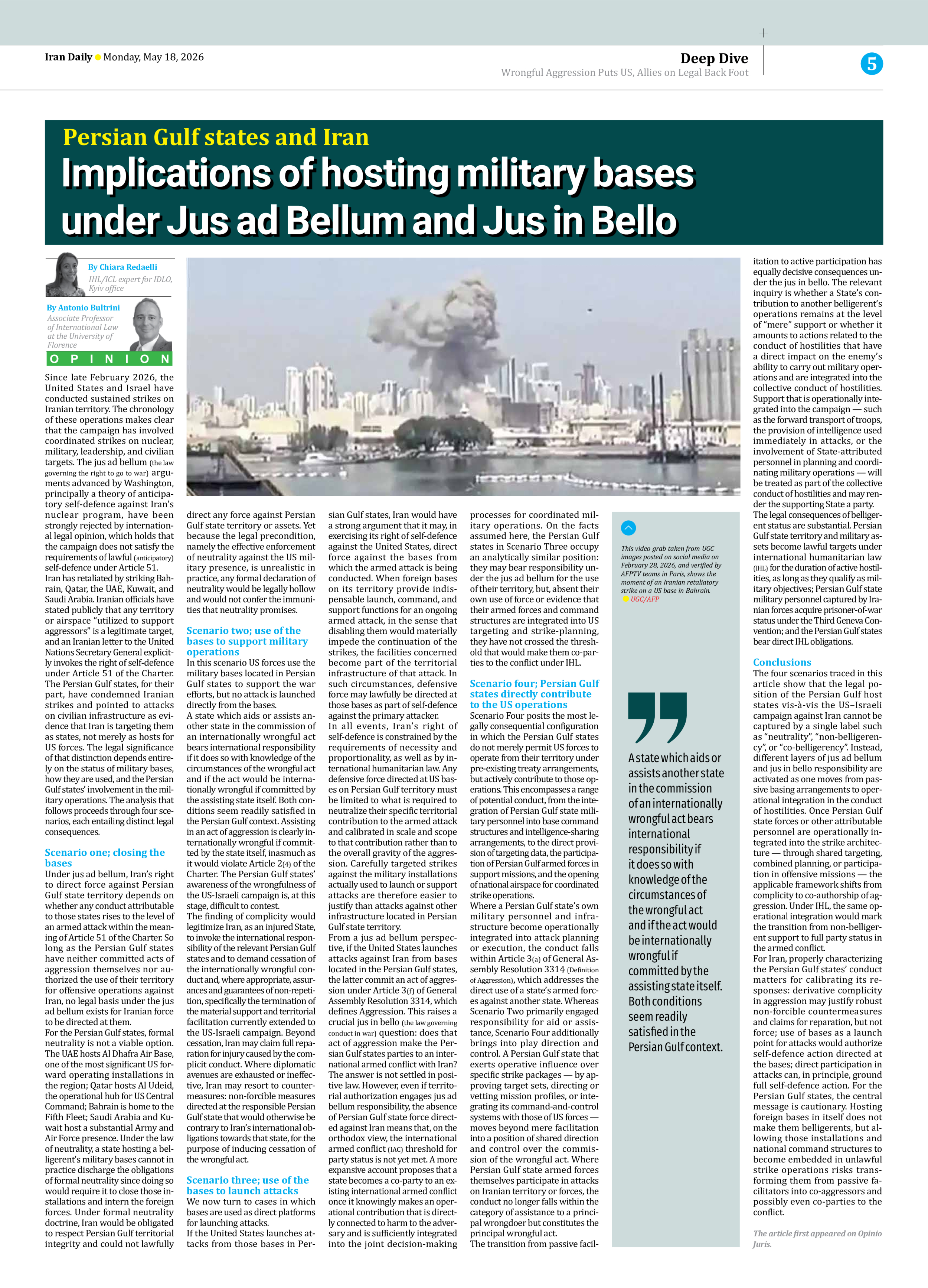
Iran has retaliated by striking Bahrain, Qatar, the UAE, Kuwait, and Saudi Arabia. Iranian officials have stated publicly that any territory or airspace “utilized to support aggressors” is a legitimate target, and an Iranian letter to the United Nations Secretary General explicitly invokes the right of self-defence under Article 51 of the Charter. The Persian Gulf states, for their part, have condemned Iranian strikes and pointed to attacks on civilian infrastructure as evidence that Iran is targeting them as states, not merely as hosts for US forces. The legal significance of that distinction depends entirely on the status of military bases, how they are used, and the Persian Gulf states’ involvement in the military operations. The analysis that follows proceeds through four scenarios, each entailing distinct legal consequences.
Scenario one; closing the bases
Under jus ad bellum, Iran’s right to direct force against Persian Gulf state territory depends on whether any conduct attributable to those states rises to the level of an armed attack within the meaning of Article 51 of the Charter. So long as the Persian Gulf states have neither committed acts of aggression themselves nor authorized the use of their territory for offensive operations against Iran, no legal basis under the jus ad bellum exists for Iranian force to be directed at them.
For the Persian Gulf states, formal neutrality is not a viable option. The UAE hosts Al Dhafra Air Base, one of the most significant US forward operating installations in the region; Qatar hosts Al Udeid, the operational hub for US Central Command; Bahrain is home to the Fifth Fleet; Saudi Arabia and Kuwait host a substantial Army and Air Force presence. Under the law of neutrality, a state hosting a belligerent’s military bases cannot in practice discharge the obligations of formal neutrality since doing so would require it to close those installations and intern the foreign forces. Under formal neutrality doctrine, Iran would be obligated to respect Persian Gulf territorial integrity and could not lawfully direct any force against Persian Gulf state territory or assets. Yet because the legal precondition, namely the effective enforcement of neutrality against the US military presence, is unrealistic in practice, any formal declaration of neutrality would be legally hollow and would not confer the immunities that neutrality promises.
Scenario two; use of the bases to support military operations
In this scenario US forces use the military bases located in Persian Gulf states to support the war efforts, but no attack is launched directly from the bases.
A state which aids or assists another state in the commission of an internationally wrongful act bears international responsibility if it does so with knowledge of the circumstances of the wrongful act and if the act would be internationally wrongful if committed by the assisting state itself. Both conditions seem readily satisfied in the Persian Gulf context. Assisting in an act of aggression is clearly internationally wrongful if committed by the state itself, inasmuch as it would violate Article 2(4) of the Charter. The Persian Gulf states’ awareness of the wrongfulness of the US-Israeli campaign is, at this stage, difficult to contest.
The finding of complicity would legitimize Iran, as an injured State, to invoke the international responsibility of the relevant Persian Gulf states and to demand cessation of the internationally wrongful conduct and, where appropriate, assurances and guarantees of non-repetition, specifically the termination of the material support and territorial facilitation currently extended to the US-Israeli campaign. Beyond cessation, Iran may claim full reparation for injury caused by the complicit conduct. Where diplomatic avenues are exhausted or ineffective, Iran may resort to countermeasures: non-forcible measures directed at the responsible Persian Gulf state that would otherwise be contrary to Iran’s international obligations towards that state, for the purpose of inducing cessation of the wrongful act.
Scenario three; use of the bases to launch attacks
We now turn to cases in which bases are used as direct platforms for launching attacks.
If the United States launches attacks from those bases in Persian Gulf states, Iran would have a strong argument that it may, in exercising its right of self-defence against the United States, direct force against the bases from which the armed attack is being conducted. When foreign bases on its territory provide indispensable launch, command, and support functions for an ongoing armed attack, in the sense that disabling them would materially impede the continuation of the strikes, the facilities concerned become part of the territorial infrastructure of that attack. In such circumstances, defensive force may lawfully be directed at those bases as part of self-defence against the primary attacker.
In all events, Iran’s right of self-defence is constrained by the requirements of necessity and proportionality, as well as by international humanitarian law. Any defensive force directed at US bases on Persian Gulf territory must be limited to what is required to neutralize their specific territorial contribution to the armed attack and calibrated in scale and scope to that contribution rather than to the overall gravity of the aggression. Carefully targeted strikes against the military installations actually used to launch or support attacks are therefore easier to justify than attacks against other infrastructure located in Persian Gulf state territory.
From a jus ad bellum perspective, if the United States launches attacks against Iran from bases located in the Persian Gulf states, the latter commit an act of aggression under Article 3(f) of General Assembly Resolution 3314, which defines Aggression. This raises a crucial jus in bello (the law governing conduct in war) question: does that act of aggression make the Persian Gulf states parties to an international armed conflict with Iran? The answer is not settled in positive law. However, even if territorial authorization engages jus ad bellum responsibility, the absence of Persian Gulf state force directed against Iran means that, on the orthodox view, the international armed conflict (IAC) threshold for party status is not yet met. A more expansive account proposes that a state becomes a co-party to an existing international armed conflict once it knowingly makes an operational contribution that is directly connected to harm to the adversary and is sufficiently integrated into the joint decision-making processes for coordinated military operations. On the facts assumed here, the Persian Gulf states in Scenario Three occupy an analytically similar position: they may bear responsibility under the jus ad bellum for the use of their territory, but, absent their own use of force or evidence that their armed forces and command structures are integrated into US targeting and strike-planning, they have not crossed the threshold that would make them co-parties to the conflict under IHL.
Scenario four; Persian Gulf states directly contribute to the US operations
Scenario Four posits the most legally consequential configuration in which the Persian Gulf states do not merely permit US forces to operate from their territory under pre-existing treaty arrangements, but actively contribute to those operations. This encompasses a range of potential conduct, from the integration of Persian Gulf state military personnel into base command structures and intelligence-sharing arrangements, to the direct provision of targeting data, the participation of Persian Gulf armed forces in support missions, and the opening of national airspace for coordinated strike operations.
Where a Persian Gulf state’s own military personnel and infrastructure become operationally integrated into attack planning or execution, the conduct falls within Article 3(a) of General Assembly Resolution 3314 (Definition of Aggression), which addresses the direct use of a state’s armed forces against another state. Whereas Scenario Two primarily engaged responsibility for aid or assistance, Scenario Four additionally brings into play direction and control. A Persian Gulf state that exerts operative influence over specific strike packages — by approving target sets, directing or vetting mission profiles, or integrating its command-and-control systems with those of US forces — moves beyond mere facilitation into a position of shared direction and control over the commission of the wrongful act. Where Persian Gulf state armed forces themselves participate in attacks on Iranian territory or forces, the conduct no longer falls within the category of assistance to a principal wrongdoer but constitutes the principal wrongful act.
The transition from passive facilitation to active participation has equally decisive consequences under the jus in bello. The relevant inquiry is whether a State’s contribution to another belligerent’s operations remains at the level of “mere” support or whether it amounts to actions related to the conduct of hostilities that have a direct impact on the enemy’s ability to carry out military operations and are integrated into the collective conduct of hostilities. Support that is operationally integrated into the campaign — such as the forward transport of troops, the provision of intelligence used immediately in attacks, or the involvement of State-attributed personnel in planning and coordinating military operations — will be treated as part of the collective conduct of hostilities and may render the supporting State a party.
The legal consequences of belligerent status are substantial. Persian Gulf state territory and military assets become lawful targets under international humanitarian law (IHL) for the duration of active hostilities, as long as they qualify as military objectives; Persian Gulf state military personnel captured by Iranian forces acquire prisoner-of-war status under the Third Geneva Convention; and the Persian Gulf states bear direct IHL obligations.
Conclusions
The four scenarios traced in this article show that the legal position of the Persian Gulf host states vis-à-vis the US–Israeli campaign against Iran cannot be captured by a single label such as “neutrality”, “non-belligerency”, or “co-belligerency”. Instead, different layers of jus ad bellum and jus in bello responsibility are activated as one moves from passive basing arrangements to operational integration in the conduct of hostilities. Once Persian Gulf state forces or other attributable personnel are operationally integrated into the strike architecture — through shared targeting, combined planning, or participation in offensive missions — the applicable framework shifts from complicity to co-authorship of aggression. Under IHL, the same operational integration would mark the transition from non-belligerent support to full party status in the armed conflict.
For Iran, properly characterizing the Persian Gulf states’ conduct matters for calibrating its responses: derivative complicity in aggression may justify robust non-forcible countermeasures and claims for reparation, but not force; use of bases as a launch point for attacks would authorize self-defence action directed at the bases; direct participation in attacks can, in principle, ground full self-defence action. For the Persian Gulf states, the central message is cautionary. Hosting foreign bases in itself does not make them belligerents, but allowing those installations and national command structures to become embedded in unlawful strike operations risks transforming them from passive facilitators into co-aggressors and possibly even co-parties to the conflict.
The article first appeared on Opinio Juris.