







Expert: UAE’s Iran approach ‘strategic miscalculation,’ not cunningness
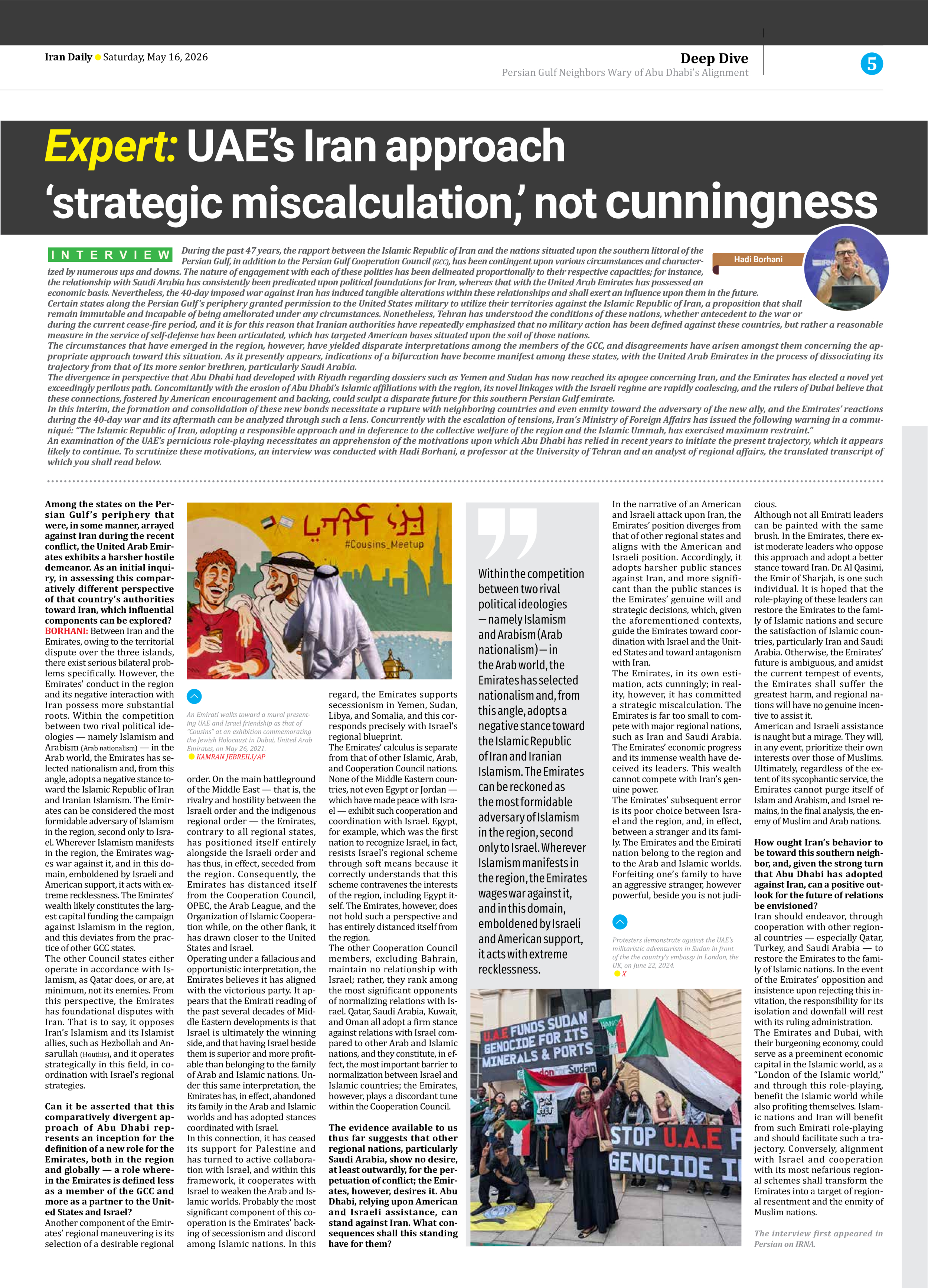
During the past 47 years, the rapport between the Islamic Republic of Iran and the nations situated upon the southern littoral of the Persian Gulf, in addition to the Persian Gulf Cooperation Council (GCC), has been contingent upon various circumstances and characterized by numerous ups and downs. The nature of engagement with each of these polities has been delineated proportionally to their respective capacities; for instance, the relationship with Saudi Arabia has consistently been predicated upon political foundations for Iran, whereas that with the United Arab Emirates has possessed an economic basis. Nevertheless, the 40-day imposed war against Iran has induced tangible alterations within these relationships and shall exert an influence upon them in the future. Certain states along the Persian Gulf’s periphery granted permission to the United States military to utilize their territories against the Islamic Republic of Iran, a proposition that shall remain immutable and incapable of being ameliorated under any circumstances. Nonetheless, Tehran has understood the conditions of these nations, whether antecedent to the war or during the current cease-fire period, and it is for this reason that Iranian authorities have repeatedly emphasized that no military action has been defined against these countries, but rather a reasonable measure in the service of self-defense has been articulated, which has targeted American bases situated upon the soil of those nations. The circumstances that have emerged in the region, however, have yielded disparate interpretations among the members of the GCC, and disagreements have arisen amongst them concerning the appropriate approach toward this situation. As it presently appears, indications of a bifurcation have become manifest among these states, with the United Arab Emirates in the process of dissociating its trajectory from that of its more senior brethren, particularly Saudi Arabia. The divergence in perspective that Abu Dhabi had developed with Riyadh regarding dossiers such as Yemen and Sudan has now reached its apogee concerning Iran, and the Emirates has elected a novel yet exceedingly perilous path. Concomitantly with the erosion of Abu Dhabi’s Islamic affiliations with the region, its novel linkages with the Israeli regime are rapidly coalescing, and the rulers of Dubai believe that these connections, fostered by American encouragement and backing, could sculpt a disparate future for this southern Persian Gulf emirate. In this interim, the formation and consolidation of these new bonds necessitate a rupture with neighboring countries and even enmity toward the adversary of the new ally, and the Emirates’ reactions during the 40-day war and its aftermath can be analyzed through such a lens. Concurrently with the escalation of tensions, Iran’s Ministry of Foreign Affairs has issued the following warning in a communiqué: “The Islamic Republic of Iran, adopting a responsible approach and in deference to the collective welfare of the region and the Islamic Ummah, has exercised maximum restraint.” An examination of the UAE’s pernicious role-playing necessitates an apprehension of the motivations upon which Abu Dhabi has relied in recent years to initiate the present trajectory, which it appears likely to continue. To scrutinize these motivations, an interview was conducted with Hadi Borhani, a professor at the University of Tehran and an analyst of regional affairs, the translated transcript of which you shall read below.
Among the states on the Persian Gulf’s periphery that were, in some manner, arrayed against Iran during the recent conflict, the United Arab Emirates exhibits a harsher hostile demeanor. As an initial inquiry, in assessing this comparatively different perspective of that country’s authorities toward Iran, which influential components can be explored?
BORHANI: Between Iran and the Emirates, owing to the territorial dispute over the three islands, there exist serious bilateral problems specifically. However, the Emirates’ conduct in the region and its negative interaction with Iran possess more substantial roots. Within the competition between two rival political ideologies — namely Islamism and Arabism (Arab nationalism) — in the Arab world, the Emirates has selected nationalism and, from this angle, adopts a negative stance toward the Islamic Republic of Iran and Iranian Islamism. The Emirates can be considered the most formidable adversary of Islamism in the region, second only to Israel. Wherever Islamism manifests in the region, the Emirates wages war against it, and in this domain, emboldened by Israeli and American support, it acts with extreme recklessness. The Emirates’ wealth likely constitutes the largest capital funding the campaign against Islamism in the region, and this deviates from the practice of other GCC states.
The other Council states either operate in accordance with Islamism, as Qatar does, or are, at minimum, not its enemies. From this perspective, the Emirates has foundational disputes with Iran. That is to say, it opposes Iran’s Islamism and its Islamist allies, such as Hezbollah and Ansarullah (Houthis), and it operates strategically in this field, in coordination with Israel’s regional strategies.
Can it be asserted that this comparatively divergent approach of Abu Dhabi represents an inception for the definition of a new role for the Emirates, both in the region and globally — a role wherein the Emirates is defined less as a member of the GCC and more as a partner to the United States and Israel?
Another component of the Emirates’ regional maneuvering is its selection of a desirable regional order. On the main battleground of the Middle East — that is, the rivalry and hostility between the Israeli order and the indigenous regional order — the Emirates, contrary to all regional states, has positioned itself entirely alongside the Israeli order and has thus, in effect, seceded from the region. Consequently, the Emirates has distanced itself from the Cooperation Council, OPEC, the Arab League, and the Organization of Islamic Cooperation while, on the other flank, it has drawn closer to the United States and Israel.
Operating under a fallacious and opportunistic interpretation, the Emirates believes it has aligned with the victorious party. It appears that the Emirati reading of the past several decades of Middle Eastern developments is that Israel is ultimately the winning side, and that having Israel beside them is superior and more profitable than belonging to the family of Arab and Islamic nations. Under this same interpretation, the Emirates has, in effect, abandoned its family in the Arab and Islamic worlds and has adopted stances coordinated with Israel.
In this connection, it has ceased its support for Palestine and has turned to active collaboration with Israel, and within this framework, it cooperates with Israel to weaken the Arab and Islamic worlds. Probably the most significant component of this cooperation is the Emirates’ backing of secessionism and discord among Islamic nations. In this regard, the Emirates supports secessionism in Yemen, Sudan, Libya, and Somalia, and this corresponds precisely with Israel’s regional blueprint.
The Emirates’ calculus is separate from that of other Islamic, Arab, and Cooperation Council nations. None of the Middle Eastern countries, not even Egypt or Jordan — which have made peace with Israel — exhibit such cooperation and coordination with Israel. Egypt, for example, which was the first nation to recognize Israel, in fact, resists Israel’s regional scheme through soft means because it correctly understands that this scheme contravenes the interests of the region, including Egypt itself. The Emirates, however, does not hold such a perspective and has entirely distanced itself from the region.
The other Cooperation Council members, excluding Bahrain, maintain no relationship with Israel; rather, they rank among the most significant opponents of normalizing relations with Israel. Qatar, Saudi Arabia, Kuwait, and Oman all adopt a firm stance against relations with Israel compared to other Arab and Islamic nations, and they constitute, in effect, the most important barrier to normalization between Israel and Islamic countries; the Emirates, however, plays a discordant tune within the Cooperation Council.
The evidence available to us thus far suggests that other regional nations, particularly Saudi Arabia, show no desire, at least outwardly, for the perpetuation of conflict; the Emirates, however, desires it. Abu Dhabi, relying upon American and Israeli assistance, can stand against Iran. What consequences shall this standing have for them?
In the narrative of an American and Israeli attack upon Iran, the Emirates’ position diverges from that of other regional states and aligns with the American and Israeli position. Accordingly, it adopts harsher public stances against Iran, and more significant than the public stances is the Emirates’ genuine will and strategic decisions, which, given the aforementioned contexts, guide the Emirates toward coordination with Israel and the United States and toward antagonism with Iran.
The Emirates, in its own estimation, acts cunningly; in reality, however, it has committed a strategic miscalculation. The Emirates is far too small to compete with major regional nations, such as Iran and Saudi Arabia. The Emirates’ economic progress and its immense wealth have deceived its leaders. This wealth cannot compete with Iran’s genuine power.
The Emirates’ subsequent error is its poor choice between Israel and the region, and, in effect, between a stranger and its family. The Emirates and the Emirati nation belong to the region and to the Arab and Islamic worlds. Forfeiting one’s family to have an aggressive stranger, however powerful, beside you is not judicious.
Although not all Emirati leaders can be painted with the same brush. In the Emirates, there exist moderate leaders who oppose this approach and adopt a better stance toward Iran. Dr. Al Qasimi, the Emir of Sharjah, is one such individual. It is hoped that the role-playing of these leaders can restore the Emirates to the family of Islamic nations and secure the satisfaction of Islamic countries, particularly Iran and Saudi Arabia. Otherwise, the Emirates’ future is ambiguous, and amidst the current tempest of events, the Emirates shall suffer the greatest harm, and regional nations will have no genuine incentive to assist it.
American and Israeli assistance is naught but a mirage. They will, in any event, prioritize their own interests over those of Muslims. Ultimately, regardless of the extent of its sycophantic service, the Emirates cannot purge itself of Islam and Arabism, and Israel remains, in the final analysis, the enemy of Muslim and Arab nations.
How ought Iran’s behavior to be toward this southern neighbor, and, given the strong turn that Abu Dhabi has adopted against Iran, can a positive outlook for the future of relations be envisioned?
Iran should endeavor, through cooperation with other regional countries — especially Qatar, Turkey, and Saudi Arabia — to restore the Emirates to the family of Islamic nations. In the event of the Emirates’ opposition and insistence upon rejecting this invitation, the responsibility for its isolation and downfall will rest with its ruling administration.
The Emirates and Dubai, with their burgeoning economy, could serve as a preeminent economic capital in the Islamic world, as a “London of the Islamic world,” and through this role-playing, benefit the Islamic world while also profiting themselves. Islamic nations and Iran will benefit from such Emirati role-playing and should facilitate such a trajectory. Conversely, alignment with Israel and cooperation with its most nefarious regional schemes shall transform the Emirates into a target of regional resentment and the enmity of Muslim nations.
The interview first appeared in
Persian on IRNA.