







Gargash, strategic rationality, and security dilemma in Persian Gulf
Kamran Yeganegi
Political analyst
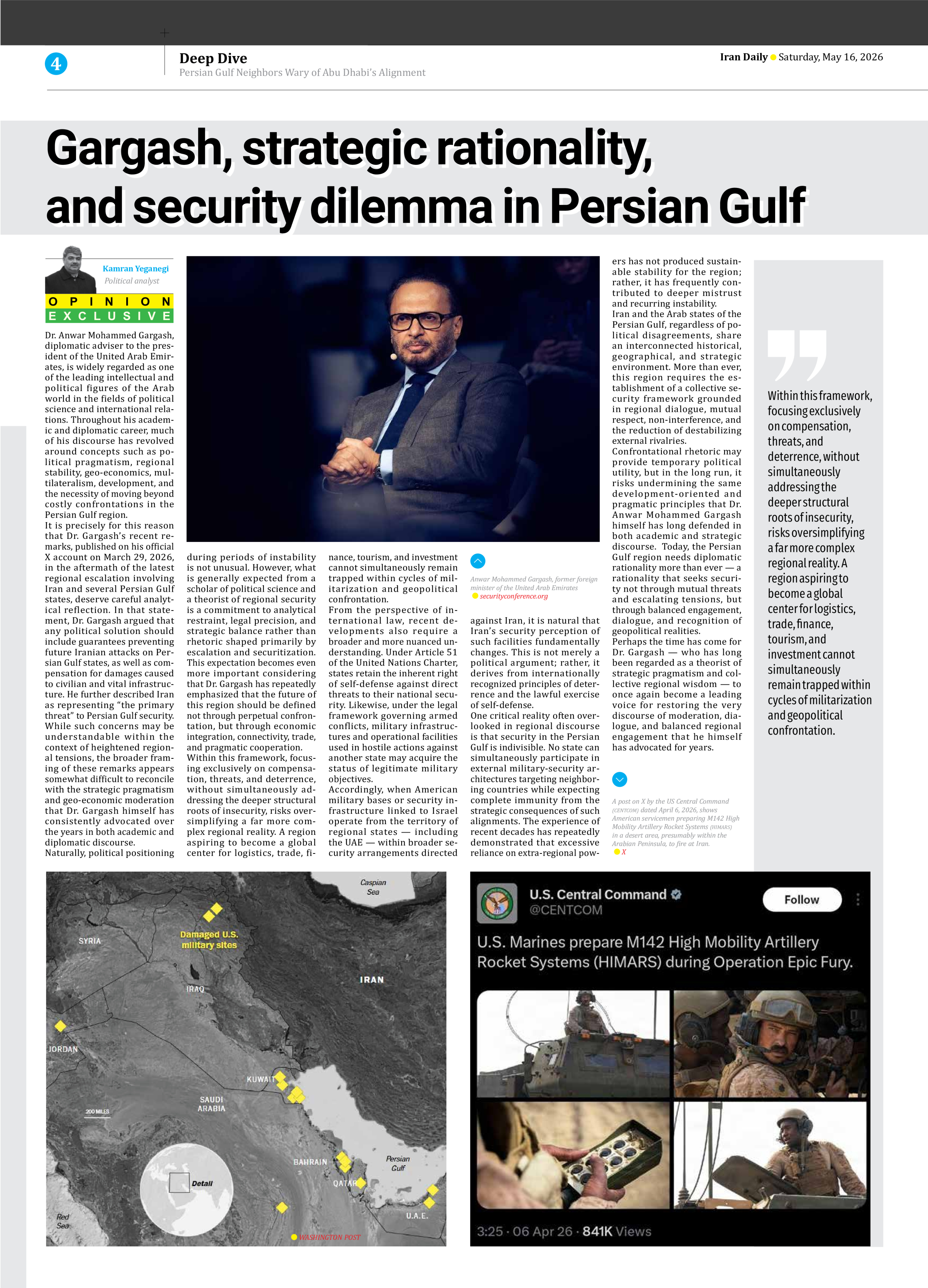
Dr. Anwar Mohammed Gargash, diplomatic adviser to the president of the United Arab Emirates, is widely regarded as one of the leading intellectual and political figures of the Arab world in the fields of political science and international relations. Throughout his academic and diplomatic career, much of his discourse has revolved around concepts such as political pragmatism, regional stability, geo-economics, multilateralism, development, and the necessity of moving beyond costly confrontations in the Persian Gulf region.
It is precisely for this reason that Dr. Gargash’s recent remarks, published on his official X account on March 29, 2026, in the aftermath of the latest regional escalation involving Iran and several Persian Gulf states, deserve careful analytical reflection. In that statement, Dr. Gargash argued that any political solution should include guarantees preventing future Iranian attacks on Persian Gulf states, as well as compensation for damages caused to civilian and vital infrastructure. He further described Iran as representing “the primary threat” to Persian Gulf security.
While such concerns may be understandable within the context of heightened regional tensions, the broader framing of these remarks appears somewhat difficult to reconcile with the strategic pragmatism and geo-economic moderation that Dr. Gargash himself has consistently advocated over the years in both academic and diplomatic discourse.
Naturally, political positioning during periods of instability is not unusual. However, what is generally expected from a scholar of political science and a theorist of regional security is a commitment to analytical restraint, legal precision, and strategic balance rather than rhetoric shaped primarily by escalation and securitization. This expectation becomes even more important considering that Dr. Gargash has repeatedly emphasized that the future of this region should be defined not through perpetual confrontation, but through economic integration, connectivity, trade, and pragmatic cooperation.
Within this framework, focusing exclusively on compensation, threats, and deterrence, without simultaneously addressing the deeper structural roots of insecurity, risks oversimplifying a far more complex regional reality. A region aspiring to become a global center for logistics, trade, finance, tourism, and investment cannot simultaneously remain trapped within cycles of militarization and geopolitical confrontation.
From the perspective of international law, recent developments also require a broader and more nuanced understanding. Under Article 51 of the United Nations Charter, states retain the inherent right of self-defense against direct threats to their national security. Likewise, under the legal framework governing armed conflicts, military infrastructures and operational facilities used in hostile actions against another state may acquire the status of legitimate military objectives.
Accordingly, when American military bases or security infrastructure linked to Israel operate from the territory of regional states — including the UAE — within broader security arrangements directed against Iran, it is natural that Iran’s security perception of such facilities fundamentally changes. This is not merely a political argument; rather, it derives from internationally recognized principles of deterrence and the lawful exercise of self-defense.
One critical reality often overlooked in regional discourse is that security in the Persian Gulf is indivisible. No state can simultaneously participate in external military-security architectures targeting neighboring countries while expecting complete immunity from the strategic consequences of such alignments. The experience of recent decades has repeatedly demonstrated that excessive reliance on extra-regional powers has not produced sustainable stability for the region; rather, it has frequently contributed to deeper mistrust and recurring instability.
Iran and the Arab states of the Persian Gulf, regardless of political disagreements, share an interconnected historical, geographical, and strategic environment. More than ever, this region requires the establishment of a collective security framework grounded in regional dialogue, mutual respect, non-interference, and the reduction of destabilizing external rivalries.
Confrontational rhetoric may provide temporary political utility, but in the long run, it risks undermining the same development-oriented and pragmatic principles that Dr. Anwar Mohammed Gargash himself has long defended in both academic and strategic discourse. Today, the Persian Gulf region needs diplomatic rationality more than ever — a rationality that seeks security not through mutual threats and escalating tensions, but through balanced engagement, dialogue, and recognition of geopolitical realities.
Perhaps the time has come for Dr. Gargash — who has long been regarded as a theorist of strategic pragmatism and collective regional wisdom — to once again become a leading voice for restoring the very discourse of moderation, dialogue, and balanced regional engagement that he himself has advocated for years.