







Iran urges SCO to establish ‘joint deterrence’ system against security threats
Bagheri Kani: US-Israeli war aimed at ‘attack on Global South’
The deputy secretary of Iran’s Supreme National Security Council (SNSC) said on Thursday that the Islamic Republic supports moves to set up “joint deterrence mechanisms” within the Shanghai Cooperation Organization (SCO) to combat security threats against the member states and the world.
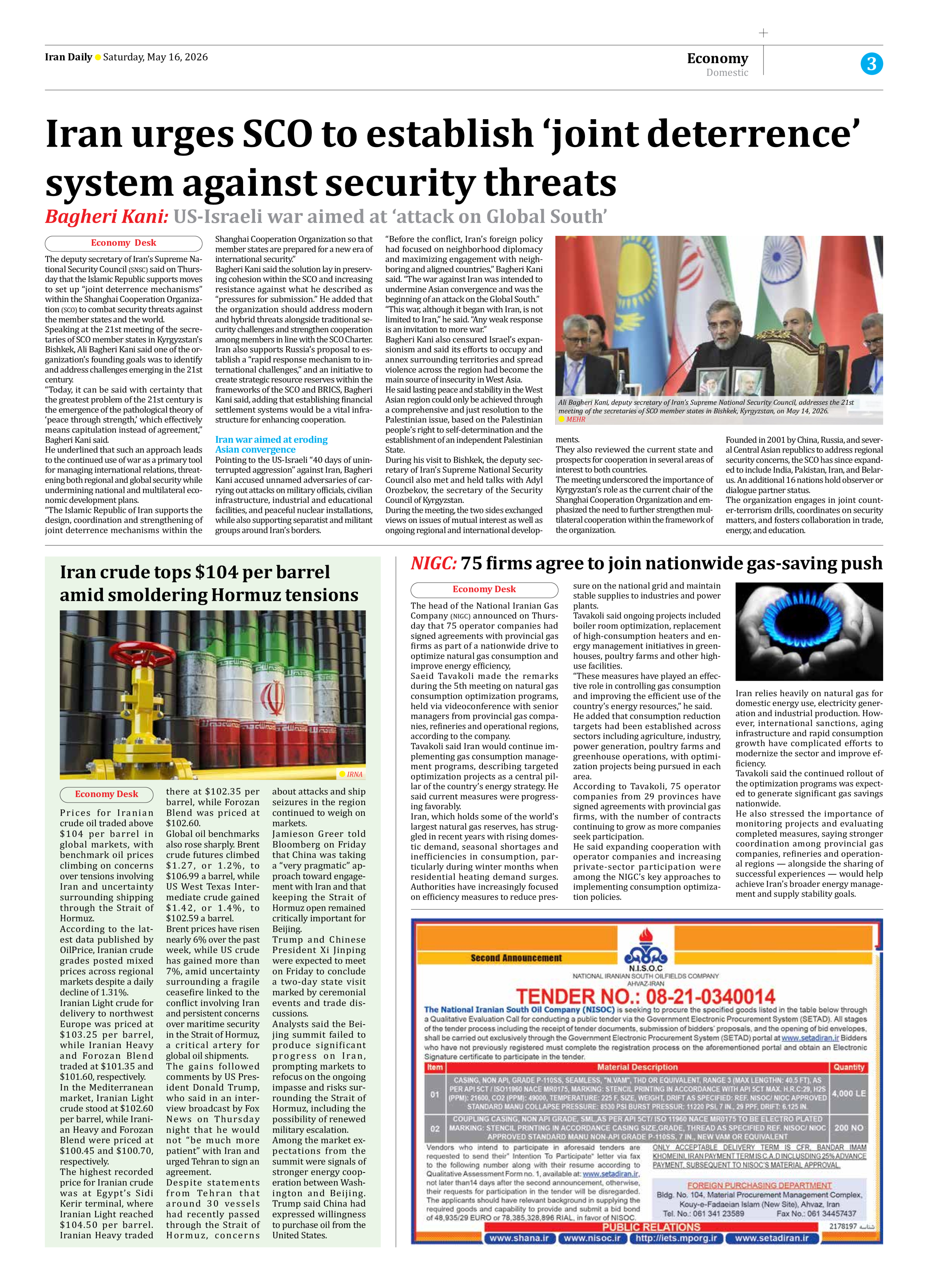
Speaking at the 21st meeting of the secretaries of SCO member states in Kyrgyzstan’s Bishkek, Ali Bagheri Kani said one of the organization’s founding goals was to identify and address challenges emerging in the 21st century.
“Today, it can be said with certainty that the greatest problem of the 21st century is the emergence of the pathological theory of ‘peace through strength,’ which effectively means capitulation instead of agreement,” Bagheri Kani said.
He underlined that such an approach leads to the continued use of war as a primary tool for managing international relations, threatening both regional and global security while undermining national and multilateral economic development plans.
“The Islamic Republic of Iran supports the design, coordination and strengthening of joint deterrence mechanisms within the Shanghai Cooperation Organization so that member states are prepared for a new era of international security.”
Bagheri Kani said the solution lay in preserving cohesion within the SCO and increasing resistance against what he described as “pressures for submission.” He added that the organization should address modern and hybrid threats alongside traditional security challenges and strengthen cooperation among members in line with the SCO Charter.
Iran also supports Russia’s proposal to establish a “rapid response mechanism to international challenges,” and an initiative to create strategic resource reserves within the frameworks of the SCO and BRICS, Bagheri Kani said, adding that establishing financial settlement systems would be a vital infrastructure for enhancing cooperation.
Iran war aimed at eroding
Asian convergence
Pointing to the US-Israeli “40 days of uninterrupted aggression” against Iran, Bagheri Kani accused unnamed adversaries of carrying out attacks on military officials, civilian infrastructure, industrial and educational facilities, and peaceful nuclear installations, while also supporting separatist and militant groups around Iran’s borders.
“Before the conflict, Iran’s foreign policy had focused on neighborhood diplomacy and maximizing engagement with neighboring and aligned countries,” Bagheri Kani said. “The war against Iran was intended to undermine Asian convergence and was the beginning of an attack on the Global South.”
“This war, although it began with Iran, is not limited to Iran,” he said. “Any weak response is an invitation to more war.”
Bagheri Kani also censured Israel’s expansionism and said its efforts to occupy and annex surrounding territories and spread violence across the region had become the main source of insecurity in West Asia.
He said lasting peace and stability in the West Asian region could only be achieved through a comprehensive and just resolution to the Palestinian issue, based on the Palestinian people’s right to self-determination and the establishment of an independent Palestinian State.
During his visit to Bishkek, the deputy secretary of Iran’s Supreme National Security Council also met and held talks with Adyl Orozbekov, the secretary of the Security Council of Kyrgyzstan.
During the meeting, the two sides exchanged views on issues of mutual interest as well as ongoing regional and international developments.
They also reviewed the current state and prospects for cooperation in several areas of interest to both countries.
The meeting underscored the importance of Kyrgyzstan’s role as the current chair of the Shanghai Cooperation Organization and emphasized the need to further strengthen multilateral cooperation within the framework of the organization.
Founded in 2001 by China, Russia, and several Central Asian republics to address regional security concerns, the SCO has since expanded to include India, Pakistan, Iran, and Belarus. An additional 16 nations hold observer or dialogue partner status.
The organization engages in joint counter-terrorism drills, coordinates on security matters, and fosters collaboration in trade, energy, and education.