





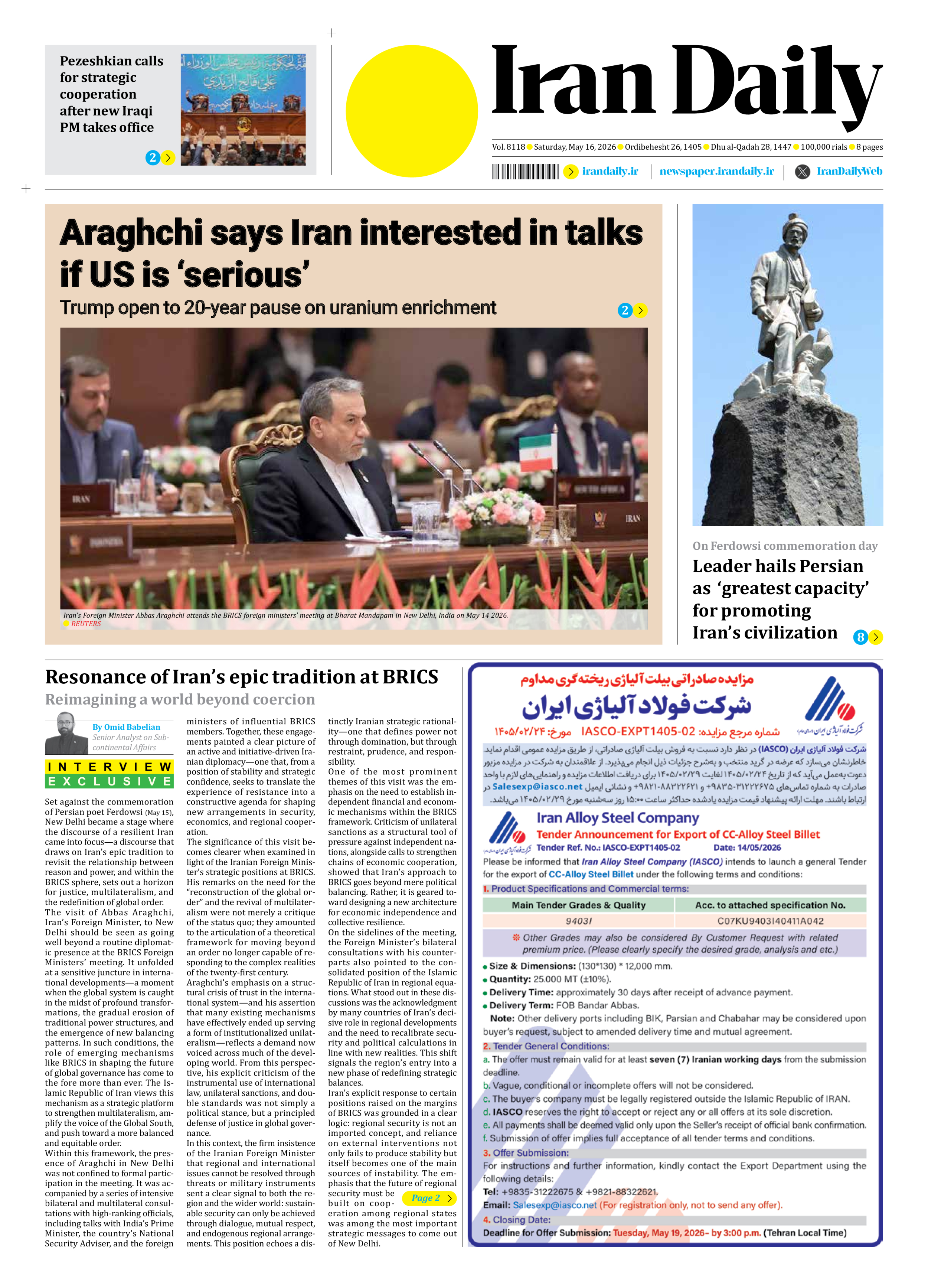


Resonance of Iran’s epic tradition at BRICS
Reimagining a world beyond coercion
By Omid Babelian
Senior Analyst on Subcontinental Affairs
Set against the commemoration of Persian poet Ferdowsi (May 15), New Delhi became a stage where the discourse of a resilient Iran came into focus—a discourse that draws on Iran’s epic tradition to revisit the relationship between reason and power, and within the BRICS sphere, sets out a horizon for justice, multilateralism, and the redefinition of global order.
The visit of Abbas Araghchi, Iran’s Foreign Minister, to New Delhi should be seen as going well beyond a routine diplomatic presence at the BRICS Foreign Ministers’ meeting. It unfolded at a sensitive juncture in international developments—a moment when the global system is caught in the midst of profound transformations, the gradual erosion of traditional power structures, and the emergence of new balancing patterns. In such conditions, the role of emerging mechanisms like BRICS in shaping the future of global governance has come to the fore more than ever. The Islamic Republic of Iran views this mechanism as a strategic platform to strengthen multilateralism, amplify the voice of the Global South, and push toward a more balanced and equitable order.
Within this framework, the presence of Araghchi in New Delhi was not confined to formal participation in the meeting. It was accompanied by a series of intensive bilateral and multilateral consultations with high-ranking officials, including talks with India’s Prime Minister, the country’s National Security Adviser, and the foreign ministers of influential BRICS members. Together, these engagements painted a clear picture of an active and initiative-driven Iranian diplomacy—one that, from a position of stability and strategic confidence, seeks to translate the experience of resistance into a constructive agenda for shaping new arrangements in security, economics, and regional cooperation.
The significance of this visit becomes clearer when examined in light of the Iranian Foreign Minister’s strategic positions at BRICS. His remarks on the need for the “reconstruction of the global order” and the revival of multilateralism were not merely a critique of the status quo; they amounted to the articulation of a theoretical framework for moving beyond an order no longer capable of responding to the complex realities of the twenty-first century.
Araghchi’s emphasis on a structural crisis of trust in the international system—and his assertion that many existing mechanisms have effectively ended up serving a form of institutionalized unilateralism—reflects a demand now voiced across much of the developing world. From this perspective, his explicit criticism of the instrumental use of international law, unilateral sanctions, and double standards was not simply a political stance, but a principled defense of justice in global governance.
In this context, the firm insistence of the Iranian Foreign Minister that regional and international issues cannot be resolved through threats or military instruments sent a clear signal to both the region and the wider world: sustainable security can only be achieved through dialogue, mutual respect, and endogenous regional arrangements. This position echoes a distinctly Iranian strategic rationality—one that defines power not through domination, but through restraint, prudence, and responsibility.
One of the most prominent themes of this visit was the emphasis on the need to establish independent financial and economic mechanisms within the BRICS framework. Criticism of unilateral sanctions as a structural tool of pressure against independent nations, alongside calls to strengthen chains of economic cooperation, showed that Iran’s approach to BRICS goes beyond mere political balancing. Rather, it is geared toward designing a new architecture for economic independence and collective resilience.
On the sidelines of the meeting, the Foreign Minister’s bilateral consultations with his counterparts also pointed to the consolidated position of the Islamic Republic of Iran in regional equations. What stood out in these discussions was the acknowledgment by many countries of Iran’s decisive role in regional developments and the need to recalibrate security and political calculations in line with new realities. This shift signals the region’s entry into a new phase of redefining strategic balances.
Iran’s explicit response to certain positions raised on the margins of BRICS was grounded in a clear logic: regional security is not an imported concept, and reliance on external interventions not only fails to produce stability but itself becomes one of the main sources of instability. The emphasis that the future of regional security must be built on cooperation among regional states was among the most important strategic messages to come out of New Delhi.
Page 2