





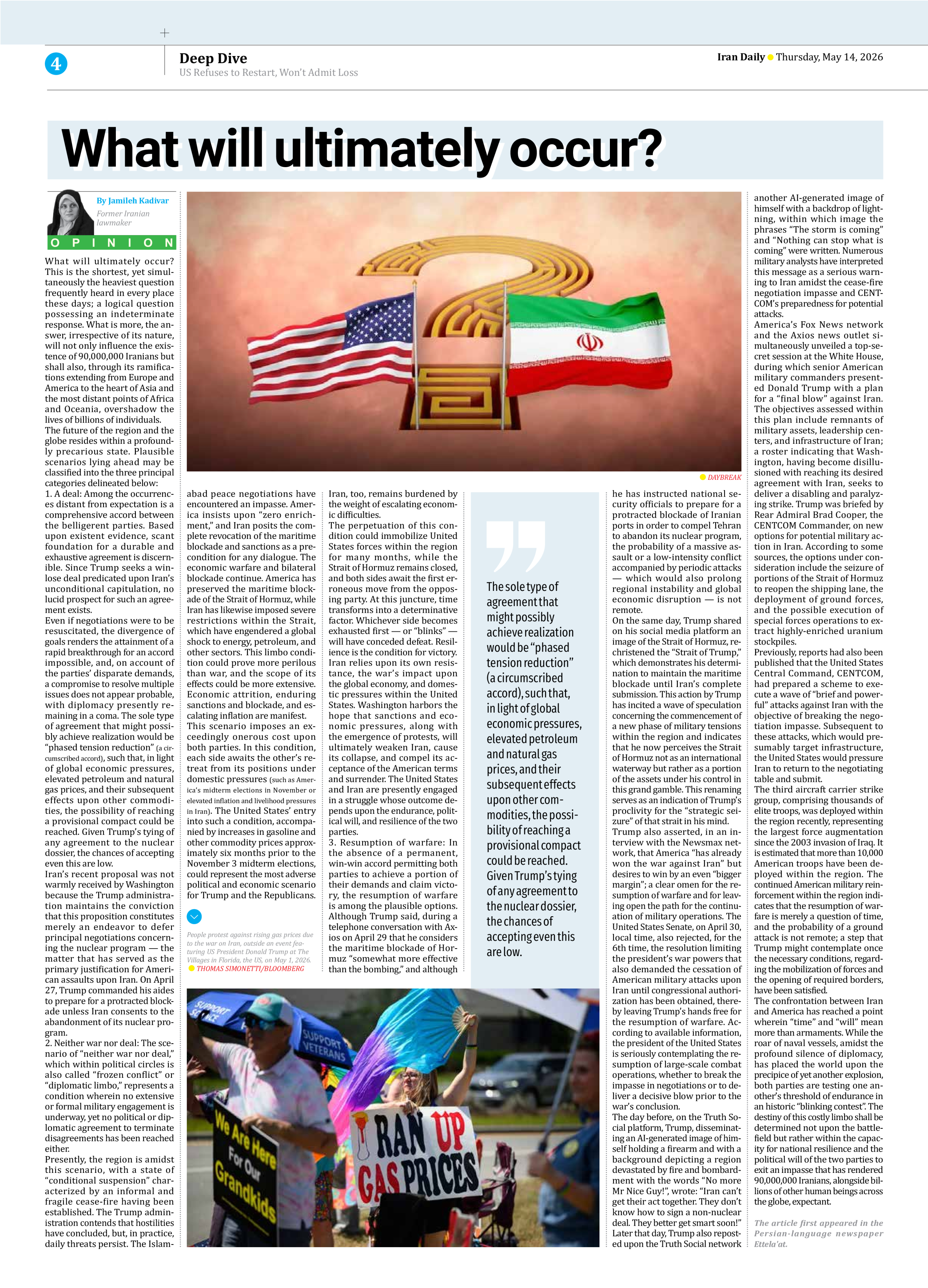


What will ultimately occur?
Former Iranian lawmaker
What will ultimately occur? This is the shortest, yet simultaneously the heaviest question frequently heard in every place these days; a logical question possessing an indeterminate response. What is more, the answer, irrespective of its nature, will not only influence the existence of 90,000,000 Iranians but shall also, through its ramifications extending from Europe and America to the heart of Asia and the most distant points of Africa and Oceania, overshadow the lives of billions of individuals.
The future of the region and the globe resides within a profoundly precarious state. Plausible scenarios lying ahead may be classified into the three principal categories delineated below:
1. A deal: Among the occurrences distant from expectation is a comprehensive accord between the belligerent parties. Based upon existent evidence, scant foundation for a durable and exhaustive agreement is discernible. Since Trump seeks a win-lose deal predicated upon Iran’s unconditional capitulation, no lucid prospect for such an agreement exists.
Even if negotiations were to be resuscitated, the divergence of goals renders the attainment of a rapid breakthrough for an accord impossible, and, on account of the parties’ disparate demands, a compromise to resolve multiple issues does not appear probable, with diplomacy presently remaining in a coma. The sole type of agreement that might possibly achieve realization would be “phased tension reduction” (a circumscribed accord), such that, in light of global economic pressures, elevated petroleum and natural gas prices, and their subsequent effects upon other commodities, the possibility of reaching a provisional compact could be reached. Given Trump’s tying of any agreement to the nuclear dossier, the chances of accepting even this are low.
Iran’s recent proposal was not warmly received by Washington because the Trump administration maintains the conviction that this proposition constitutes merely an endeavor to defer principal negotiations concerning the nuclear program — the matter that has served as the primary justification for American assaults upon Iran. On April 27, Trump commanded his aides to prepare for a protracted blockade unless Iran consents to the abandonment of its nuclear program.
2. Neither war nor deal: The scenario of “neither war nor deal,” which within political circles is also called “frozen conflict” or “diplomatic limbo,” represents a condition wherein no extensive or formal military engagement is underway, yet no political or diplomatic agreement to terminate disagreements has been reached either.
Presently, the region is amidst this scenario, with a state of “conditional suspension” characterized by an informal and fragile cease-fire having been established. The Trump administration contends that hostilities have concluded, but, in practice, daily threats persist. The Islamabad peace negotiations have encountered an impasse. America insists upon “zero enrichment,” and Iran posits the complete revocation of the maritime blockade and sanctions as a precondition for any dialogue. The economic warfare and bilateral blockade continue. America has preserved the maritime blockade of the Strait of Hormuz, while Iran has likewise imposed severe restrictions within the Strait, which have engendered a global shock to energy, petroleum, and other sectors. This limbo condition could prove more perilous than war, and the scope of its effects could be more extensive. Economic attrition, enduring sanctions and blockade, and escalating inflation are manifest.
This scenario imposes an exceedingly onerous cost upon both parties. In this condition, each side awaits the other’s retreat from its positions under domestic pressures (such as America’s midterm elections in November or elevated inflation and livelihood pressures in Iran). The United States’ entry into such a condition, accompanied by increases in gasoline and other commodity prices approximately six months prior to the November 3 midterm elections, could represent the most adverse political and economic scenario for Trump and the Republicans. Iran, too, remains burdened by the weight of escalating economic difficulties.
The perpetuation of this condition could immobilize United States forces within the region for many months, while the Strait of Hormuz remains closed, and both sides await the first erroneous move from the opposing party. At this juncture, time transforms into a determinative factor. Whichever side becomes exhausted first — or “blinks” — will have conceded defeat. Resilience is the condition for victory.
Iran relies upon its own resistance, the war’s impact upon the global economy, and domestic pressures within the United States. Washington harbors the hope that sanctions and economic pressures, along with the emergence of protests, will ultimately weaken Iran, cause its collapse, and compel its acceptance of the American terms and surrender. The United States and Iran are presently engaged in a struggle whose outcome depends upon the endurance, political will, and resilience of the two parties.
3. Resumption of warfare: In the absence of a permanent, win-win accord permitting both parties to achieve a portion of their demands and claim victory, the resumption of warfare is among the plausible options. Although Trump said, during a telephone conversation with Axios on April 29 that he considers the maritime blockade of Hormuz “somewhat more effective than the bombing,” and although he has instructed national security officials to prepare for a protracted blockade of Iranian ports in order to compel Tehran to abandon its nuclear program, the probability of a massive assault or a low-intensity conflict accompanied by periodic attacks — which would also prolong regional instability and global economic disruption — is not remote.
On the same day, Trump shared on his social media platform an image of the Strait of Hormuz, rechristened the “Strait of Trump,” which demonstrates his determination to maintain the maritime blockade until Iran’s complete submission. This action by Trump has incited a wave of speculation concerning the commencement of a new phase of military tensions within the region and indicates that he now perceives the Strait of Hormuz not as an international waterway but rather as a portion of the assets under his control in this grand gamble. This renaming serves as an indication of Trump’s proclivity for the “strategic seizure” of that strait in his mind.
Trump also asserted, in an interview with the Newsmax network, that America “has already won the war against Iran” but desires to win by an even “bigger margin”; a clear omen for the resumption of warfare and for leaving open the path for the continuation of military operations. The United States Senate, on April 30, local time, also rejected, for the 6th time, the resolution limiting the president’s war powers that also demanded the cessation of American military attacks upon Iran until congressional authorization has been obtained, thereby leaving Trump’s hands free for the resumption of warfare. According to available information, the president of the United States is seriously contemplating the resumption of large-scale combat operations, whether to break the impasse in negotiations or to deliver a decisive blow prior to the war’s conclusion.
The day before, on the Truth Social platform, Trump, disseminating an AI-generated image of himself holding a firearm and with a background depicting a region devastated by fire and bombardment with the words “No more Mr Nice Guy!”, wrote: “Iran can’t get their act together. They don’t know how to sign a non-nuclear deal. They better get smart soon!” Later that day, Trump also reposted upon the Truth Social network another AI-generated image of himself with a backdrop of lightning, within which image the phrases “The storm is coming” and “Nothing can stop what is coming” were written. Numerous military analysts have interpreted this message as a serious warning to Iran amidst the cease-fire negotiation impasse and CENTCOM’s preparedness for potential attacks.
America’s Fox News network and the Axios news outlet simultaneously unveiled a top-secret session at the White House, during which senior American military commanders presented Donald Trump with a plan for a “final blow” against Iran. The objectives assessed within this plan include remnants of military assets, leadership centers, and infrastructure of Iran; a roster indicating that Washington, having become disillusioned with reaching its desired agreement with Iran, seeks to deliver a disabling and paralyzing strike. Trump was briefed by Rear Admiral Brad Cooper, the CENTCOM Commander, on new options for potential military action in Iran. According to some sources, the options under consideration include the seizure of portions of the Strait of Hormuz to reopen the shipping lane, the deployment of ground forces, and the possible execution of special forces operations to extract highly-enriched uranium stockpiles.
Previously, reports had also been published that the United States Central Command, CENTCOM, had prepared a scheme to execute a wave of “brief and powerful” attacks against Iran with the objective of breaking the negotiation impasse. Subsequent to these attacks, which would presumably target infrastructure, the United States would pressure Iran to return to the negotiating table and submit.
The third aircraft carrier strike group, comprising thousands of elite troops, was deployed within the region recently, representing the largest force augmentation since the 2003 invasion of Iraq. It is estimated that more than 10,000 American troops have been deployed within the region. The continued American military reinforcement within the region indicates that the resumption of warfare is merely a question of time, and the probability of a ground attack is not remote; a step that Trump might contemplate once the necessary conditions, regarding the mobilization of forces and the opening of required borders, have been satisfied.
The confrontation between Iran and America has reached a point wherein “time” and “will” mean more than armaments. While the roar of naval vessels, amidst the profound silence of diplomacy, has placed the world upon the precipice of yet another explosion, both parties are testing one another’s threshold of endurance in an historic “blinking contest”. The destiny of this costly limbo shall be determined not upon the battlefield but rather within the capacity for national resilience and the political will of the two parties to exit an impasse that has rendered 90,000,000 Iranians, alongside billions of other human beings across the globe, expectant.
The article first appeared in the Persian-language newspaper
Ettela'at.