





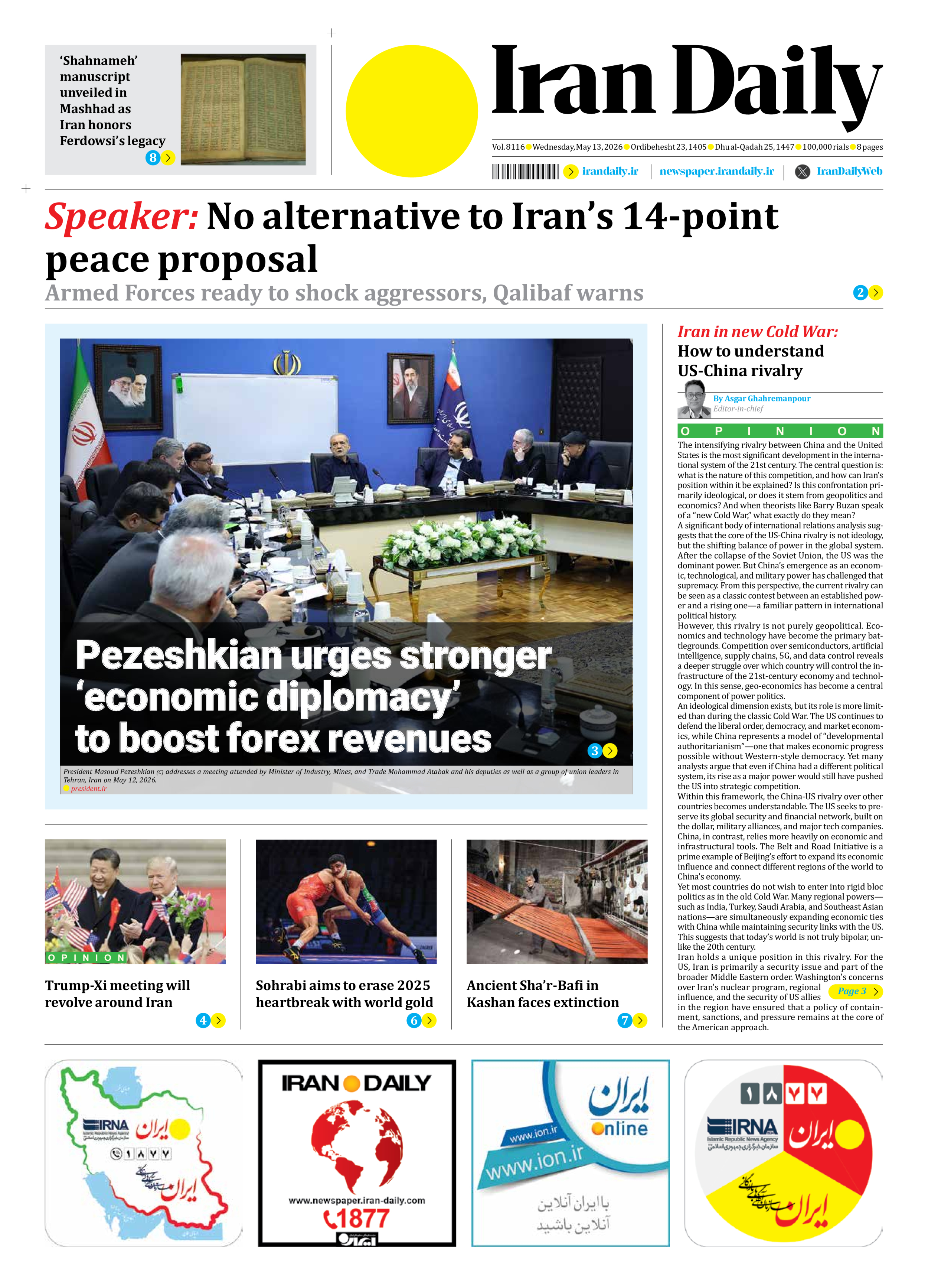


Iran in new Cold War: How to understand US-China rivalry
By Asgar Ghahremanpour
Editor-in-chief
The intensifying rivalry between China and the United States is the most significant development in the international system of the 21st century. The central question is: what is the nature of this competition, and how can Iran’s position within it be explained? Is this confrontation primarily ideological, or does it stem from geopolitics and economics? And when theorists like Barry Buzan speak of a “new Cold War,” what exactly do they mean?
A significant body of international relations analysis suggests that the core of the US-China rivalry is not ideology, but the shifting balance of power in the global system. After the collapse of the Soviet Union, the US was the dominant power. But China’s emergence as an economic, technological, and military power has challenged that supremacy. From this perspective, the current rivalry can be seen as a classic contest between an established power and a rising one—a familiar pattern in international political history.
However, this rivalry is not purely geopolitical. Economics and technology have become the primary battlegrounds. Competition over semiconductors, artificial intelligence, supply chains, 5G, and data control reveals a deeper struggle over which country will control the infrastructure of the 21st-century economy and technology. In this sense, geo-economics has become a central component of power politics.
An ideological dimension exists, but its role is more limited than during the classic Cold War. The US continues to defend the liberal order, democracy, and market economics, while China represents a model of “developmental authoritarianism”—one that makes economic progress possible without Western-style democracy. Yet many analysts argue that even if China had a different political system, its rise as a major power would still have pushed the US into strategic competition.
Within this framework, the China-US rivalry over other countries becomes understandable. The US seeks to preserve its global security and financial network, built on the dollar, military alliances, and major tech companies. China, in contrast, relies more heavily on economic and infrastructural tools. The Belt and Road Initiative is a prime example of Beijing’s effort to expand its economic influence and connect different regions of the world to China’s economy.
Yet most countries do not wish to enter into rigid bloc politics as in the old Cold War. Many regional powers—such as India, Turkey, Saudi Arabia, and Southeast Asian nations—are simultaneously expanding economic ties with China while maintaining security links with the US. This suggests that today’s world is not truly bipolar, unlike the 20th century.
Iran holds a unique position in this rivalry. For the US, Iran is primarily a security issue and part of the broader Middle Eastern order. Washington’s concerns over Iran’s nuclear program, regional influence, and the security of US allies in the region have ensured that a policy of containment, sanctions, and pressure remains at the core of the American approach.
Page 3