







US strikes on fishing boats risking livelihoods of thousands: Businessman
Tensions and military confrontations within the waters of the Persian Gulf have disrupted numerous conventional maritime trade routes of Iran, consequently diverting Iran’s aquatic exports from the Persian Gulf toward terrestrial boundaries. Stakeholders within this industry claim that a substantial portion of exports, which formerly departed from southern ports via the Persian Gulf corridor to markets of Persian Gulf nations and East Asia, have either ceased entirely or been redirected toward substitute pathways. These developments transpire under circumstances wherein, traditionally, more than 80% of Iran’s aquatic exports have depended upon the southern corridor and maritime transit. But, presently, exporters are compelled to preserve their export markets through re-marketing endeavors and the utilization of overland routes. Although certain commodities, such as shrimp, have even experienced an augmentation in export volume, escalated transportation costs, maritime restrictions, and the uncertainty engendered by wartime conditions have imposed pressures upon stakeholders in this industry. In conjunction with export-related challenges, the subsistence of southern fishermen has not remained unscathed by the repercussions of warfare. Reports indicate damage to launches (boats) and fishing vessels, as well as the targeted destruction of certain fishing gear within southern ports and waters — an occurrence that not only impedes the fishing process and the supply of aquatic products, but also adversely affects the lives of thousands of families whose livelihoods are inextricably tethered to the sea. To explore the status of aquatic exports, the transformation of export destinations, the condition of production and fishing in the southern region of the country, and furthermore, the prospective outlook of this industry amidst the persistence of maritime insecurities, Iran Daily approached Ali Akbar Khodaei, secretary-general of the Union of Aquatic Production and Trade of Iran, and conducted an exclusive interview with him, the full transcript of which you can read below.
By Sadeq Dehqan
Staff writer
IRAN DAILY: Given the prevailing wartime conditions dominating the country, what has been the status of Iran’s aquatic exports during the current year, and what alterations has this situation exhibited relative to the preceding year?
KHODAEI: Aquatic exports of Iran have not ceased during the past two months, notwithstanding the emergence of certain difficulties. Nevertheless, transportation routes have undergone fundamental transformations. Maritime routes, due to existent challenges in transit as well as the exceptional circumstances of the Persian Gulf, have been reduced to the minimum feasible degree. Although one cannot assert that these routes have been entirely terminated, the volume of exports via this modality has approached near zero. Exports to the port of the United Arab Emirates and several littoral states of the Persian Gulf have severely diminished. Furthermore, the dispatch of aquatic products through the Persian Gulf toward eastern destinations, including China, has confronted a significant decline. Under such conditions, stakeholders in this domain have turned toward the utilization of overland routes and exports to neighboring countries.
First, kindly elucidate what amount of Iran’s aquatic exports ordinarily transpired via the sea and the Persian Gulf?
According to statistics from the first 10 months of the previous Persian calendar year of 1404 (started March 21, 2025), of a total of approximately 157,000 tons exported during that period, approximately 125,000 tons — that is, more than 80% — were conducted via the southern corridor and maritime routes. This 80% share of exports has now been severely impacted and is presently undergoing a rerouting toward alternative options and pathways.
Conversely, exports to nations possessing lesser dependence upon maritime routes and which were already executed via trucks and tractor-trailers have assumed an ascending trajectory. Destinations such as Russia, Turkey, and other neighboring countries, which have received our export consignments via refrigerated containers, continue operations without complication. The requisite number of trucks for overland exports remains available, and just the transportation costs have, in all probability, increased.
Generally speaking, how has the export situation in the Persian year of 1404 been relative to 1403, and, if possible, provide approximate 12-month statistics as well?
In the Persian calendar year 1404 (March 21, 2025–March 21, 2026 Gregorian), no dramatic change in export volume has been recorded relative to 1403 (2024–2025 Gregorian). Based on ten-month data, exports in 1404 amounted to 157,000 tons, whereas this figure stood at 160,000 tons during the comparative period in 1403. Total exports until the end of 1403 reached 225,000 tons, and it is anticipated that a similar figure shall materialize for 1404.
Of course, it must be noted that commencing from the calendar month of Esfand (February 20–March 20, 2026), concurrently with the initiation of military hostilities, a decremental effect upon final statistics may be observed. In aggregate, it is estimated that aquatic exports in 1404 shall reach approximately 350,000 tons, of which about 140,000 tons pertain to aquatic feed. After deducting this amount, net aquatic exports shall stand at approximately 210,000 tons, demonstrating no considerable change relative to the prior year. It must be mentioned that Iranian aquatic products are exported to more than 60 countries worldwide.
After the commencement of military conflicts within the waters of the Persian Gulf, toward which destinations have Iran’s aquatic exports been rerouted?
Export destinations have been diverted from the routes of southern waters toward neighboring countries and land borders. This rerouting, however, does not merely signify a diminution in exports, as we have even experienced volumetric growth in certain seafood products. For example, the nation’s shrimp exports during the one-year period concluding in Esfand 1403 amounted to 1,950 tons, whereas, in Esfand 1404 and its next month, this figure reached approximately 4,000 tons. This increase of more than 100% resulted from the rerouting of exports and the development of novel export destinations in other countries via terrestrial boundaries. Previously, a substantial portion of shrimp exports was conducted exclusively by sea and to the United Arab Emirates. However, exporters, through renewed marketing efforts, have discovered alternative routes. In this process concerning shrimp, solely the export destination has changed, while export volume has doubled.
How do you assess the current status of fish capture and aquaculture production? Does warfare appear to have exerted a negative influence upon aquaculture output as well as upon harvest and extraction from the sea?
Generally speaking, approximately 70% of the nation’s aquatic exports are supplied through marine capture, which predominantly concerns haram-flesh fish (non-scaled, bottom-dwelling species) of the Persian Gulf and the Sea of Oman — most of which are exported. Thus, one could posit that, during the past month or two, both production and harvest have remained at acceptable levels. However, these products have largely been transferred to warehouses and exported via overland routes and substitute destinations.
Nonetheless, recently, due to wartime conditions in the southern sea, marine capture has declined considerably. The current circumstances represent one of the afflictions of warfare, and numerous enterprises have sustained losses. Naturally, the volume of marine production, whether from aquaculture or marine capture, has also faced reduction. For instance, in the domain of shrimp farming, stockpiling has decreased because feed costs have risen, and cultivators confront liquidity shortages as well as anxieties stemming from market conditions.
Does such a situation similarly exist regarding domestically marketable fish, such as rainbow trout?
Yes, analogous circumstances do exist. Domestic fish purchases during the final days of the calendar year were unsatisfactory. Under normal conditions, cultivators would offer their products during the New Year’s Eve period; but this year, due to warfare, numerous individuals had departed Tehran and other cities, and familial priorities revolved around securing safety of life and livelihood, rather than purchasing fish. Unsatisfactory sales of fish products in the domestic market during the New Year’s Eve period have resulted in cultivators being
unable to completely empty their ponds and prepare them for restocking. For these reasons, production reduction in both the aquaculture sector and the marine capture sector appears unavoidable.
Regarding marine capture in the southern sea, what is the condition of launches and fishing vessels? Have any damages been inflicted upon these vessels by the enemy during the war?
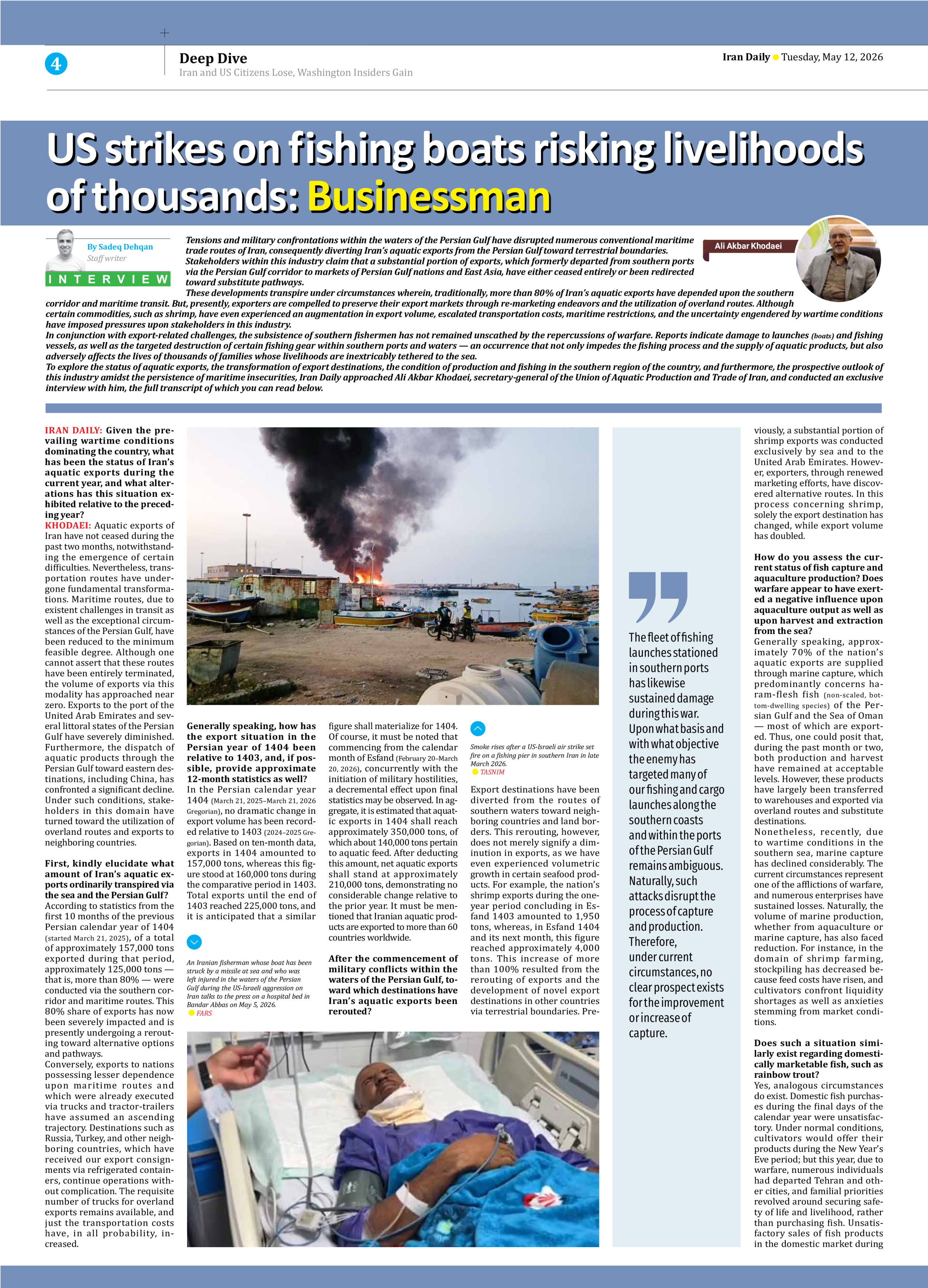
In the realm of capture from the southern sea, as you are aware, numerous restrictions currently exist due to wartime conditions. The fleet of fishing launches stationed in southern ports has likewise sustained damage during this war. Upon what basis and with what objective the enemy has targeted many of our fishing and cargo launches along the southern coasts and within the ports of the Persian Gulf remains ambiguous. Naturally, such attacks disrupt the process of capture and production. Therefore, under current circumstances, no clear prospect exists for the improvement or increase of capture.
As previously indicated, we shall also confront diminished production in the aquaculture sector. Consequently, a lesser quantity of product shall be available for export, and exports this year shall likely decrease relative to the preceding year. The precise magnitude of this reduction depends upon various prospective scenarios. Naturally, the sooner the existent wartime conditions are resolved, the lesser the damage sustained. However, should this trend persist, greater harm shall be inflicted upon both production and exports.