





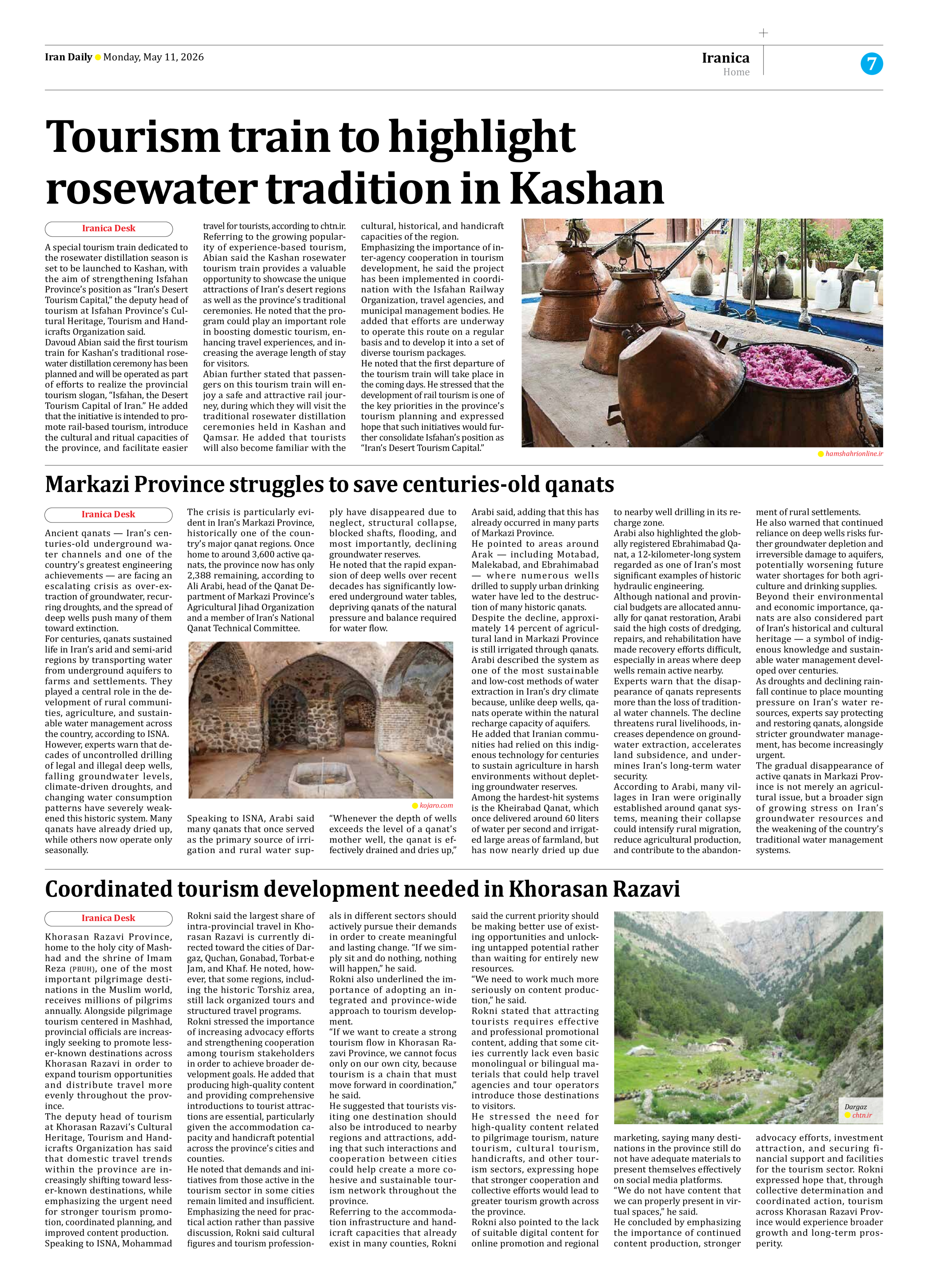


Markazi Province struggles to save centuries-old qanats
Ancient qanats — Iran’s centuries-old underground water channels and one of the country’s greatest engineering achievements — are facing an escalating crisis as over-extraction of groundwater, recurring droughts, and the spread of deep wells push many of them toward extinction.
For centuries, qanats sustained life in Iran’s arid and semi-arid regions by transporting water from underground aquifers to farms and settlements. They played a central role in the development of rural communities, agriculture, and sustainable water management across the country, according to ISNA.
However, experts warn that decades of uncontrolled drilling of legal and illegal deep wells, falling groundwater levels, climate-driven droughts, and changing water consumption patterns have severely weakened this historic system. Many qanats have already dried up, while others now operate only seasonally.
The crisis is particularly evident in Iran’s Markazi Province, historically one of the country’s major qanat regions. Once home to around 3,600 active qanats, the province now has only 2,388 remaining, according to Ali Arabi, head of the Qanat Department of Markazi Province’s Agricultural Jihad Organization and a member of Iran’s National Qanat Technical Committee.
Speaking to ISNA, Arabi said many qanats that once served as the primary source of irrigation and rural water supply have disappeared due to neglect, structural collapse, blocked shafts, flooding, and most importantly, declining groundwater reserves.
He noted that the rapid expansion of deep wells over recent decades has significantly lowered underground water tables, depriving qanats of the natural pressure and balance required for water flow.
“Whenever the depth of wells exceeds the level of a qanat’s mother well, the qanat is effectively drained and dries up,” Arabi said, adding that this has already occurred in many parts of Markazi Province.
He pointed to areas around Arak — including Motabad, Malekabad, and Ebrahimabad — where numerous wells drilled to supply urban drinking water have led to the destruction of many historic qanats.
Despite the decline, approximately 14 percent of agricultural land in Markazi Province is still irrigated through qanats. Arabi described the system as one of the most sustainable and low-cost methods of water extraction in Iran’s dry climate because, unlike deep wells, qanats operate within the natural recharge capacity of aquifers.
He added that Iranian communities had relied on this indigenous technology for centuries to sustain agriculture in harsh environments without depleting groundwater reserves.
Among the hardest-hit systems is the Kheirabad Qanat, which once delivered around 60 liters of water per second and irrigated large areas of farmland, but has now nearly dried up due to nearby well drilling in its recharge zone.
Arabi also highlighted the globally registered Ebrahimabad Qanat, a 12-kilometer-long system regarded as one of Iran’s most significant examples of historic hydraulic engineering.
Although national and provincial budgets are allocated annually for qanat restoration, Arabi said the high costs of dredging, repairs, and rehabilitation have made recovery efforts difficult, especially in areas where deep wells remain active nearby.
Experts warn that the disappearance of qanats represents more than the loss of traditional water channels. The decline threatens rural livelihoods, increases dependence on groundwater extraction, accelerates land subsidence, and undermines Iran’s long-term water security.
According to Arabi, many villages in Iran were originally established around qanat systems, meaning their collapse could intensify rural migration, reduce agricultural production, and contribute to the abandonment of rural settlements.
He also warned that continued reliance on deep wells risks further groundwater depletion and irreversible damage to aquifers, potentially worsening future water shortages for both agriculture and drinking supplies.
Beyond their environmental and economic importance, qanats are also considered part of Iran’s historical and cultural heritage — a symbol of indigenous knowledge and sustainable water management developed over centuries.
As droughts and declining rainfall continue to place mounting pressure on Iran’s water resources, experts say protecting and restoring qanats, alongside stricter groundwater management, has become increasingly urgent.
The gradual disappearance of active qanats in Markazi Province is not merely an agricultural issue, but a broader sign of growing stress on Iran’s groundwater resources and the weakening of the country’s traditional water management systems.