







Implications of China’s blocking ban on US sanctions
On April 24, the United States Department of the Treasury added five Chinese refineries to its sanctions list. In response, on May 2, the Chinese Ministry of Commerce (MOFCOM), through an official communiqué, stated that, for the purpose of safeguarding national sovereignty, security, and developmental interests, the American sanctions against said enterprises “will not be recognized, executed, or complied with”. This unprecedented move rests upon a foundation of mechanisms designed, since 2021, by the MOFCOM under the framework of the regulation, titled “Rules on Counteracting Unjustified Extraterritorial Application of Foreign Legislation and Other Measures,” a decree that bans Chinese firms from adhering to foreign sanctions.
Continuing along this trajectory, on April 13, 2026, the State Council of China, in its capacity as the supreme executive authority within the nation, issued a statute denominated the “People’s Republic of China Regulations on Countering Improper Extraterritorial Jurisdiction by Foreign States”. This regulation establishes a comprehensive, multi-agency framework for counteracting extraterritorial jurisdiction, according to which any entity, whether Chinese or even foreign, that abstains from transacting with a sanctioned Chinese company due to Washington’s directives, may be litigated against in Chinese courts. In effect, this regulation has expanded the role of the Chinese Ministry of Justice in obstructing American sanctions.
Concerning the rationale for China’s current decision to counteract American extraterritorial sanctions, one may mention two causal factors pertaining to the necessity of action and one enabling foundation pertaining to the feasibility of implementation.
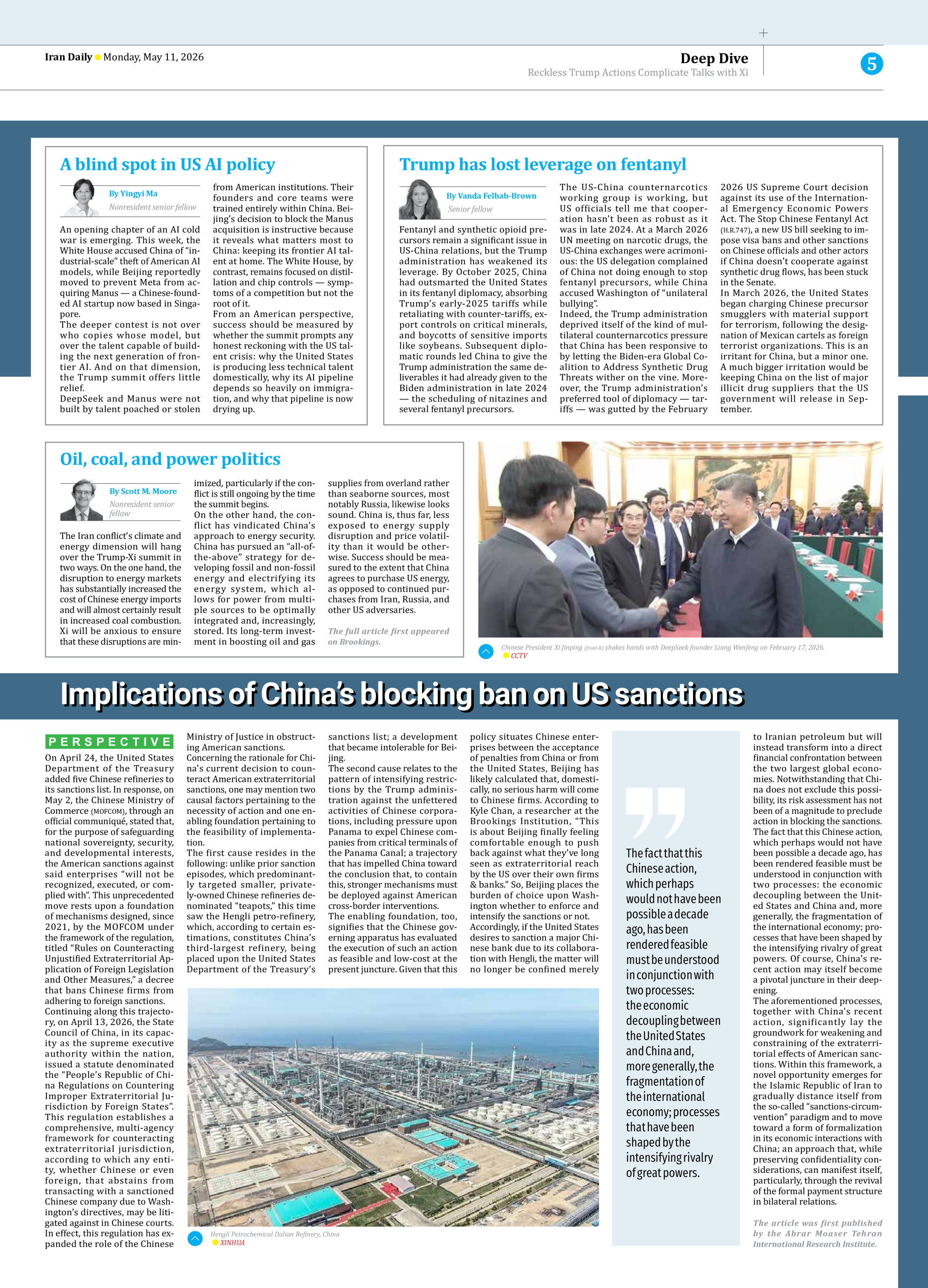
The first cause resides in the following: unlike prior sanction episodes, which predominantly targeted smaller, privately-owned Chinese refineries denominated “teapots,” this time saw the Hengli petro-refinery, which, according to certain estimations, constitutes China’s third-largest refinery, being placed upon the United States Department of the Treasury’s sanctions list; a development that became intolerable for Beijing.
The second cause relates to the pattern of intensifying restrictions by the Trump administration against the unfettered activities of Chinese corporations, including pressure upon Panama to expel Chinese companies from critical terminals of the Panama Canal; a trajectory that has impelled China toward the conclusion that, to contain this, stronger mechanisms must be deployed against American cross-border interventions.
The enabling foundation, too, signifies that the Chinese governing apparatus has evaluated the execution of such an action as feasible and low-cost at the present juncture. Given that this policy situates Chinese enterprises between the acceptance of penalties from China or from the United States, Beijing has likely calculated that, domestically, no serious harm will come to Chinese firms. According to Kyle Chan, a researcher at the Brookings Institution, “This is about Beijing finally feeling comfortable enough to push back against what they’ve long seen as extraterritorial reach by the US over their own firms & banks.” So, Beijing places the burden of choice upon Washington whether to enforce and intensify the sanctions or not.
Accordingly, if the United States desires to sanction a major Chinese bank due to its collaboration with Hengli, the matter will no longer be confined merely to Iranian petroleum but will instead transform into a direct financial confrontation between the two largest global economies. Notwithstanding that China does not exclude this possibility, its risk assessment has not been of a magnitude to preclude action in blocking the sanctions.
The fact that this Chinese action, which perhaps would not have been possible a decade ago, has been rendered feasible must be understood in conjunction with two processes: the economic decoupling between the United States and China and, more generally, the fragmentation of the international economy; processes that have been shaped by the intensifying rivalry of great powers. Of course, China’s recent action may itself become a pivotal juncture in their deepening.
The aforementioned processes, together with China’s recent action, significantly lay the groundwork for weakening and constraining of the extraterritorial effects of American sanctions. Within this framework, a novel opportunity emerges for the Islamic Republic of Iran to gradually distance itself from the so-called “sanctions-circumvention” paradigm and to move toward a form of formalization in its economic interactions with China; an approach that, while preserving confidentiality considerations, can manifest itself, particularly, through the revival of the formal payment structure in bilateral relations.
The article was first published by the Abrar Moaser Tehran
International Research Institute.