





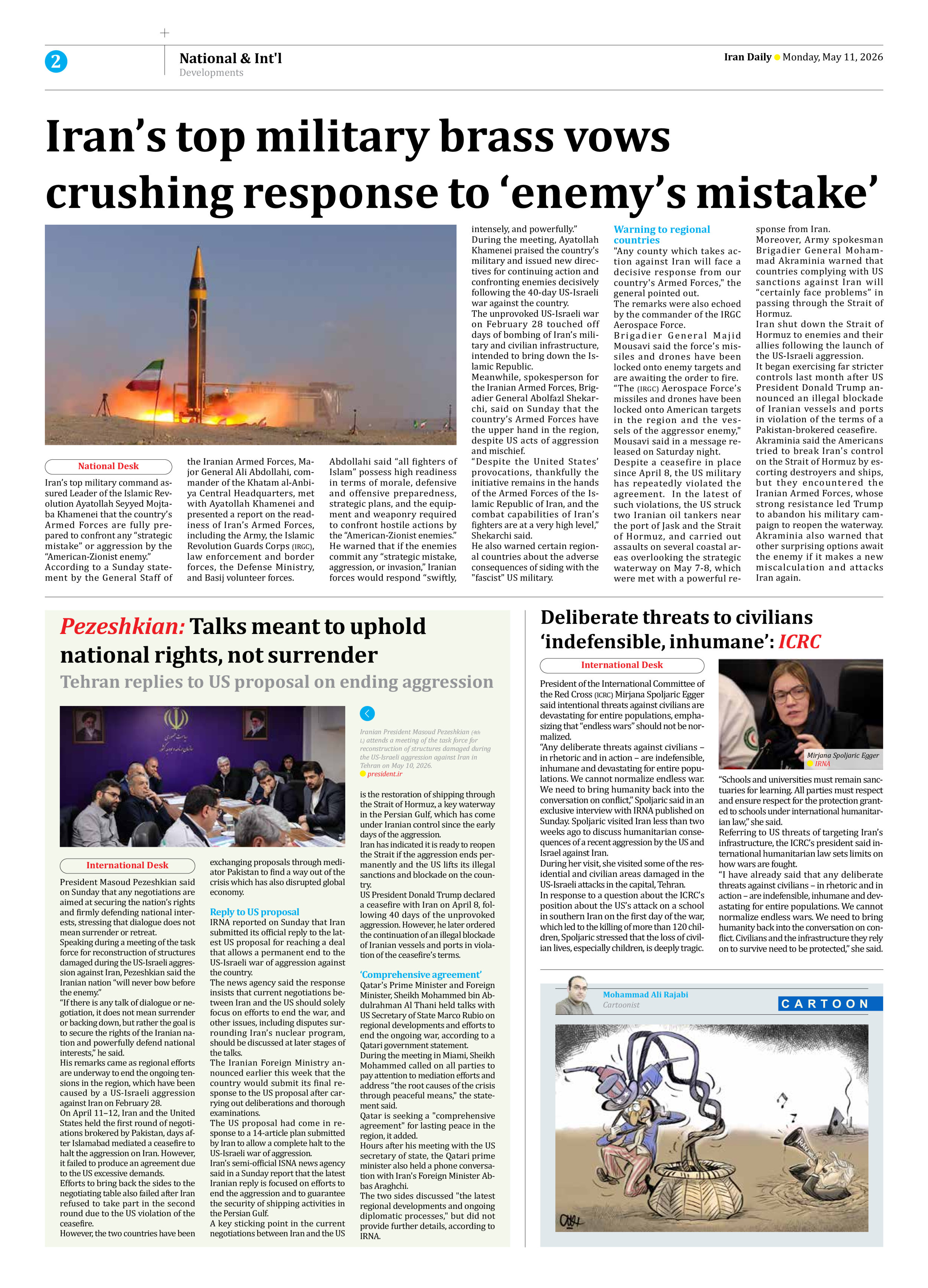


Pezeshkian: Talks meant to uphold national rights, not surrender
Tehran replies to US proposal on ending aggression
President Masoud Pezeshkian said on Sunday that any negotiations are aimed at securing the nation’s rights and firmly defending national interests, stressing that dialogue does not mean surrender or retreat.
Speaking during a meeting of the task force for reconstruction of structures damaged during the US-Israeli aggression against Iran, Pezeshkian said the Iranian nation “will never bow before the enemy.”
“If there is any talk of dialogue or negotiation, it does not mean surrender or backing down, but rather the goal is to secure the rights of the Iranian nation and powerfully defend national interests,” he said.
His remarks came as regional efforts are underway to end the ongoing tensions in the region, which have been caused by a US-Israeli aggression against Iran on February 28.
On April 11–12, Iran and the United States held the first round of negotiations brokered by Pakistan, days after Islamabad mediated a ceasefire to halt the aggression on Iran. However, it failed to produce an agreement due to the US excessive demands.
Efforts to bring back the sides to the negotiating table also failed after Iran refused to take part in the second round due to the US violation of the ceasefire.
However, the two countries have been exchanging proposals through mediator Pakistan to find a way out of the crisis which has also disrupted global economy.
Reply to US proposal
IRNA reported on Sunday that Iran submitted its official reply to the latest US proposal for reaching a deal that allows a permanent end to the US-Israeli war of aggression against the country.
The news agency said the response insists that current negotiations between Iran and the US should solely focus on efforts to end the war, and other issues, including disputes surrounding Iran’s nuclear program, should be discussed at later stages of the talks.
The Iranian Foreign Ministry announced earlier this week that the country would submit its final response to the US proposal after carrying out deliberations and thorough examinations.
The US proposal had come in response to a 14-article plan submitted by Iran to allow a complete halt to the US-Israeli war of aggression.
Iran’s semi-official ISNA news agency said in a Sunday report that the latest Iranian reply is focused on efforts to end the aggression and to guarantee the security of shipping activities in the Persian Gulf.
A key sticking point in the current negotiations between Iran and the US is the restoration of shipping through the Strait of Hormuz, a key waterway in the Persian Gulf, which has come under Iranian control since the early days of the aggression.
Iran has indicated it is ready to reopen the Strait if the aggression ends permanently and the US lifts its illegal sanctions and blockade on the country.
US President Donald Trump declared a ceasefire with Iran on April 8, following 40 days of the unprovoked aggression. However, he later ordered the continuation of an illegal blockade of Iranian vessels and ports in violation of the ceasefire’s terms.
‘Comprehensive agreement’
Qatar's Prime Minister and Foreign Minister, Sheikh Mohammed bin Abdulrahman Al Thani held talks with US Secretary of State Marco Rubio on regional developments and efforts to end the ongoing war, according to a Qatari government statement.
During the meeting in Miami, Sheikh Mohammed called on all parties to pay attention to mediation efforts and address “the root causes of the crisis through peaceful means," the statement said.
Qatar is seeking a "comprehensive agreement" for lasting peace in the region, it added.
Hours after his meeting with the US secretary of state, the Qatari prime minister also held a phone conversation with Iran's Foreign Minister Abbas Araghchi.
The two sides discussed "the latest regional developments and ongoing diplomatic processes," but did not provide further details, according to IRNA.