







Is Pakistan looking for exit by attacking Afghanistan?
By Abhishek De
Senior Assistant Editor
at India Today
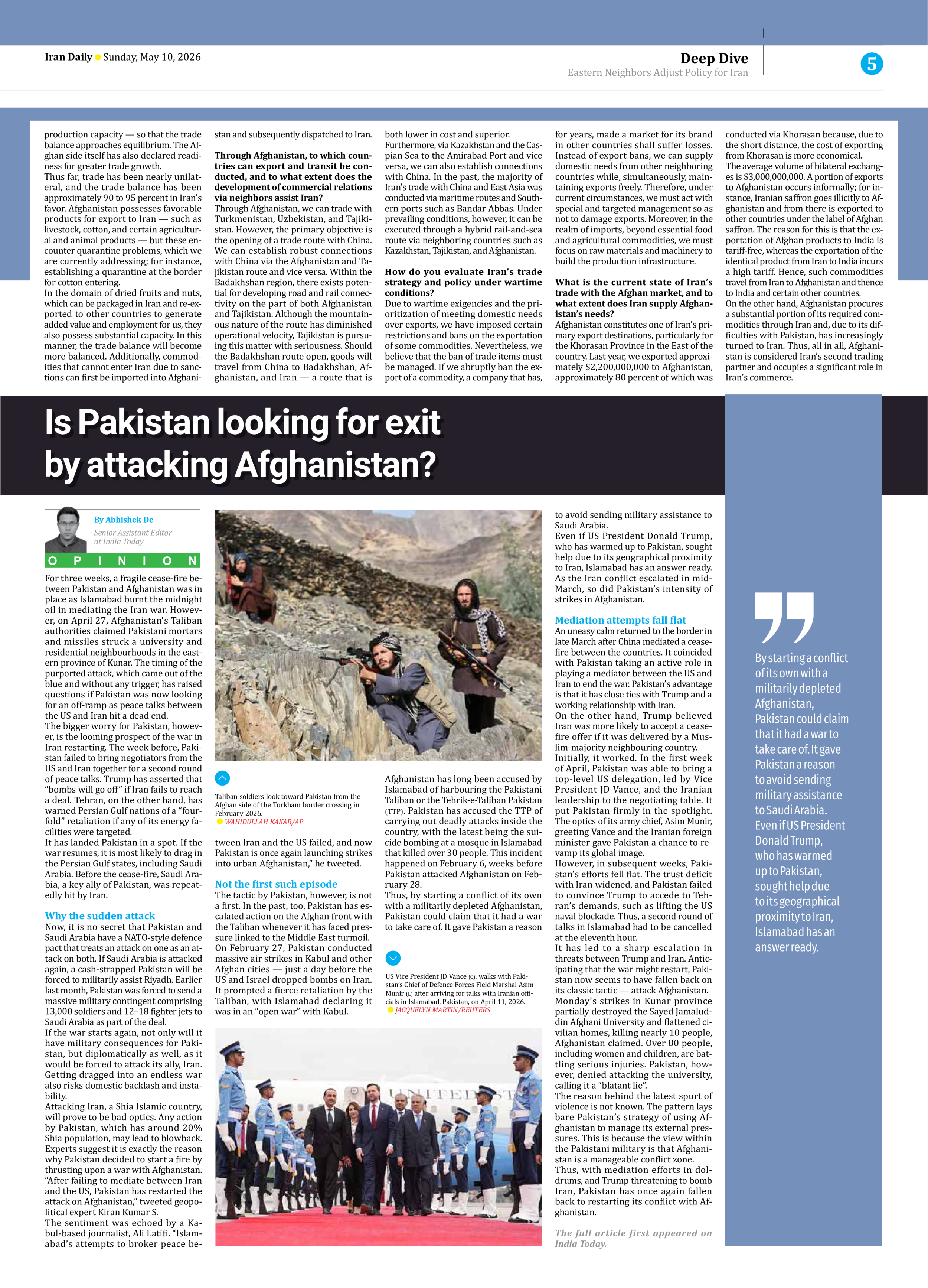
For three weeks, a fragile cease-fire between Pakistan and Afghanistan was in place as Islamabad burnt the midnight oil in mediating the Iran war. However, on April 27, Afghanistan’s Taliban authorities claimed Pakistani mortars and missiles struck a university and residential neighbourhoods in the eastern province of Kunar. The timing of the purported attack, which came out of the blue and without any trigger, has raised questions if Pakistan was now looking for an off-ramp as peace talks between the US and Iran hit a dead end.
The bigger worry for Pakistan, however, is the looming prospect of the war in Iran restarting. The week before, Pakistan failed to bring negotiators from the US and Iran together for a second round of peace talks. Trump has asserted that “bombs will go off” if Iran fails to reach a deal. Tehran, on the other hand, has warned Persian Gulf nations of a “fourfold” retaliation if any of its energy facilities were targeted.
It has landed Pakistan in a spot. If the war resumes, it is most likely to drag in the Persian Gulf states, including Saudi Arabia. Before the cease-fire, Saudi Arabia, a key ally of Pakistan, was repeatedly hit by Iran.
Why the sudden attack
Now, it is no secret that Pakistan and Saudi Arabia have a NATO-style defence pact that treats an attack on one as an attack on both. If Saudi Arabia is attacked again, a cash-strapped Pakistan will be forced to militarily assist Riyadh. Earlier last month, Pakistan was forced to send a massive military contingent comprising 13,000 soldiers and 12–18 fighter jets to Saudi Arabia as part of the deal.
If the war starts again, not only will it have military consequences for Pakistan, but diplomatically as well, as it would be forced to attack its ally, Iran. Getting dragged into an endless war also risks domestic backlash and instability.
Attacking Iran, a Shia Islamic country, will prove to be bad optics. Any action by Pakistan, which has around 20% Shia population, may lead to blowback.
Experts suggest it is exactly the reason why Pakistan decided to start a fire by thrusting upon a war with Afghanistan.
“After failing to mediate between Iran and the US, Pakistan has restarted the attack on Afghanistan,” tweeted geopolitical expert Kiran Kumar S.
The sentiment was echoed by a Kabul-based journalist, Ali Latifi. “Islamabad’s attempts to broker peace between Iran and the US failed, and now Pakistan is once again launching strikes into urban Afghanistan,” he tweeted.
Not the first such episode
The tactic by Pakistan, however, is not a first. In the past, too, Pakistan has escalated action on the Afghan front with the Taliban whenever it has faced pressure linked to the Middle East turmoil.
On February 27, Pakistan conducted massive air strikes in Kabul and other Afghan cities — just a day before the US and Israel dropped bombs on Iran. It prompted a fierce retaliation by the Taliban, with Islamabad declaring it was in an “open war” with Kabul.
Afghanistan has long been accused by Islamabad of harbouring the Pakistani Taliban or the Tehrik-e-Taliban Pakistan (TTP). Pakistan has accused the TTP of carrying out deadly attacks inside the country, with the latest being the suicide bombing at a mosque in Islamabad that killed over 30 people. This incident happened on February 6, weeks before Pakistan attacked Afghanistan on February 28.
Thus, by starting a conflict of its own with a militarily depleted Afghanistan, Pakistan could claim that it had a war to take care of. It gave Pakistan a reason to avoid sending military assistance to Saudi Arabia.
Even if US President Donald Trump, who has warmed up to Pakistan, sought help due to its geographical proximity to Iran, Islamabad has an answer ready.
As the Iran conflict escalated in mid-March, so did Pakistan’s intensity of strikes in Afghanistan.
Mediation attempts fall flat
An uneasy calm returned to the border in late March after China mediated a cease-fire between the countries. It coincided with Pakistan taking an active role in playing a mediator between the US and Iran to end the war. Pakistan’s advantage is that it has close ties with Trump and a working relationship with Iran.
On the other hand, Trump believed Iran was more likely to accept a cease-fire offer if it was delivered by a Muslim-majority neighbouring country.
Initially, it worked. In the first week of April, Pakistan was able to bring a top-level US delegation, led by Vice President JD Vance, and the Iranian leadership to the negotiating table. It put Pakistan firmly in the spotlight. The optics of its army chief, Asim Munir, greeting Vance and the Iranian foreign minister gave Pakistan a chance to revamp its global image.
However, in subsequent weeks, Pakistan’s efforts fell flat. The trust deficit with Iran widened, and Pakistan failed to convince Trump to accede to Tehran’s demands, such as lifting the US naval blockade. Thus, a second round of talks in Islamabad had to be cancelled at the eleventh hour.
It has led to a sharp escalation in threats between Trump and Iran. Anticipating that the war might restart, Pakistan now seems to have fallen back on its classic tactic — attack Afghanistan.
Monday’s strikes in Kunar province partially destroyed the Sayed Jamaluddin Afghani University and flattened civilian homes, killing nearly 10 people, Afghanistan claimed. Over 80 people, including women and children, are battling serious injuries. Pakistan, however, denied attacking the university, calling it a “blatant lie”.
The reason behind the latest spurt of violence is not known. The pattern lays bare Pakistan’s strategy of using Afghanistan to manage its external pressures. This is because the view within the Pakistani military is that Afghanistan is a manageable conflict zone.
Thus, with mediation efforts in doldrums, and Trump threatening to bomb Iran, Pakistan has once again fallen back to restarting its conflict with Afghanistan.
The full article first appeared on
India Today.