







Iran circumventing maritime blockade through Afghanistan: Businessman
2.5-fold surge in truck crossings at eastern border
Political and security developments along Iran’s eastern periphery — particularly in Afghanistan — have consistently constituted one of the pivotal variables influencing bilateral commercial and transit relations. Following the ascendancy of the Taliban in Afghanistan during 2021 and the consequent transformation of the governance structure in Kabul, numerous economic observers felt profound skepticism regarding the future of Iran-Afghanistan exchanges. Nevertheless, the passage of nearly five years has demonstrated that border trade and economic relations have not only not failed to cease but have, in certain domains, been accompanied by growth and novel facilitations. In this context, Iran’s eastern borders — especially the Dogharoun Border Crossing in the Khorasan Razavi Province — play a central role in bilateral trade, serving as one of the most crucial conduits for land commerce with Afghanistan. The Khorasan Razavi Province, through the Dogharoun Free Zone’s infrastructures and provincial collaborations with Afghanistan’s Herat Province, has successfully handled a considerable volume of re-exports, transit operations, and even imports of essential commodities from Afghanistan. To ascertain the most recent state of Iran-Afghanistan exchanges, border cooperations, matters pertaining to tolls, trade balance, strategies for circumventing maritime sanctions, and also transit capacities through Afghanistan toward Central Asia and China, Iran Daily has conducted an exclusive interview with the Vice President of the Joint Chamber of Commerce of Iran and Afghanistan Kazem Shirdel, the full text of which you will read below:
By Sadeq Dehqan
Staff writer
IRAN DAILY: Given the recent developments related to the US-Israeli war on Iran, what trajectory has the state of commercial exchanges between Iran and Afghanistan taken?
SHIRDEL: Our Afghan counterparts, at present, exhibit commendable cooperation with us regarding trade. In the past, within the mechanism of the transport fleet traversing between Iran and Afghanistan, both countries had imposed fees under designations such as “road pass” and “soil money” for revenue generation; however, during the recent journey of the Governor of Khorasan Razavi Province Qolamreza Mozaffari to Herat and his meeting with the provincial governor there, these fees have been abolished. Currently, the Afghan side no longer collects money from that side, and soon the Iranian side shall also cease collecting this amount to take reciprocal action — a favorable development for augmenting commercial interactions between the two countries.
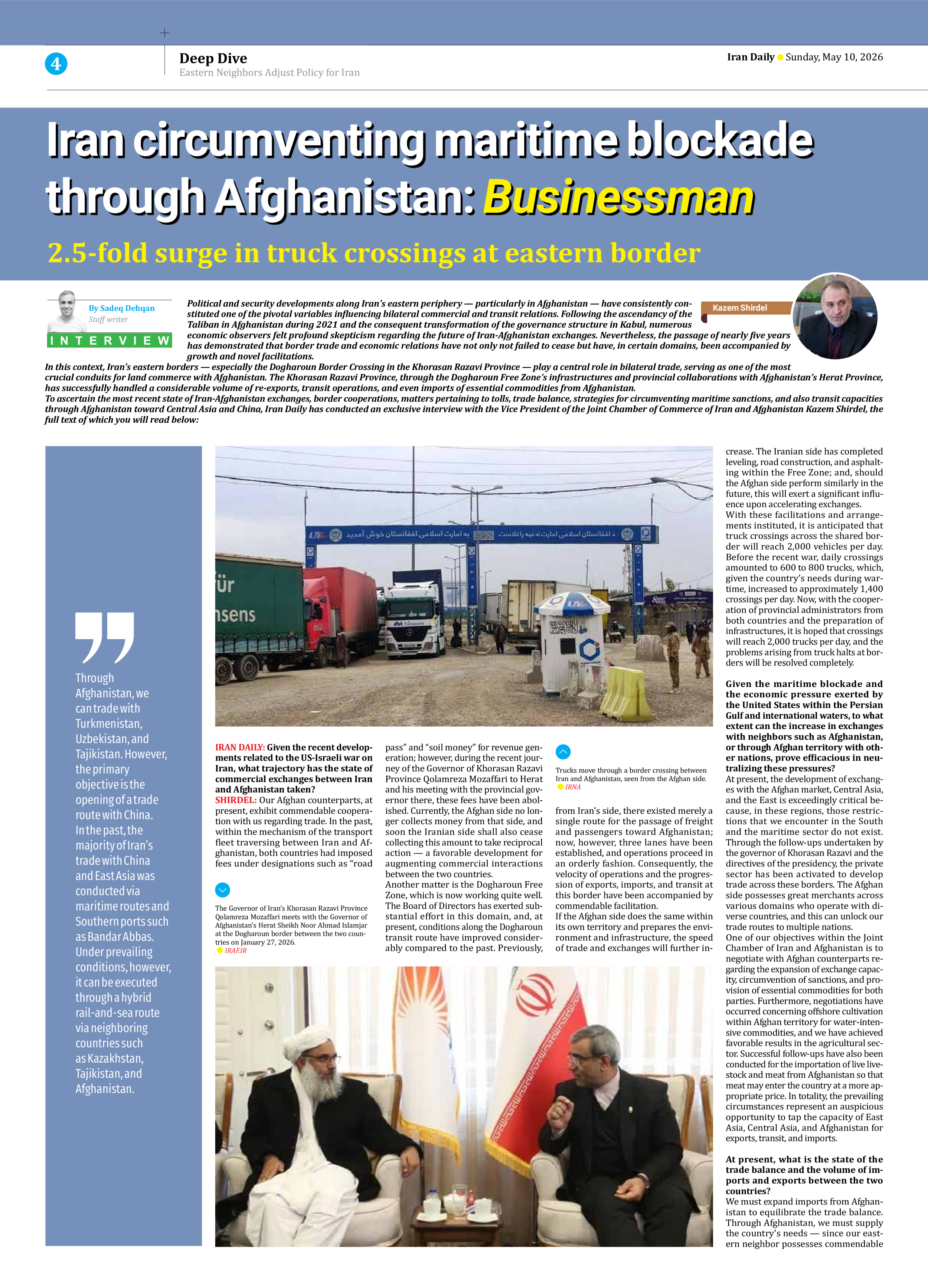
Another matter is the Dogharoun Free Zone, which is now working quite well. The Board of Directors has exerted substantial effort in this domain, and, at present, conditions along the Dogharoun transit route have improved considerably compared to the past. Previously, from Iran’s side, there existed merely a single route for the passage of freight and passengers toward Afghanistan; now, however, three lanes have been established, and operations proceed in an orderly fashion. Consequently, the velocity of operations and the progression of exports, imports, and transit at this border have been accompanied by commendable facilitation.
If the Afghan side does the same within its own territory and prepares the environment and infrastructure, the speed of trade and exchanges will further increase. The Iranian side has completed leveling, road construction, and asphalting within the Free Zone; and, should the Afghan side perform similarly in the future, this will exert a significant influence upon accelerating exchanges.
With these facilitations and arrangements instituted, it is anticipated that truck crossings across the shared border will reach 2,000 vehicles per day. Before the recent war, daily crossings amounted to 600 to 800 trucks, which, given the country’s needs during wartime, increased to approximately 1,400 crossings per day. Now, with the cooperation of provincial administrators from both countries and the preparation of infrastructures, it is hoped that crossings will reach 2,000 trucks per day, and the problems arising from truck halts at borders will be resolved completely.
Given the maritime blockade and the economic pressure exerted by the United States within the Persian Gulf and international waters, to what extent can the increase in exchanges with neighbors such as Afghanistan, or through Afghan territory with other nations, prove efficacious in neutralizing these pressures?
At present, the development of exchanges with the Afghan market, Central Asia, and the East is exceedingly critical because, in these regions, those restrictions that we encounter in the South and the maritime sector do not exist. Through the follow-ups undertaken by the governor of Khorasan Razavi and the directives of the presidency, the private sector has been activated to develop trade across these borders. The Afghan side possesses great merchants across various domains who operate with diverse countries, and this can unlock our trade routes to multiple nations.
One of our objectives within the Joint Chamber of Iran and Afghanistan is to negotiate with Afghan counterparts regarding the expansion of exchange capacity, circumvention of sanctions, and provision of essential commodities for both parties. Furthermore, negotiations have occurred concerning offshore cultivation within Afghan territory for water-intensive commodities, and we have achieved favorable results in the agricultural sector. Successful follow-ups have also been conducted for the importation of live livestock and meat from Afghanistan so that meat may enter the country at a more appropriate price. In totality, the prevailing circumstances represent an auspicious opportunity to tap the capacity of East Asia, Central Asia, and Afghanistan for exports, transit, and imports.
At present, what is the state of the trade balance and the volume of imports and exports between the two countries?
We must expand imports from Afghanistan to equilibrate the trade balance. Through Afghanistan, we must supply the country’s needs — since our eastern neighbor possesses commendable production capacity — so that the trade balance approaches equilibrium. The Afghan side itself has also declared readiness for greater trade growth.
Thus far, trade has been nearly unilateral, and the trade balance has been approximately 90 to 95 percent in Iran’s favor. Afghanistan possesses favorable products for export to Iran — such as livestock, cotton, and certain agricultural and animal products — but these encounter quarantine problems, which we are currently addressing; for instance, establishing a quarantine at the border for cotton entering.
In the domain of dried fruits and nuts, which can be packaged in Iran and re-exported to other countries to generate added value and employment for us, they also possess substantial capacity. In this manner, the trade balance will become more balanced. Additionally, commodities that cannot enter Iran due to sanctions can first be imported into Afghanistan and subsequently dispatched to Iran.
Through Afghanistan, to which countries can export and transit be conducted, and to what extent does the development of commercial relations via neighbors assist Iran?
Through Afghanistan, we can trade with Turkmenistan, Uzbekistan, and Tajikistan. However, the primary objective is the opening of a trade route with China. We can establish robust connections with China via the Afghanistan and Tajikistan route and vice versa. Within the Badakhshan region, there exists potential for developing road and rail connectivity on the part of both Afghanistan and Tajikistan. Although the mountainous nature of the route has diminished operational velocity, Tajikistan is pursuing this matter with seriousness. Should the Badakhshan route open, goods will travel from China to Badakhshan, Afghanistan, and Iran — a route that is both lower in cost and superior.
Furthermore, via Kazakhstan and the Caspian Sea to the Amirabad Port and vice versa, we can also establish connections with China. In the past, the majority of Iran’s trade with China and East Asia was conducted via maritime routes and Southern ports such as Bandar Abbas. Under prevailing conditions, however, it can be executed through a hybrid rail-and-sea route via neighboring countries such as Kazakhstan, Tajikistan, and Afghanistan.
How do you evaluate Iran’s trade strategy and policy under wartime conditions?
Due to wartime exigencies and the prioritization of meeting domestic needs over exports, we have imposed certain restrictions and bans on the exportation of some commodities. Nevertheless, we believe that the ban of trade items must be managed. If we abruptly ban the export of a commodity, a company that has, for years, made a market for its brand in other countries shall suffer losses. Instead of export bans, we can supply domestic needs from other neighboring countries while, simultaneously, maintaining exports freely. Therefore, under current circumstances, we must act with special and targeted management so as not to damage exports. Moreover, in the realm of imports, beyond essential food and agricultural commodities, we must focus on raw materials and machinery to build the production infrastructure.
What is the current state of Iran’s trade with the Afghan market, and to what extent does Iran supply Afghanistan’s needs?
Afghanistan constitutes one of Iran’s primary export destinations, particularly for the Khorasan Province in the East of the country. Last year, we exported approximately $2,200,000,000 to Afghanistan, approximately 80 percent of which was conducted via Khorasan because, due to the short distance, the cost of exporting from Khorasan is more economical.
The average volume of bilateral exchanges is $3,000,000,000. A portion of exports to Afghanistan occurs informally; for instance, Iranian saffron goes illicitly to Afghanistan and from there is exported to other countries under the label of Afghan saffron. The reason for this is that the exportation of Afghan products to India is tariff-free, whereas the exportation of the identical product from Iran to India incurs a high tariff. Hence, such commodities travel from Iran to Afghanistan and thence to India and certain other countries.
On the other hand, Afghanistan procures a substantial portion of its required commodities through Iran and, due to its difficulties with Pakistan, has increasingly turned to Iran. Thus, all in all, Afghanistan is considered Iran’s second trading partner and occupies a significant role in Iran’s commerce.