





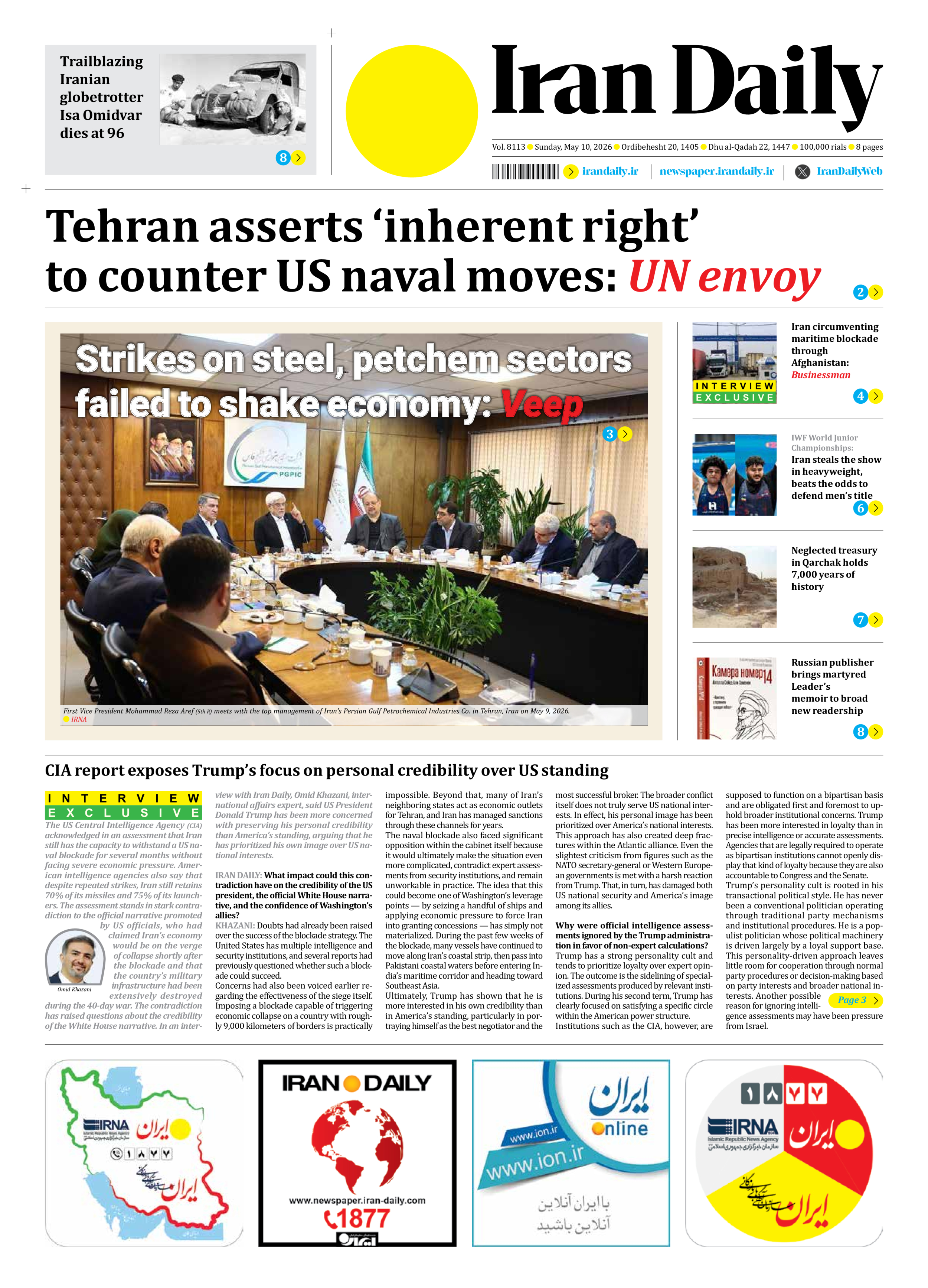


CIA report exposes Trump’s focus on personal credibility over US standing
The US Central Intelligence Agency (CIA) acknowledged in an assessment that Iran still has the capacity to withstand a US naval blockade for several months without facing severe economic pressure. American intelligence agencies also say that despite repeated strikes, Iran still retains 70% of its missiles and 75% of its launchers. The assessment stands in stark contradiction to the official narrative promoted by US officials, who had claimed Iran’s economy would be on the verge of collapse shortly after the blockade and that the country’s military infrastructure had been extensively destroyed during the 40-day war. The contradiction has raised questions about the credibility of the White House narrative. In an interview with Iran Daily, Omid Khazani, international affairs expert, said US President Donald Trump has been more concerned with preserving his personal credibility than America’s standing, arguing that he has prioritized his own image over US national interests.
IRAN DAILY: What impact could this contradiction have on the credibility of the US president, the official White House narrative, and the confidence of Washington’s allies?
KHAZANI: Doubts had already been raised over the success of the blockade strategy. The United States has multiple intelligence and security institutions, and several reports had previously questioned whether such a blockade could succeed.
Concerns had also been voiced earlier regarding the effectiveness of the siege itself. Imposing a blockade capable of triggering economic collapse on a country with roughly 9,000 kilometers of borders is practically impossible. Beyond that, many of Iran’s neighboring states act as economic outlets for Tehran, and Iran has managed sanctions through these channels for years.
The naval blockade also faced significant opposition within the cabinet itself because it would ultimately make the situation even more complicated, contradict expert assessments from security institutions, and remain unworkable in practice. The idea that this could become one of Washington’s leverage points — by seizing a handful of ships and applying economic pressure to force Iran into granting concessions — has simply not materialized. During the past few weeks of the blockade, many vessels have continued to move along Iran’s coastal strip, then pass into Pakistani coastal waters before entering India’s maritime corridor and heading toward Southeast Asia.
Ultimately, Trump has shown that he is more interested in his own credibility than in America’s standing, particularly in portraying himself as the best negotiator and the most successful broker. The broader conflict itself does not truly serve US national interests. In effect, his personal image has been prioritized over America’s national interests. This approach has also created deep fractures within the Atlantic alliance. Even the slightest criticism from figures such as the NATO secretary-general or Western European governments is met with a harsh reaction from Trump. That, in turn, has damaged both US national security and America’s image among its allies.
Why were official intelligence assessments ignored by the Trump administration in favor of non-expert calculations?
Trump has a strong personality cult and tends to prioritize loyalty over expert opinion. The outcome is the sidelining of specialized assessments produced by relevant institutions. During his second term, Trump has clearly focused on satisfying a specific circle within the American power structure.
Institutions such as the CIA, however, are supposed to function on a bipartisan basis and are obligated first and foremost to uphold broader institutional concerns. Trump has been more interested in loyalty than in precise intelligence or accurate assessments. Agencies that are legally required to operate as bipartisan institutions cannot openly display that kind of loyalty because they are also accountable to Congress and the Senate.
Trump’s personality cult is rooted in his transactional political style. He has never been a conventional politician operating through traditional party mechanisms and institutional procedures. He is a populist politician whose political machinery is driven largely by a loyal support base. This personality-driven approach leaves little room for cooperation through normal party procedures or decision-making based on party interests and broader national interests. Another possible reason for ignoring intelligence assessments may have been pressure from Israel.
Page 3