







2008 crash predictor warns of looming Wall Street meltdown
By Benjamin Curry
Deputy editor at Daily Mail
Almost nothing can stop a recession from happening this year, warns one of the top US economists.
But that’s not all: The recession might very well be accompanied by a massive stock market crash that could wipe out as much as a third of your 401(k)’s value.
The doomsayer is Gary Shilling, who believes this massive economic catastrophe is inevitable thanks to declining consumer spending.
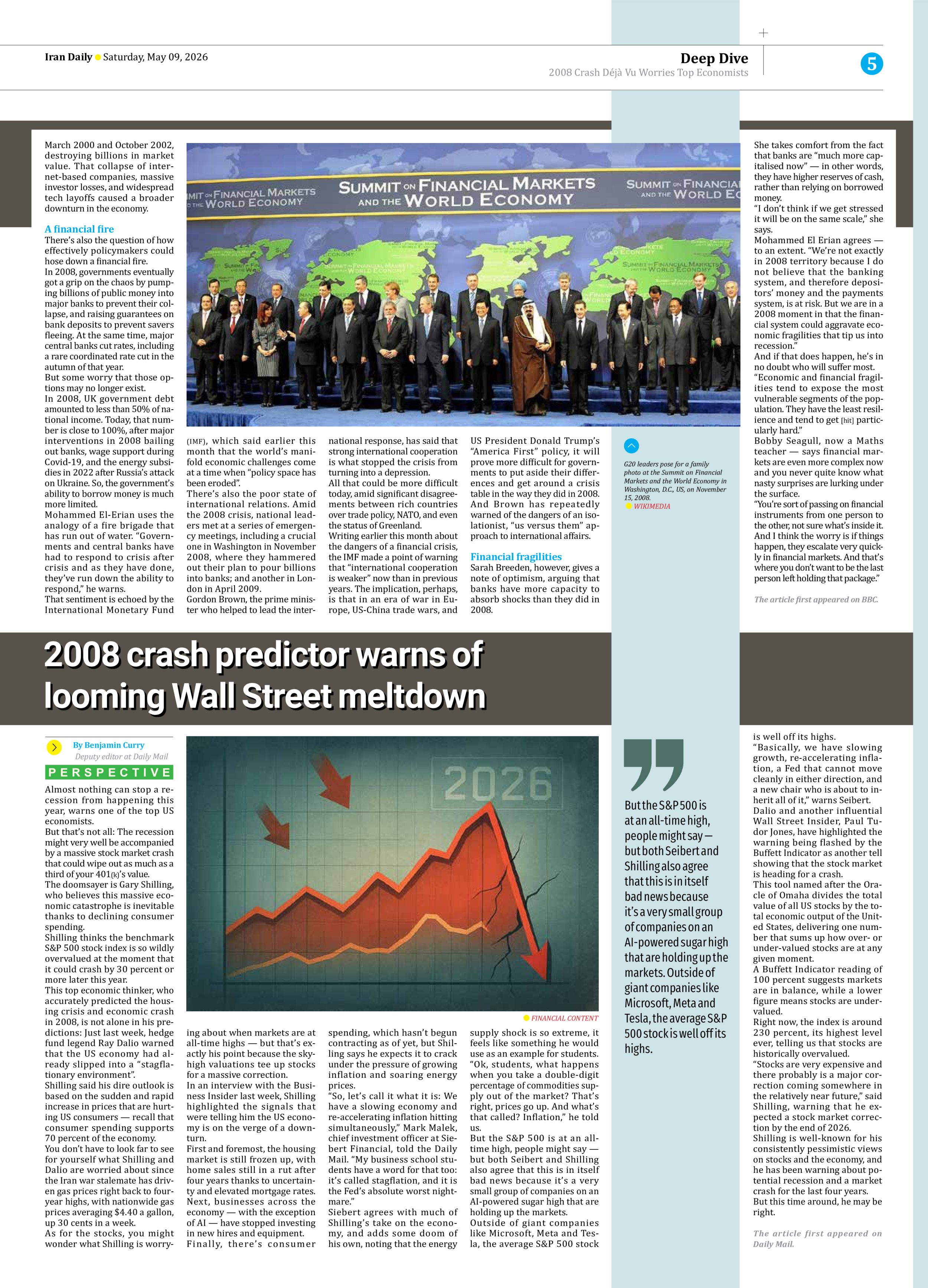
Shilling thinks the benchmark S&P 500 stock index is so wildly overvalued at the moment that it could crash by 30 percent or more later this year.
This top economic thinker, who accurately predicted the housing crisis and economic crash in 2008, is not alone in his predictions: Just last week, hedge fund legend Ray Dalio warned that the US economy had already slipped into a “stagflationary environment”.
Shilling said his dire outlook is based on the sudden and rapid increase in prices that are hurting US consumers — recall that consumer spending supports 70 percent of the economy.
You don’t have to look far to see for yourself what Shilling and Dalio are worried about since the Iran war stalemate has driven gas prices right back to four-year highs, with nationwide gas prices averaging $4.40 a gallon, up 30 cents in a week.
As for the stocks, you might wonder what Shilling is worrying about when markets are at all-time highs — but that’s exactly his point because the sky-high valuations tee up stocks for a massive correction.
In an interview with the Business Insider last week, Shilling highlighted the signals that were telling him the US economy is on the verge of a downturn.
First and foremost, the housing market is still frozen up, with home sales still in a rut after four years thanks to uncertainty and elevated mortgage rates.
Next, businesses across the economy — with the exception of AI — have stopped investing in new hires and equipment.
Finally, there’s consumer spending, which hasn’t begun contracting as of yet, but Shilling says he expects it to crack under the pressure of growing inflation and soaring energy prices.
“So, let’s call it what it is: We have a slowing economy and re-accelerating inflation hitting simultaneously,” Mark Malek, chief investment officer at Siebert Financial, told the Daily Mail. “My business school students have a word for that too: it’s called stagflation, and it is the Fed’s absolute worst nightmare.”
Siebert agrees with much of Shilling’s take on the economy, and adds some doom of his own, noting that the energy supply shock is so extreme, it feels like something he would use as an example for students.
“Ok, students, what happens when you take a double-digit percentage of commodities supply out of the market? That’s right, prices go up. And what’s that called? Inflation,” he told us.
But the S&P 500 is at an all-time high, people might say — but both Seibert and Shilling also agree that this is in itself bad news because it’s a very small group of companies on an AI-powered sugar high that are holding up the markets.
Outside of giant companies like Microsoft, Meta and Tesla, the average S&P 500 stock is well off its highs.
“Basically, we have slowing growth, re-accelerating inflation, a Fed that cannot move cleanly in either direction, and a new chair who is about to inherit all of it,” warns Seibert.
Dalio and another influential Wall Street Insider, Paul Tudor Jones, have highlighted the warning being flashed by the Buffett Indicator as another tell showing that the stock market is heading for a crash.
This tool named after the Oracle of Omaha divides the total value of all US stocks by the total economic output of the United States, delivering one number that sums up how over- or under-valued stocks are at any given moment.
A Buffett Indicator reading of 100 percent suggests markets are in balance, while a lower figure means stocks are undervalued.
Right now, the index is around 230 percent, its highest level ever, telling us that stocks are historically overvalued.
“Stocks are very expensive and there probably is a major correction coming somewhere in the relatively near future,” said Shilling, warning that he expected a stock market correction by the end of 2026.
Shilling is well-known for his consistently pessimistic views on stocks and the economy, and he has been warning about potential recession and a market crash for the last four years.
But this time around, he may be right.
The article first appeared on
Daily Mail.