







Russia rejects US-Bahrain anti-Iran move at UNSC
Tehran raps draft resolution as ‘deeply flawed’
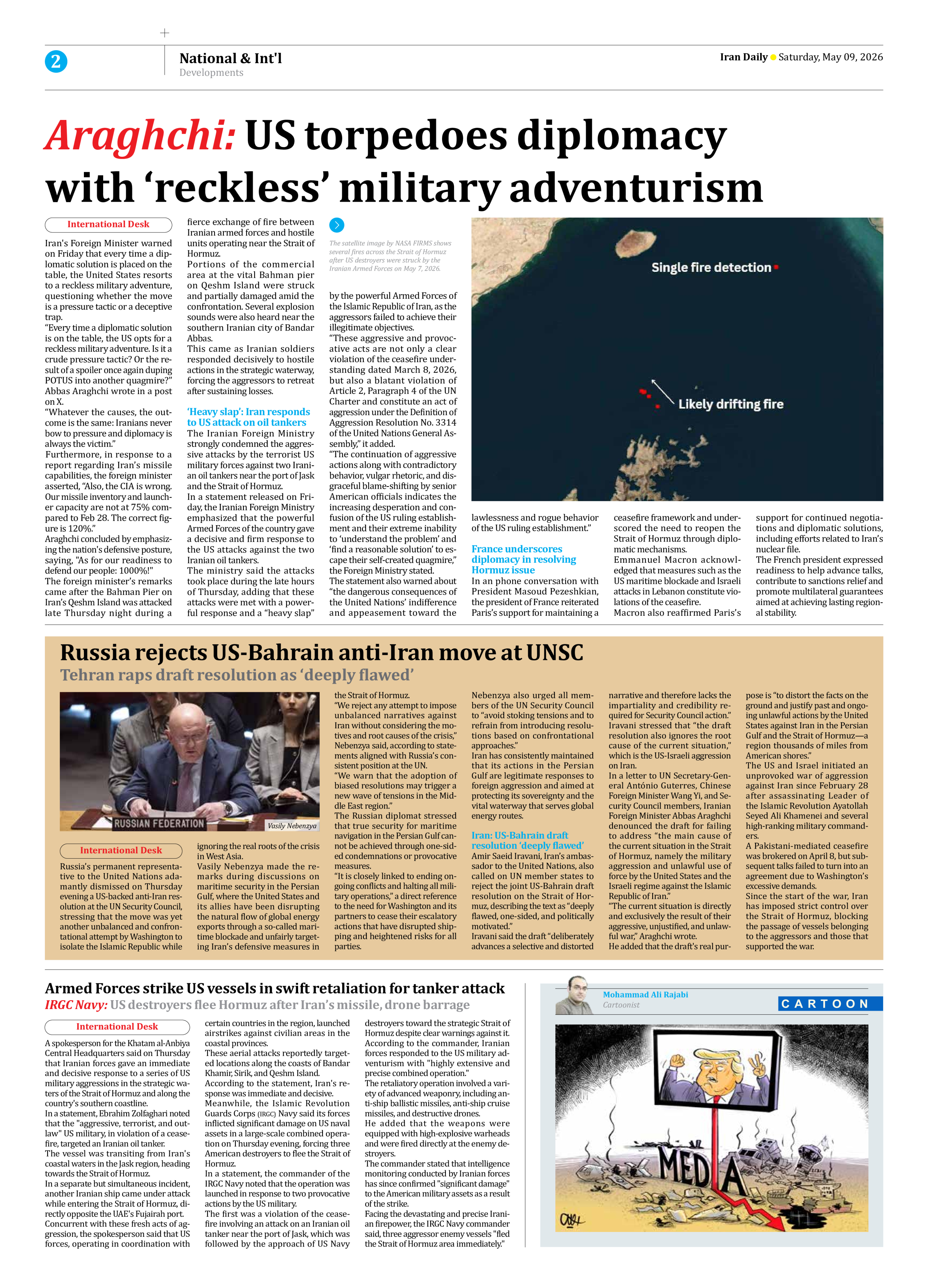
Russia’s permanent representative to the United Nations adamantly dismissed on Thursday evening a US-backed anti-Iran resolution at the UN Security Council, stressing that the move was yet another unbalanced and confrontational attempt by Washington to isolate the Islamic Republic while ignoring the real roots of the crisis in West Asia.
Vasily Nebenzya made the remarks during discussions on maritime security in the Persian Gulf, where the United States and its allies have been disrupting the natural flow of global energy exports through a so-called maritime blockade and unfairly targeting Iran’s defensive measures in the Strait of Hormuz.
“We reject any attempt to impose unbalanced narratives against Iran without considering the motives and root causes of the crisis,” Nebenzya said, according to statements aligned with Russia’s consistent position at the UN.
“We warn that the adoption of biased resolutions may trigger a new wave of tensions in the Middle East region.”
The Russian diplomat stressed that true security for maritime navigation in the Persian Gulf cannot be achieved through one-sided condemnations or provocative measures.
“It is closely linked to ending ongoing conflicts and halting all military operations,” a direct reference to the need for Washington and its partners to cease their escalatory actions that have disrupted shipping and heightened risks for all parties.
Nebenzya also urged all members of the UN Security Council to “avoid stoking tensions and to refrain from introducing resolutions based on confrontational approaches.”
Iran has consistently maintained that its actions in the Persian Gulf are legitimate responses to foreign aggression and aimed at protecting its sovereignty and the vital waterway that serves global energy routes.
Iran: US-Bahrain draft resolution ‘deeply flawed’
Amir Saeid Iravani, Iran’s ambassador to the United Nations, also called on UN member states to reject the joint US-Bahrain draft resolution on the Strait of Hormuz, describing the text as “deeply flawed, one-sided, and politically motivated.”
Iravani said the draft “deliberately advances a selective and distorted narrative and therefore lacks the impartiality and credibility required for Security Council action.”
Iravani stressed that “the draft resolution also ignores the root cause of the current situation,” which is the US-Israeli aggression on Iran.
In a letter to UN Secretary-General António Guterres, Chinese Foreign Minister Wang Yi, and Security Council members, Iranian Foreign Minister Abbas Araghchi denounced the draft for failing to address “the main cause of the current situation in the Strait of Hormuz, namely the military aggression and unlawful use of force by the United States and the Israeli regime against the Islamic Republic of Iran.”
“The current situation is directly and exclusively the result of their aggressive, unjustified, and unlawful war,” Araghchi wrote.
He added that the draft's real purpose is “to distort the facts on the ground and justify past and ongoing unlawful actions by the United States against Iran in the Persian Gulf and the Strait of Hormuz—a region thousands of miles from American shores.”
The US and Israel initiated an unprovoked war of aggression against Iran since February 28 after assassinating Leader of the Islamic Revolution Ayatollah Seyed Ali Khamenei and several high-ranking military commanders.
A Pakistani-mediated ceasefire was brokered on April 8, but subsequent talks failed to turn into an agreement due to Washington’s excessive demands.
Since the start of the war, Iran has imposed strict control over the Strait of Hormuz, blocking the passage of vessels belonging to the aggressors and those that supported the war.