







US naval blockade unlawful: Official
But collecting tolls from ships transiting Strait of Hormuz logical
By Sadeq Dehqan
Staff writer
During these days, the deployment of military forces of the United States Central Command (CENTCOM) within the waters of the Middle East and the claim of imposing restrictions upon the transit of commercial vessels, particularly Iranian oil tankers, has created an atmosphere of profound uncertainty over the shipping industry. These measures are being executed notwithstanding the fact that Iranian authorities have consistently emphasized the unlawful nature of such behaviors from the perspective of the law of the sea and international conventions.
According to international law, especially the 1982 United Nations Convention on the Law of the Sea (UNCLOS) and the regulations of the International Maritime Organization (IMO), the imposition of a naval blockade by an extra-regional power, absent a delegation of authority from the United Nations Security Council, is deemed devoid of legal legitimacy. Legal scholars maintain that such actions not only contravene the principles of innocent passage through international straits and waterways but could also place the safety of navigation and the supply chain of essential commodities, such as medicines, foodstuffs, and fuel, in grave jeopardy.
Within this intricate context, the Iranian shipping industry, notwithstanding external pressures and escalating operational costs, has endeavored to sustain its maritime transits. Nevertheless, issues such as war risk insurance, heightened vessel costs, the seizure of certain watercraft, and the anxiety resulting from foreign military presence have generated daily challenges for ship owners, crews, and logistics operators.
In this regard, Iran Daily has conducted an exclusive interview with Masoud Polmeh, secretary-general of the Iranian Shipping Association, to explore the legal and practical dimensions of the naval blockade, the status of Iranian vessel transits, the costs imposed upon shipping companies, the legal measures undertaken in international tribunals, and furthermore, Iran’s stance concerning the management of the Strait of Hormuz.
IRAN DAILY: How do you assess the naval blockade of Iran by the United States, and fundamentally, what situation, challenges, and restrictions do Iranian vessels confront under current circumstances?
POLMEH: Permit me to state unequivocally, from the outset, that the subject of a naval blockade of Iran by the United States of America constitutes an entirely illegitimate measure. According to the law of the sea, this action possesses no legal validity whatsoever; neither from the standpoint of binding international conventions nor from that of United Nations resolutions does any legitimacy for such a blockade exist. The United States has, in truth, acted once again in accordance with its self-appointed role as the world’s police. In effect, a naval blockade is a traditional instrument that the Americans employ to exert pressure upon any nation that does not behave according to their desires. Through this blockade, they have endeavored, by leveraging their military forces, to apply maximum economic pressure.
So, then, you mean that under international maritime rules and treaties, and even within the laws of armed conflict, something called a “naval blockade” in this form has not been authorized?
Such a thing does not exist under any circumstance. According to the mandates of the IMO, not only has the imposition of such behavior not been authorized, but these types of actions have been explicitly prohibited. Shipping must, in the ordinary course, serve to protect the interests of nations, and no impediment to the transit of commercial vessels carrying humanitarian goods, foodstuffs, medicines, and other essential items should exist. Vessels must conduct their commercial activities freely. This is separate from the regime of “innocent passage,” which possesses its own rules and whereby nations may apply pressure solely upon coastal states within a specified zone. However, for the United States to arrive from thousands of kilometers away and take such an action within our region’s waters is an unlawful act devoid of international legitimacy.
With this description, what effects have the actions of the United States produced, and what has been Iran’s reaction to this blockade?
The measures that the United States undertakes undoubtedly produce effects. However, we have adopted a reciprocal approach, and naturally, in response to this blockade and to secure the rights of our people, we are preventing the commercial transits of nations hostile to the Islamic Republic of Iran through the Strait of Hormuz. Consequently, due to this American military action, we are witnessing an increase in the price of oil, fuel, and energy globally, a phenomenon that has placed a double burden upon the entire world economy and has caused nations dependent upon the commerce and energy of the Persian Gulf to experience difficult conditions.
One of the most adversely affected nations in this blockade is the United States itself because the American economy is profoundly dependent upon Persian Gulf commerce, whether in terms of investors, producers, the stock exchange, and, most importantly, the matter of oil and energy, which subjects the consumer fuel rate in the United States to fluctuation and price increases every day.
Under such circumstances, how do you assess the status of Iranian vessel transits? Has the naval blockade succeeded in disrupting our activities?
In aggregate, our maritime logistics activities, despite the claim of an American naval blockade, continue. With the support of the armed forces, a portion of our watercraft are safely traversing this geographical blockade that has been established at sea. Furthermore, a segment of our tankers has also crossed the blockade line. Of course, another segment has remained inactive due to CENTCOM pressures or has refrained from transiting owing to concerns about potential military confrontations.
However, in sum, it must be stated that the exceptionally dire scenario which the United States had envisioned through the establishment of this blockade has not materialized. At the same time, naturally, the risk of shipping operations has increased, and the owners of foreign vessels transiting this region have become concerned. So, the naval blockade has certainly been effective in raising the price of oil, and this blockade complements American military actions, which have produced deleterious economic outcomes for nations and even for the United States itself.
Could this naval blockade expose Iran’s economy to a serious and irremediable bottleneck?
That is not at all the case. We possess several thousand kilometers of land borders, and we have another waterway available to us in the north of our country. We maintain connections with seven nations via road and rail, and in parallel with these connections, we also sustain maritime links with five countries. We have commercial relations with China via rail.
It is quite certain that this blockade cannot produce the effect that the United States desires. For many years, we have kept the North-South and East-West corridors active; corridors that support and sustain our commercial activities alongside the high seas. Although a larger volume of goods is usually transported to ports via maritime transport, road and rail can compensate for this gap to an acceptable extent. The very quantity of goods moved via road and rail suffices to nullify the destructive effects that the United States and the Zionist regime anticipate from a naval blockade.
What costs have the restrictions resulting from the naval blockade imposed upon Iranian shipping companies? And are international and domestic insurance companies capable of covering these losses?
Costs vary for vessels and, naturally, change according to the type of operation a vessel performs, its size, and the kind of cargo transported (ordinary goods, general cargo, dangerous goods). Accordingly, the regional insurance rate is likewise variable, and, naturally, during wartime conditions, the insurance rate increases.
The rate for maritime operations, depending on the type of operation, has increased by at least 100%, from fuel costs to vessel duties and tolls to insurance premiums, and on long routes, this figure reaches 300% to 400%. Naturally, insurance companies also encounter difficulties in covering these damages because, during wartime, due to the elevated risk, some insurance companies refuse to accept war risk, and consequently, compensation for losses must be administered reciprocally in a managed fashion.
Given the unlawful action of the United States in seizing certain Iranian vessels, has any specific legal action been undertaken by Iran or by shipping companies to file a lawsuit in international courts, or do you have a plan in this regard?
Yes, certainly. Preliminary actions and complaints have been lodged via diplomatic channels, as well as through organizations that conduct international professional and trade union activities, in The Hague and also at the IMO. Even the Iranian Shipping Association itself has pursued these complaints. These complaints have been raised under the headings of “imposing navigation restrictions” and “unlawful seizure of vessels”.
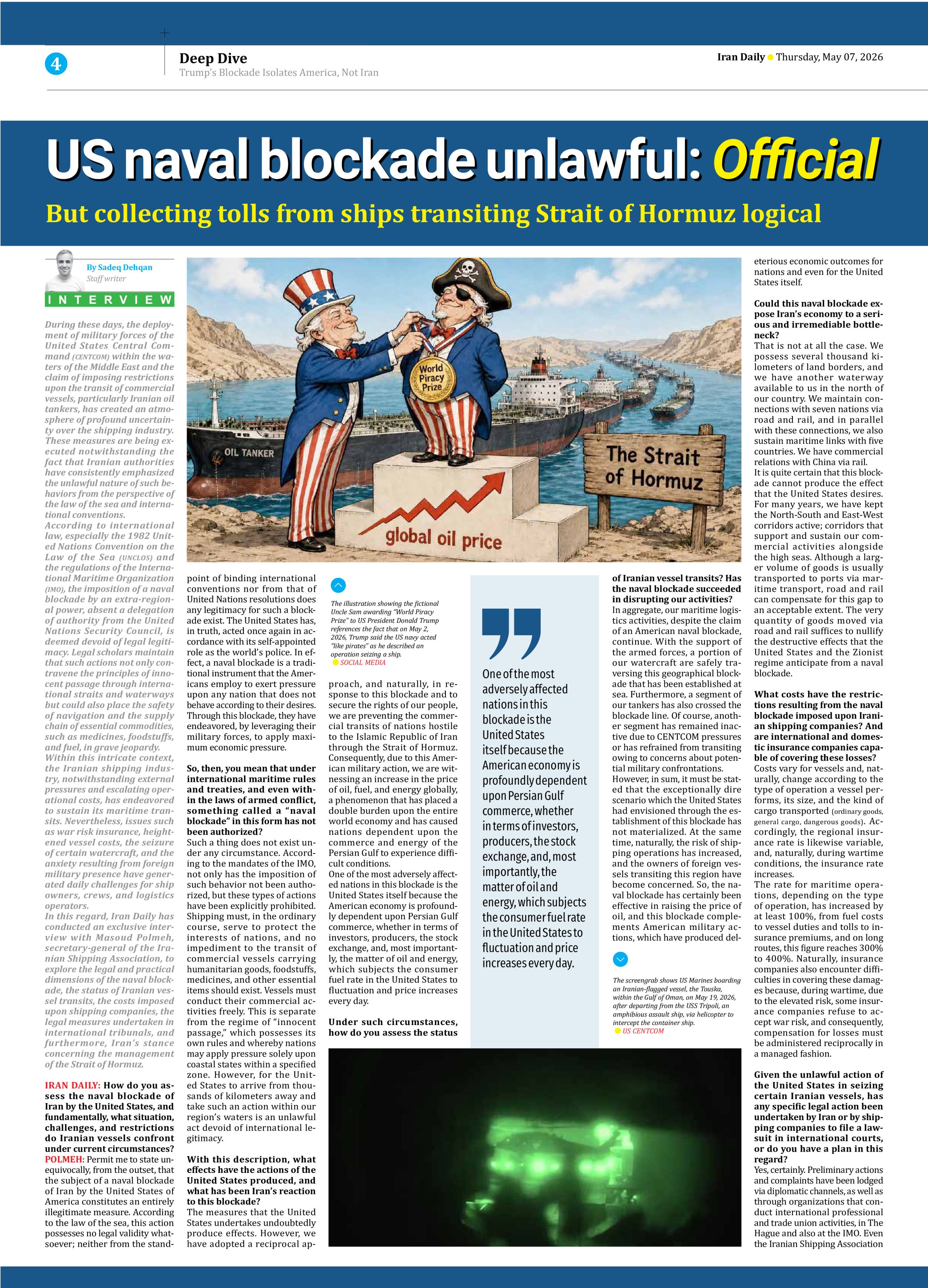
Naturally, for as long as the seizure of vessels continues, all material and moral rights of ship owners, cargo owners, and crew must be considered and preserved, and the protection of these persons and properties is the responsibility of the party that has executed the seizure. The Americans’ action in seizing vessels is, from an ethical standpoint, nothing other than “piracy”; however, from a legal perspective, this term is imprecise because piracy is not ordinarily carried out in an official manner with a documented identity.
In response to the American blockade, Iran has also raised the issue of closing the Strait of Hormuz. Some believe this action is likewise indefensible from a legal standpoint. On the other hand, the Strait of Hormuz is considered part of Iran’s territorial waters. Please explain what legal regime governs international straits and high seas, and how do you distinguish between the two?
We have a convention from the year 1982 of the IMO that the Islamic Republic of Iran has still neither signed nor ratified in the Parliament. Nevertheless, even based upon that same convention, navigation in coastal zones must be conducted as “innocent passage”.
In the Strait of Hormuz, we have in practice only prevented hostile nations; that is to say, we control vessels that intend to conduct military activities against us or naval operations harmful to Iran’s sovereignty and territorial integrity. However, this does not signify the complete closure of the Strait of Hormuz. At present, many vessels from various countries, including Turkey, Iraq, India, Pakistan, or even Qatar, following a behavioral modification that occurred, are transiting the Strait of Hormuz.
On the other hand, the Islamic Republic of Iran, under a specific legal process and regime, and in cooperation with Oman, manages the transit through the Strait of Hormuz. We do not claim to impose unilaterally our rights upon all international waterways and expect other nations to comply; rather, our actions in the Strait of Hormuz are based solely upon the interests of regional nations, the prevention of transit by harmful vessels, and the securing of the rights of the Iranian people.
Another topic raised these days concerns the collection of tolls upon vessels transiting the Strait of Hormuz. Does Iran possess the right to collect tolls in order to provide security or compensate for environmental pollution caused by vessel transit through its territorial waters?
Yes, absolutely. The conventions ratified by the IMO, which operates under the United Nations, have rendered mandatory for all IMO member states certain requirements for environmental protection, prevention of water pollution, control of vessels’ ballast water, and prevention of the discharge of garbage and vessel waste into the sea. Accordingly, when we speak of tolls, we mean the costs of monitoring and enforcing the implementation of these very conventions.
It is natural that any vessel intending to transit this region must pay the costs associated with the protection and safeguarding of the environment. From air pollution, such as the non-use of high-sulfur fuels, to water pollution resulting from oil spills or vessel fuel discharges, all such phenomena are forms of pollution, and their control and remediation entail specific costs. For these costs to be borne by the nation using the region’s waters, the collection of tolls is an entirely reasonable and logical matter.