





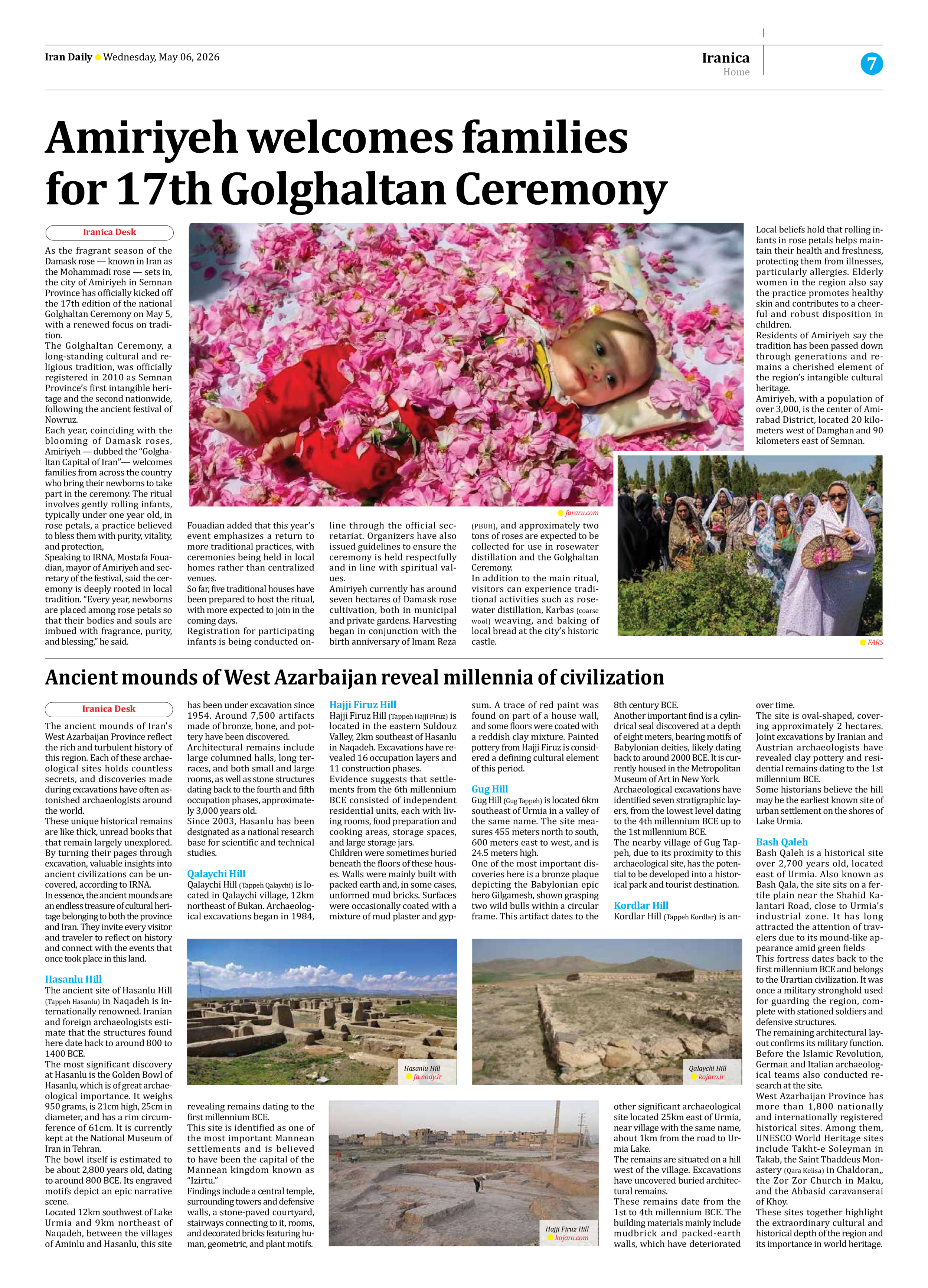


Ancient mounds of West Azarbaijan reveal millennia of civilization
The ancient mounds of Iran’s West Azarbaijan Province reflect the rich and turbulent history of this region. Each of these archaeological sites holds countless secrets, and discoveries made during excavations have often astonished archaeologists around the world.
These unique historical remains are like thick, unread books that that remain largely unexplored. By turning their pages through excavation, valuable insights into ancient civilizations can be uncovered, according to IRNA.
In essence, the ancient mounds are an endless treasure of cultural heritage belonging to both the province and Iran. They invite every visitor and traveler to reflect on history and connect with the events that once took place in this land.
Hasanlu Hill
The ancient site of Hasanlu Hill (Tappeh Hasanlu) in Naqadeh is internationally renowned. Iranian and foreign archaeologists estimate that the structures found here date back to around 800 to 1400 BCE.
The most significant discovery at Hasanlu is the Golden Bowl of Hasanlu, which is of great archaeological importance. It weighs 950 grams, is 21cm high, 25cm in diameter, and has a rim circumference of 61cm. It is currently kept at the National Museum of Iran in Tehran.
The bowl itself is estimated to be about 2,800 years old, dating to around 800 BCE. Its engraved motifs depict an epic narrative scene.
Located 12km southwest of Lake Urmia and 9km northeast of Naqadeh, between the villages of Aminlu and Hasanlu, this site has been under excavation since 1954. Around 7,500 artifacts made of bronze, bone, and pottery have been discovered.
Architectural remains include large columned halls, long terraces, and both small and large rooms, as well as stone structures dating back to the fourth and fifth occupation phases, approximately 3,000 years old.
Since 2003, Hasanlu has been designated as a national research base for scientific and technical studies.
Qalaychi Hill
Qalaychi Hill (Tappeh Qalaychi) is located in Qalaychi village, 12km northeast of Bukan. Archaeological excavations began in 1984, revealing remains dating to the first millennium BCE.
This site is identified as one of the most important Mannean settlements and is believed to have been the capital of the Mannean kingdom known as “Izirtu.”
Findings include a central temple, surrounding towers and defensive walls, a stone-paved courtyard, stairways connecting to it, rooms, and decorated bricks featuring human, geometric, and plant motifs.
Hajji Firuz Hill
Hajji Firuz Hill (Tappeh Hajji Firuz) is located in the eastern Suldouz Valley, 2km southeast of Hasanlu in Naqadeh. Excavations have revealed 16 occupation layers and 11 construction phases.
Evidence suggests that settlements from the 6th millennium BCE consisted of independent residential units, each with living rooms, food preparation and cooking areas, storage spaces, and large storage jars.
Children were sometimes buried beneath the floors of these houses. Walls were mainly built with packed earth and, in some cases, unformed mud bricks. Surfaces were occasionally coated with a mixture of mud plaster and gypsum. A trace of red paint was found on part of a house wall, and some floors were coated with a reddish clay mixture. Painted pottery from Hajji Firuz is considered a defining cultural element of this period.
Gug Hill
Gug Hill (Gug Tappeh) is located 6km southeast of Urmia in a valley of the same name. The site measures 455 meters north to south, 600 meters east to west, and is 24.5 meters high.
One of the most important discoveries here is a bronze plaque depicting the Babylonian epic hero Gilgamesh, shown grasping two wild bulls within a circular frame. This artifact dates to the 8th century BCE.
Another important find is a cylindrical seal discovered at a depth of eight meters, bearing motifs of Babylonian deities, likely dating back to around 2000 BCE. It is currently housed in the Metropolitan Museum of Art in New York.
Archaeological excavations have identified seven stratigraphic layers, from the lowest level dating to the 4th millennium BCE up to the 1st millennium BCE.
The nearby village of Gug Tappeh, due to its proximity to this archaeological site, has the potential to be developed into a historical park and tourist destination.
Kordlar Hill
Kordlar Hill (Tappeh Kordlar) is another significant archaeological site located 25km east of Urmia, near village with the same name, about 1km from the road to Urmia Lake.
The remains are situated on a hill west of the village. Excavations have uncovered buried architectural remains.
These remains date from the 1st to 4th millennium BCE. The building materials mainly include mudbrick and packed-earth walls, which have deteriorated over time.
The site is oval-shaped, covering approximately 2 hectares. Joint excavations by Iranian and Austrian archaeologists have revealed clay pottery and residential remains dating to the 1st millennium BCE.
Some historians believe the hill may be the earliest known site of urban settlement on the shores of Lake Urmia.
Bash Qaleh
Bash Qaleh is a historical site over 2,700 years old, located east of Urmia. Also known as Bash Qala, the site sits on a fertile plain near the Shahid Kalantari Road, close to Urmia’s industrial zone. It has long attracted the attention of travelers due to its mound-like appearance amid green fields
This fortress dates back to the first millennium BCE and belongs to the Urartian civilization. It was once a military stronghold used for guarding the region, complete with stationed soldiers and defensive structures.
The remaining architectural layout confirms its military function. Before the Islamic Revolution, German and Italian archaeological teams also conducted research at the site.
West Azarbaijan Province has more than 1,800 nationally and internationally registered historical sites. Among them, UNESCO World Heritage sites include Takht-e Soleyman in Takab, the Saint Thaddeus Monastery (Qara Kelisa) in Chaldoran,, the Zor Zor Church in Maku, and the Abbasid caravanserai of Khoy.
These sites together highlight the extraordinary cultural and historical depth of the region and its importance in world heritage.