







India’s yuan settlement with Iran reconfiguring energy trade
By Kashif Hasan Khan
Head of the Economics Department at Paragon International University
India’s decision to settle payments for Iranian oil in Chinese yuan marks a subtle yet potentially consequential shift in the evolving architecture of global energy trade and finance. While the transaction may appear technical, its implications extend well beyond bilateral trade, touching on sanctions regimes, currency politics, and the long-term trajectory of the dollar-centred international system. In a world increasingly shaped by geopolitical tensions and economic fragmentation, such moves are better understood as part of a broader structural transition rather than isolated events.
Breaking from dollar-centric order
For decades, the global oil trade has been conducted overwhelmingly in US dollars, forming the foundation of what is commonly referred to as the petrodollar system. This arrangement has ensured sustained global demand for the dollar while reinforcing US financial dominance through institutions such as SWIFT and the International Monetary Fund (IMF). It has also provided Washington with a powerful geopolitical tool: the ability to impose sanctions that restrict access to dollar-based financial networks.
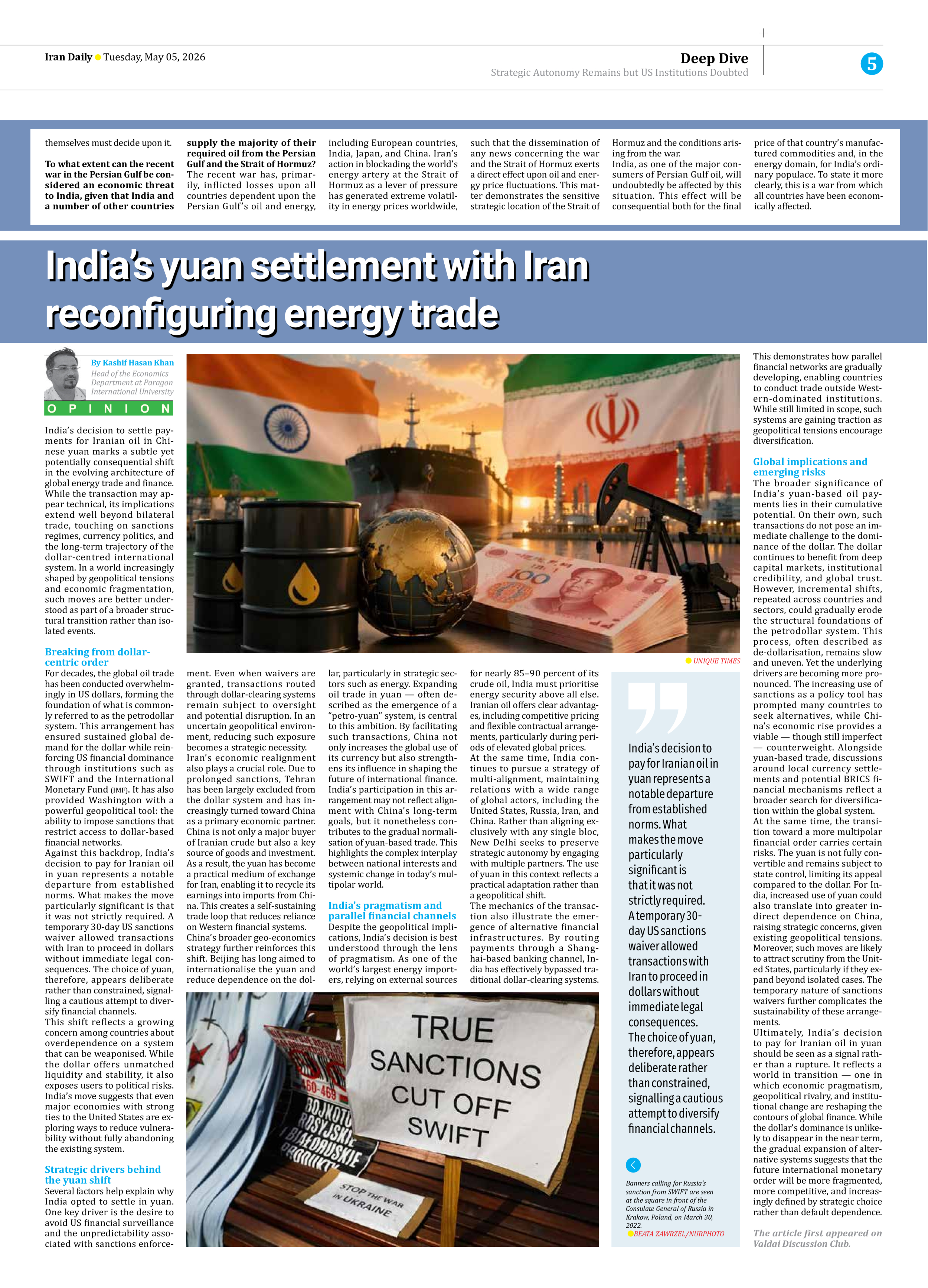
Against this backdrop, India’s decision to pay for Iranian oil in yuan represents a notable departure from established norms. What makes the move particularly significant is that it was not strictly required. A temporary 30-day US sanctions waiver allowed transactions with Iran to proceed in dollars without immediate legal consequences. The choice of yuan, therefore, appears deliberate rather than constrained, signalling a cautious attempt to diversify financial channels.
This shift reflects a growing concern among countries about overdependence on a system that can be weaponised. While the dollar offers unmatched liquidity and stability, it also exposes users to political risks. India’s move suggests that even major economies with strong ties to the United States are exploring ways to reduce vulnerability without fully abandoning the existing system.
Strategic drivers behind the yuan shift
Several factors help explain why India opted to settle in yuan. One key driver is the desire to avoid US financial surveillance and the unpredictability associated with sanctions enforcement. Even when waivers are granted, transactions routed through dollar-clearing systems remain subject to oversight and potential disruption. In an uncertain geopolitical environment, reducing such exposure becomes a strategic necessity.
Iran’s economic realignment also plays a crucial role. Due to prolonged sanctions, Tehran has been largely excluded from the dollar system and has increasingly turned toward China as a primary economic partner. China is not only a major buyer of Iranian crude but also a key source of goods and investment. As a result, the yuan has become a practical medium of exchange for Iran, enabling it to recycle its earnings into imports from China. This creates a self-sustaining trade loop that reduces reliance on Western financial systems.
China’s broader geo-economics strategy further reinforces this shift. Beijing has long aimed to internationalise the yuan and reduce dependence on the dollar, particularly in strategic sectors such as energy. Expanding oil trade in yuan — often described as the emergence of a “petro-yuan” system, is central to this ambition. By facilitating such transactions, China not only increases the global use of its currency but also strengthens its influence in shaping the future of international finance. India’s participation in this arrangement may not reflect alignment with China’s long-term goals, but it nonetheless contributes to the gradual normalisation of yuan-based trade. This highlights the complex interplay between national interests and systemic change in today’s multipolar world.
India’s pragmatism and parallel financial channels
Despite the geopolitical implications, India’s decision is best understood through the lens of pragmatism. As one of the world’s largest energy importers, relying on external sources for nearly 85–90 percent of its crude oil, India must prioritise energy security above all else. Iranian oil offers clear advantages, including competitive pricing and flexible contractual arrangements, particularly during periods of elevated global prices.
At the same time, India continues to pursue a strategy of multi-alignment, maintaining relations with a wide range of global actors, including the United States, Russia, Iran, and China. Rather than aligning exclusively with any single bloc, New Delhi seeks to preserve strategic autonomy by engaging with multiple partners. The use of yuan in this context reflects a practical adaptation rather than a geopolitical shift.
The mechanics of the transaction also illustrate the emergence of alternative financial infrastructures. By routing payments through a Shanghai-based banking channel, India has effectively bypassed traditional dollar-clearing systems. This demonstrates how parallel financial networks are gradually developing, enabling countries to conduct trade outside Western-dominated institutions. While still limited in scope, such systems are gaining traction as geopolitical tensions encourage diversification.
Global implications and emerging risks
The broader significance of India’s yuan-based oil payments lies in their cumulative potential. On their own, such transactions do not pose an immediate challenge to the dominance of the dollar. The dollar continues to benefit from deep capital markets, institutional credibility, and global trust. However, incremental shifts, repeated across countries and sectors, could gradually erode the structural foundations of the petrodollar system. This process, often described as de-dollarisation, remains slow and uneven. Yet the underlying drivers are becoming more pronounced. The increasing use of sanctions as a policy tool has prompted many countries to seek alternatives, while China’s economic rise provides a viable — though still imperfect — counterweight. Alongside yuan-based trade, discussions around local currency settlements and potential BRICS financial mechanisms reflect a broader search for diversification within the global system.
At the same time, the transition toward a more multipolar financial order carries certain risks. The yuan is not fully convertible and remains subject to state control, limiting its appeal compared to the dollar. For India, increased use of yuan could also translate into greater indirect dependence on China, raising strategic concerns, given existing geopolitical tensions. Moreover, such moves are likely to attract scrutiny from the United States, particularly if they expand beyond isolated cases. The temporary nature of sanctions waivers further complicates the sustainability of these arrangements.
Ultimately, India’s decision to pay for Iranian oil in yuan should be seen as a signal rather than a rupture. It reflects a world in transition — one in which economic pragmatism, geopolitical rivalry, and institutional change are reshaping the contours of global finance. While the dollar’s dominance is unlikely to disappear in the near term, the gradual expansion of alternative systems suggests that the future international monetary order will be more fragmented, more competitive, and increasingly defined by strategic choice rather than default dependence.
The article first appeared on Valdai Discussion Club.