







India refuses to ‘miss out’ on strategic port of Chabahar: Businessman
With the intensification of regional tensions and the disruption of main maritime arteries, Iran’s commercial exchanges with several of its key partners have entered a novel phase. In this context, economic relations with India have, more than ever before, been impacted by wartime conditions, maritime restrictions, and developments at critical chokepoints such as the Strait of Hormuz; a passage that plays a pivotal role in energy transmission and global commerce. Adjacent to these developments, the significance of alternative harbors and novel routes has become increasingly pronounced, particularly the Port of Chabahar, which, as one of the strategic alternatives for the continuation of Iranian-Indian exchanges, is proposed and can compensate for a portion of the limitations arising from wartime conditions. Within such an atmosphere, an examination of the status of the two countries’ commercial relations before and after the war, as well as the role of alternative routes in preserving the flow of commerce, can provide a clearer picture of the prospects of Iranian-Indian economic cooperation. In the forthcoming interview with “Mahdi Rangrona,” vice president of the Iran-India Joint Chamber of Commerce, the status of Iranian-Indian exchanges and its modalities, the rerouting of commercial pathways, and the role of political and sanctions-related factors therein are examined.
By Sadeq Dehqan
Staff writer
IRAN DAILY: What is the status of Iran-India commercial relations during the pre-war period and the war itself?
RANGRONA: Prior to the commencement of the Ramadan War, the majority of commercial transactions between Iran and India were conducted through third countries, owing to sanctions and India’s conservative approach, which stems from that country’s extensive commercial ties with the United States. This conservatism was also manifest among Indian traders. With the exception of sanction-exempt items such as pharmaceutical and food products, other commodities were definitely moved via intermediary nations, including financial intermediaries, as well as the documentary and commercial mechanisms of other countries.
During the recent war, the difficulties generated along the maritime route for vessels resulted in a cessation of maritime transit. Consequently, Bandar Abbas, Iran’s principal commercial nexus, suffered disruption. This situation adversely impacted even that meager volume of commercial dealings with India and, specifically, caused a severe reduction of exchanges.
However, in the middle of the war and after the blockade of the Strait of Hormuz, the United States of America applied certain sanctions exemptions to control oil prices. India, too, was included in these exemptions in the domain of oil and gas condensate purchases. Subsequently, India was able to benefit from this exemption and, after years, made direct oil purchases from Iran.
Does India’s oil exemption remain active? If so, is it still practically relevant now that the US naval blockade has commenced?
According to certain reports, the Indian government is endeavoring to convince the United States to extend the oil exemption for one additional month, and rumors are that this exemption will probably be extended. However, it appears that this exemption is applicable mostly to oil tankers that were already present in the waters prior and are navigating outside the framework of the naval blockade.
How were commodity exchanges between Iran and India before the war and under sanctions conditions, and through what mechanism did these exchanges occur?
As I indicated, prior to the war and the formation of the naval blockade, Iran-India commerce was extremely limited due to sanctions and India’s conservative approach. This conservatism definitely exerted an influence upon economic relations between India and Iran. As was noted, the majority of commerce between the two countries was directed toward sanction-exempt commodities such as foodstuffs and pharmaceuticals. However, a portion of commodities outside the purview of sanctions were exchanged via the rupee payment arrangement mechanism. Another portion of commerce between the traders of the two countries takes place as barter and commodity-swapping fashion. For example, due to the difficulties existing in monetary transfers, an Iranian exporter sends agricultural products to India and, in return, imports commodities such as rice and tea from India.
After the war, did the non-oil commodity sector of commerce between the two countries cease?
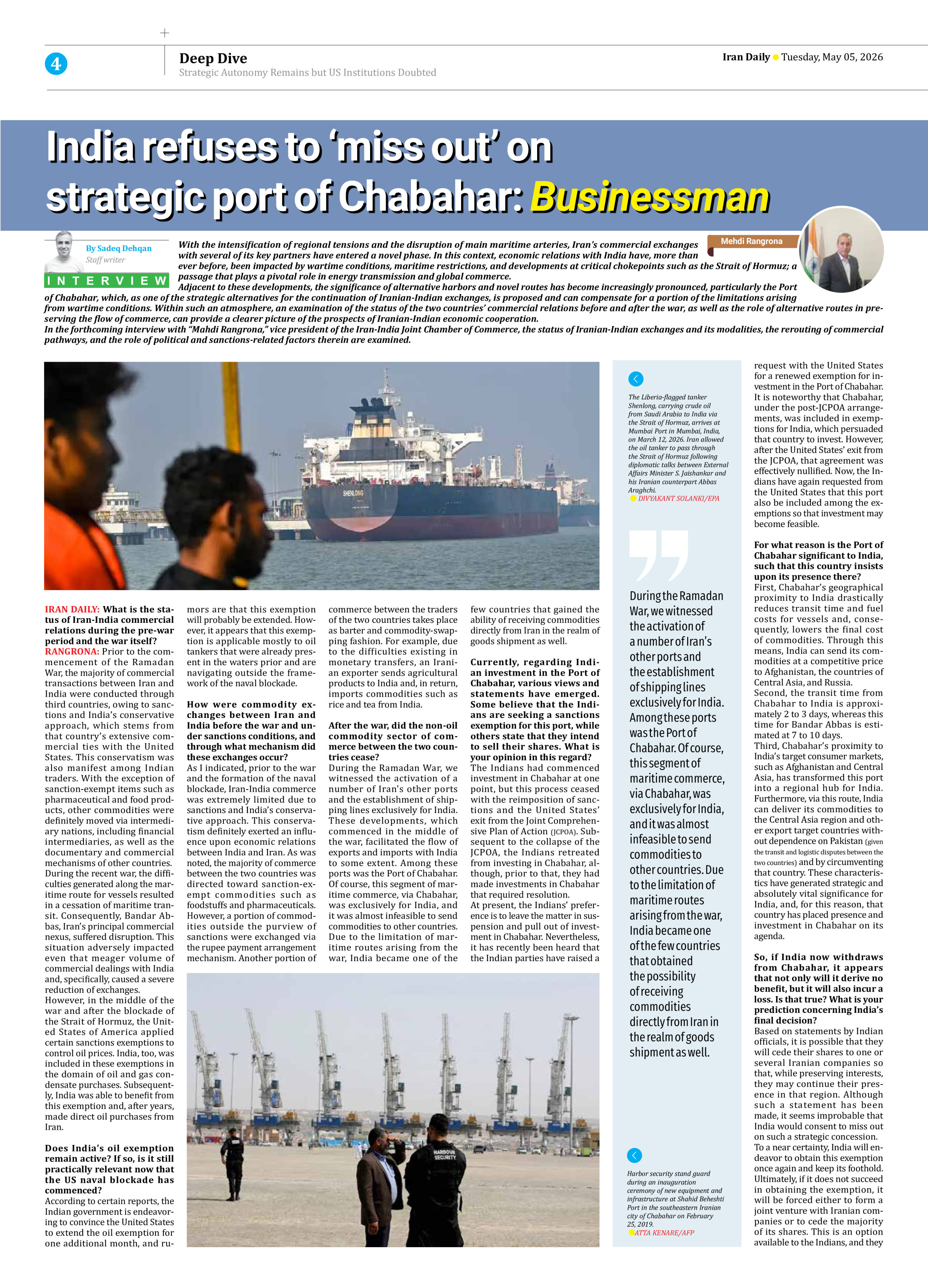
During the Ramadan War, we witnessed the activation of a number of Iran’s other ports and the establishment of shipping lines exclusively for India. These developments, which commenced in the middle of the war, facilitated the flow of exports and imports with India to some extent. Among these ports was the Port of Chabahar. Of course, this segment of maritime commerce, via Chabahar, was exclusively for India, and it was almost infeasible to send commodities to other countries. Due to the limitation of maritime routes arising from the war, India became one of the few countries that gained the ability of receiving commodities directly from Iran in the realm of goods shipment as well.
Currently, regarding Indian investment in the Port of Chabahar, various views and statements have emerged. Some believe that the Indians are seeking a sanctions exemption for this port, while others state that they intend to sell their shares. What is your opinion in this regard?
The Indians had commenced investment in Chabahar at one point, but this process ceased with the reimposition of sanctions and the United States’ exit from the Joint Comprehensive Plan of Action (JCPOA). Subsequent to the collapse of the JCPOA, the Indians retreated from investing in Chabahar, although, prior to that, they had made investments in Chabahar that required resolution.
At present, the Indians’ preference is to leave the matter in suspension and pull out of investment in Chabahar. Nevertheless, it has recently been heard that the Indian parties have raised a request with the United States for a renewed exemption for investment in the Port of Chabahar. It is noteworthy that Chabahar, under the post-JCPOA arrangements, was included in exemptions for India, which persuaded that country to invest. However, after the United States’ exit from the JCPOA, that agreement was effectively nullified. Now, the Indians have again requested from the United States that this port also be included among the exemptions so that investment may become feasible.
For what reason is the Port of Chabahar significant to India, such that this country insists upon its presence there?
First, Chabahar’s geographical proximity to India drastically reduces transit time and fuel costs for vessels and, consequently, lowers the final cost of commodities. Through this means, India can send its commodities at a competitive price to Afghanistan, the countries of Central Asia, and Russia.
Second, the transit time from Chabahar to India is approximately 2 to 3 days, whereas this time for Bandar Abbas is estimated at 7 to 10 days.
Third, Chabahar’s proximity to India’s target consumer markets, such as Afghanistan and Central Asia, has transformed this port into a regional hub for India. Furthermore, via this route, India can deliver its commodities to the Central Asia region and other export target countries without dependence on Pakistan (given the transit and logistic disputes between the two countries) and by circumventing that country. These characteristics have generated strategic and absolutely vital significance for India, and, for this reason, that country has placed presence and investment in Chabahar on its agenda.
So, if India now withdraws from Chabahar, it appears that not only will it derive no benefit, but it will also incur a loss. Is that true? What is your prediction concerning India’s final decision?
Based on statements by Indian officials, it is possible that they will cede their shares to one or several Iranian companies so that, while preserving interests, they may continue their presence in that region. Although such a statement has been made, it seems improbable that India would consent to miss out on such a strategic concession.
To a near certainty, India will endeavor to obtain this exemption once again and keep its foothold. Ultimately, if it does not succeed in obtaining the exemption, it will be forced either to form a joint venture with Iranian companies or to cede the majority of its shares. This is an option available to the Indians, and they themselves must decide upon it.
To what extent can the recent war in the Persian Gulf be considered an economic threat to India, given that India and a number of other countries supply the majority of their required oil from the Persian Gulf and the Strait of Hormuz?
The recent war has, primarily, inflicted losses upon all countries dependent upon the Persian Gulf’s oil and energy, including European countries, India, Japan, and China. Iran’s action in blockading the world’s energy artery at the Strait of Hormuz as a lever of pressure has generated extreme volatility in energy prices worldwide, such that the dissemination of any news concerning the war and the Strait of Hormuz exerts a direct effect upon oil and energy price fluctuations. This matter demonstrates the sensitive strategic location of the Strait of Hormuz and the conditions arising from the war.
India, as one of the major consumers of Persian Gulf oil, will undoubtedly be affected by this situation. This effect will be consequential both for the final price of that country’s manufactured commodities and, in the energy domain, for India’s ordinary populace. To state it more clearly, this is a war from which all countries have been economically affected.