





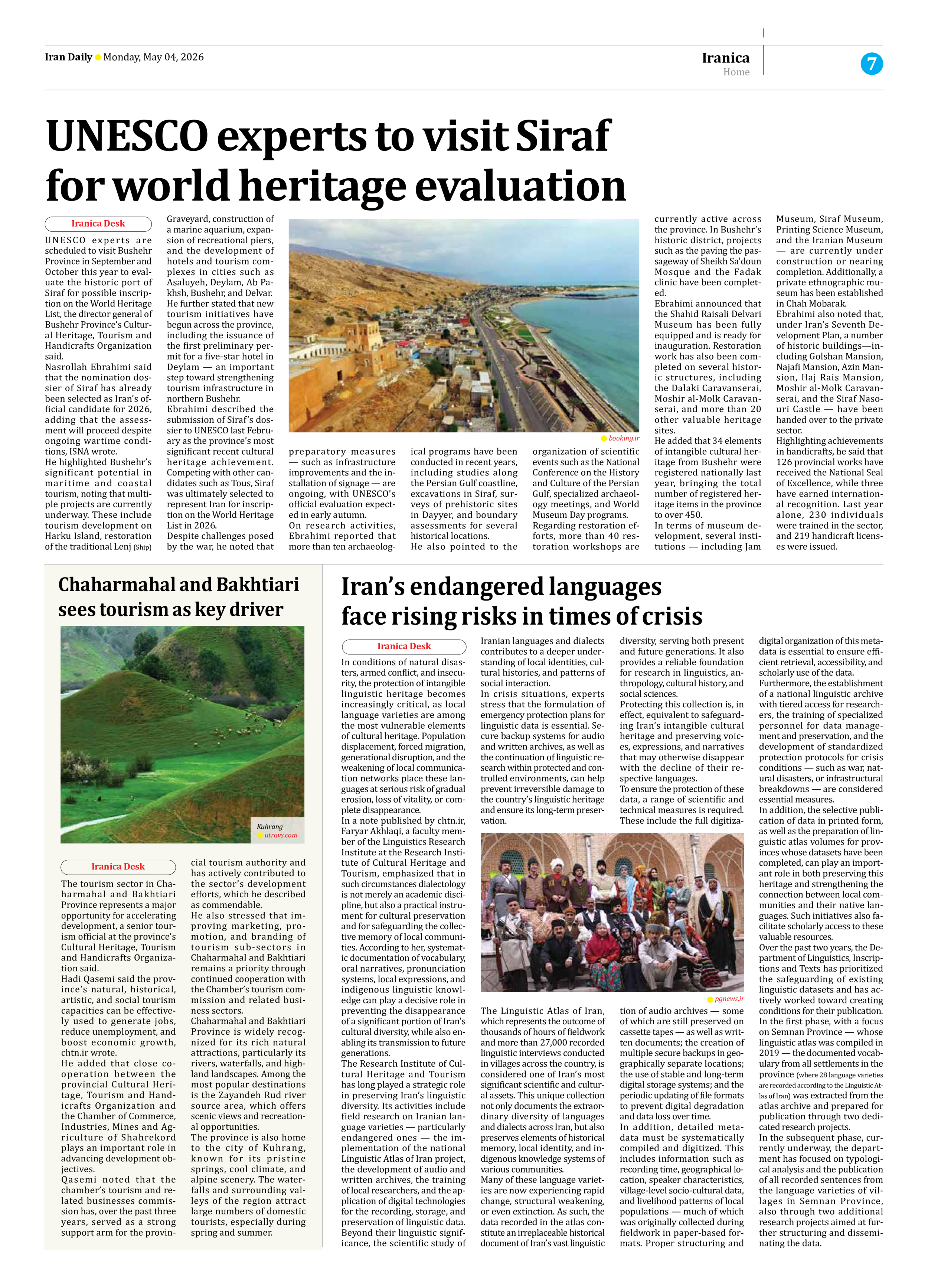


Iran’s endangered languages face rising risks in times of crisis
In conditions of natural disasters, armed conflict, and insecurity, the protection of intangible linguistic heritage becomes increasingly critical, as local language varieties are among the most vulnerable elements of cultural heritage. Population displacement, forced migration, generational disruption, and the weakening of local communication networks place these languages at serious risk of gradual erosion, loss of vitality, or complete disappearance.
In a note published by chtn.ir, Faryar Akhlaqi, a faculty member of the Linguistics Research Institute at the Research Institute of Cultural Heritage and Tourism, emphasized that in such circumstances dialectology is not merely an academic discipline, but also a practical instrument for cultural preservation and for safeguarding the collective memory of local communities. According to her, systematic documentation of vocabulary, oral narratives, pronunciation systems, local expressions, and indigenous linguistic knowledge can play a decisive role in preventing the disappearance of a significant portion of Iran’s cultural diversity, while also enabling its transmission to future generations.
The Research Institute of Cultural Heritage and Tourism has long played a strategic role in preserving Iran’s linguistic diversity. Its activities include field research on Iranian language varieties — particularly endangered ones — the implementation of the national Linguistic Atlas of Iran project, the development of audio and written archives, the training of local researchers, and the application of digital technologies for the recording, storage, and preservation of linguistic data. Beyond their linguistic significance, the scientific study of Iranian languages and dialects contributes to a deeper understanding of local identities, cultural histories, and patterns of social interaction.
In crisis situations, experts stress that the formulation of emergency protection plans for linguistic data is essential. Secure backup systems for audio and written archives, as well as the continuation of linguistic research within protected and controlled environments, can help prevent irreversible damage to the country’s linguistic heritage and ensure its long-term preservation.
The Linguistic Atlas of Iran, which represents the outcome of thousands of hours of fieldwork and more than 27,000 recorded linguistic interviews conducted in villages across the country, is considered one of Iran’s most significant scientific and cultural assets. This unique collection not only documents the extraordinary diversity of languages and dialects across Iran, but also preserves elements of historical memory, local identity, and indigenous knowledge systems of various communities.
Many of these language varieties are now experiencing rapid change, structural weakening, or even extinction. As such, the data recorded in the atlas constitute an irreplaceable historical document of Iran’s vast linguistic diversity, serving both present and future generations. It also provides a reliable foundation for research in linguistics, anthropology, cultural history, and social sciences.
Protecting this collection is, in effect, equivalent to safeguarding Iran’s intangible cultural heritage and preserving voices, expressions, and narratives that may otherwise disappear with the decline of their respective languages.
To ensure the protection of these data, a range of scientific and technical measures is required. These include the full digitization of audio archives — some of which are still preserved on cassette tapes — as well as written documents; the creation of multiple secure backups in geographically separate locations; the use of stable and long-term digital storage systems; and the periodic updating of file formats to prevent digital degradation and data loss over time.
In addition, detailed metadata must be systematically compiled and digitized. This includes information such as recording time, geographical location, speaker characteristics, village-level socio-cultural data, and livelihood patterns of local populations — much of which was originally collected during fieldwork in paper-based formats. Proper structuring and digital organization of this metadata is essential to ensure efficient retrieval, accessibility, and scholarly use of the data.
Furthermore, the establishment of a national linguistic archive with tiered access for researchers, the training of specialized personnel for data management and preservation, and the development of standardized protection protocols for crisis conditions — such as war, natural disasters, or infrastructural breakdowns — are considered essential measures.
In addition, the selective publication of data in printed form, as well as the preparation of linguistic atlas volumes for provinces whose datasets have been completed, can play an important role in both preserving this heritage and strengthening the connection between local communities and their native languages. Such initiatives also facilitate scholarly access to these valuable resources.
Over the past two years, the Department of Linguistics, Inscriptions and Texts has prioritized the safeguarding of existing linguistic datasets and has actively worked toward creating conditions for their publication. In the first phase, with a focus on Semnan Province — whose linguistic atlas was compiled in 2019 — the documented vocabulary from all settlements in the province (where 28 language varieties are recorded according to the Linguistic Atlas of Iran) was extracted from the atlas archive and prepared for publication through two dedicated research projects.
In the subsequent phase, currently underway, the department has focused on typological analysis and the publication of all recorded sentences from the language varieties of villages in Semnan Province, also through two additional research projects aimed at further structuring and disseminating the data.