





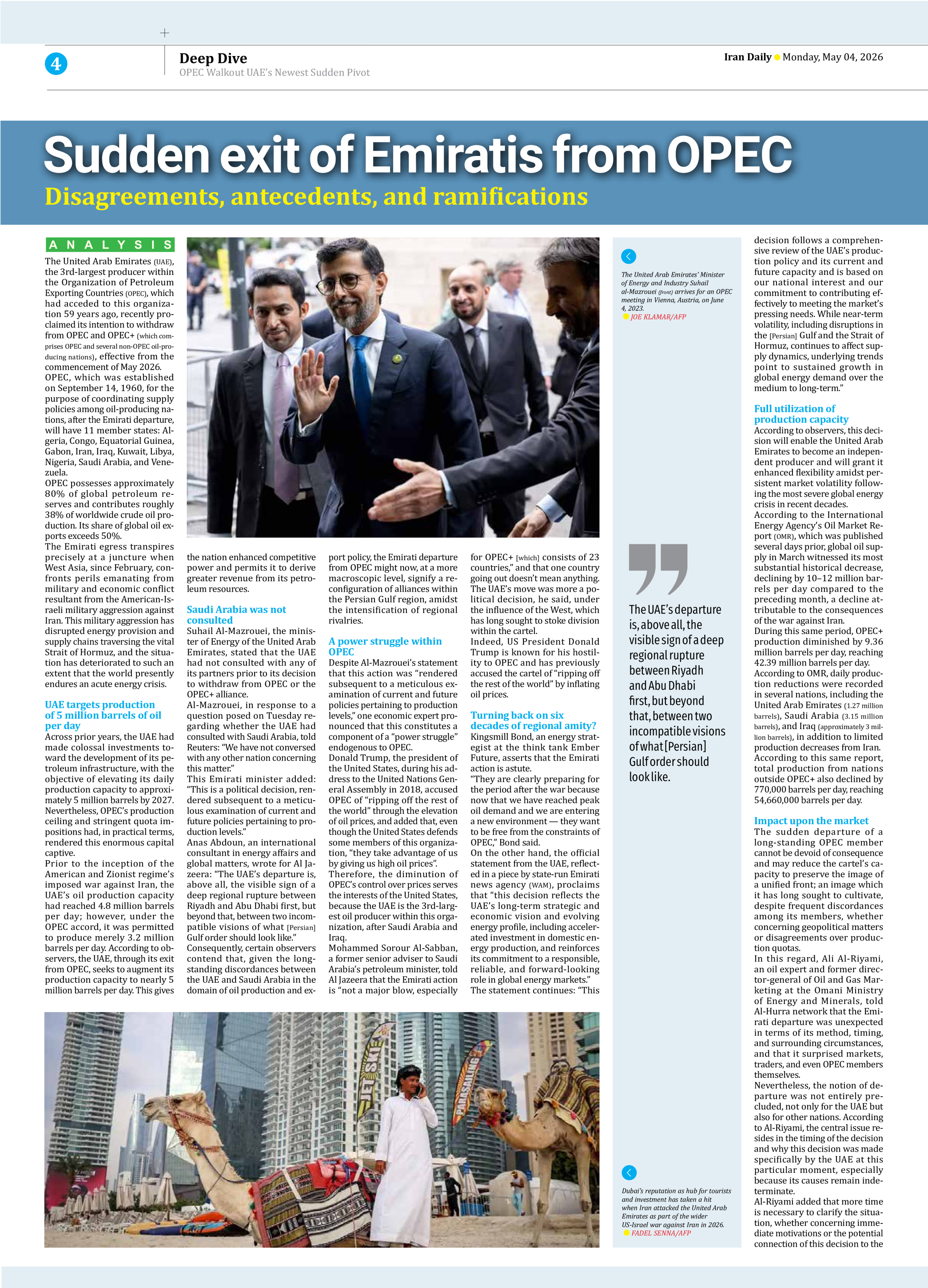


Sudden exit of Emiratis from OPEC
Disagreements, antecedents, and ramifications
The United Arab Emirates (UAE), the 3rd-largest producer within the Organization of Petroleum Exporting Countries (OPEC), which had acceded to this organization 59 years ago, recently proclaimed its intention to withdraw from OPEC and OPEC+ (which comprises OPEC and several non-OPEC oil-producing nations), effective from the commencement of May 2026.
OPEC, which was established on September 14, 1960, for the purpose of coordinating supply policies among oil-producing nations, after the Emirati departure, will have 11 member states: Algeria, Congo, Equatorial Guinea, Gabon, Iran, Iraq, Kuwait, Libya, Nigeria, Saudi Arabia, and Venezuela.
OPEC possesses approximately 80% of global petroleum reserves and contributes roughly 38% of worldwide crude oil production. Its share of global oil exports exceeds 50%.
The Emirati egress transpires precisely at a juncture when West Asia, since February, confronts perils emanating from military and economic conflict resultant from the American-Israeli military aggression against Iran. This military aggression has disrupted energy provision and supply chains traversing the vital Strait of Hormuz, and the situation has deteriorated to such an extent that the world presently endures an acute energy crisis.
UAE targets production
of 5 million barrels of oil per day
Across prior years, the UAE had made colossal investments toward the development of its petroleum infrastructure, with the objective of elevating its daily production capacity to approximately 5 million barrels by 2027. Nevertheless, OPEC’s production ceiling and stringent quota impositions had, in practical terms, rendered this enormous capital captive.
Prior to the inception of the American and Zionist regime’s imposed war against Iran, the UAE’s oil production capacity had reached 4.8 million barrels per day; however, under the OPEC accord, it was permitted to produce merely 3.2 million barrels per day. According to observers, the UAE, through its exit from OPEC, seeks to augment its production capacity to nearly 5 million barrels per day. This gives the nation enhanced competitive power and permits it to derive greater revenue from its petroleum resources.
Saudi Arabia was not consulted
Suhail Al-Mazrouei, the minister of Energy of the United Arab Emirates, stated that the UAE had not consulted with any of its partners prior to its decision to withdraw from OPEC or the OPEC+ alliance.
Al-Mazrouei, in response to a question posed on Tuesday regarding whether the UAE had consulted with Saudi Arabia, told Reuters: “We have not conversed with any other nation concerning this matter.”
This Emirati minister added: “This is a political decision, rendered subsequent to a meticulous examination of current and future policies pertaining to production levels.”
Anas Abdoun, an international consultant in energy affairs and global matters, wrote for Al Jazeera: “The UAE’s departure is, above all, the visible sign of a deep regional rupture between Riyadh and Abu Dhabi first, but beyond that, between two incompatible visions of what [Persian] Gulf order should look like.”
Consequently, certain observers contend that, given the longstanding discordances between the UAE and Saudi Arabia in the domain of oil production and export policy, the Emirati departure from OPEC might now, at a more macroscopic level, signify a reconfiguration of alliances within the Persian Gulf region, amidst the intensification of regional rivalries.
A power struggle within OPEC
Despite Al-Mazrouei’s statement that this action was “rendered subsequent to a meticulous examination of current and future policies pertaining to production levels,” one economic expert pronounced that this constitutes a component of a “power struggle” endogenous to OPEC.
Donald Trump, the president of the United States, during his address to the United Nations General Assembly in 2018, accused OPEC of “ripping off the rest of the world” through the elevation of oil prices, and added that, even though the United States defends some members of this organization, “they take advantage of us by giving us high oil prices”.
Therefore, the diminution of OPEC’s control over prices serves the interests of the United States, because the UAE is the 3rd-largest oil producer within this organization, after Saudi Arabia and Iraq.
Mohammed Sorour Al-Sabban, a former senior adviser to Saudi Arabia’s petroleum minister, told Al Jazeera that the Emirati action is “not a major blow, especially for OPEC+ [which] consists of 23 countries,” and that one country going out doesn’t mean anything.
The UAE’s move was more a political decision, he said, under the influence of the West, which has long sought to stoke division within the cartel.
Indeed, US President Donald Trump is known for his hostility to OPEC and has previously accused the cartel of “ripping off the rest of the world” by inflating oil prices.
Turning back on six decades of regional amity?
Kingsmill Bond, an energy strategist at the think tank Ember Future, asserts that the Emirati action is astute.
“They are clearly preparing for the period after the war because now that we have reached peak oil demand and we are entering a new environment — they want to be free from the constraints of OPEC,” Bond said.
On the other hand, the official statement from the UAE, reflected in a piece by state-run Emirati news agency (WAM), proclaims that “this decision reflects the UAE’s long-term strategic and economic vision and evolving energy profile, including accelerated investment in domestic energy production, and reinforces its commitment to a responsible, reliable, and forward-looking role in global energy markets.”
The statement continues: “This decision follows a comprehensive review of the UAE’s production policy and its current and future capacity and is based on our national interest and our commitment to contributing effectively to meeting the market’s pressing needs. While near-term volatility, including disruptions in the [Persian] Gulf and the Strait of Hormuz, continues to affect supply dynamics, underlying trends point to sustained growth in global energy demand over the medium to long-term.”
Full utilization of production capacity
According to observers, this decision will enable the United Arab Emirates to become an independent producer and will grant it enhanced flexibility amidst persistent market volatility following the most severe global energy crisis in recent decades.
According to the International Energy Agency’s Oil Market Report (OMR), which was published several days prior, global oil supply in March witnessed its most substantial historical decrease, declining by 10–12 million barrels per day compared to the preceding month, a decline attributable to the consequences of the war against Iran.
During this same period, OPEC+ production diminished by 9.36 million barrels per day, reaching 42.39 million barrels per day.
According to OMR, daily production reductions were recorded in several nations, including the United Arab Emirates (1.27 million barrels), Saudi Arabia (3.15 million barrels), and Iraq (approximately 3 million barrels), in addition to limited production decreases from Iran.
According to this same report, total production from nations outside OPEC+ also declined by 770,000 barrels per day, reaching 54,660,000 barrels per day.
Impact upon the market
The sudden departure of a long-standing OPEC member cannot be devoid of consequence and may reduce the cartel’s capacity to preserve the image of a unified front; an image which it has long sought to cultivate, despite frequent discordances among its members, whether concerning geopolitical matters or disagreements over production quotas.
In this regard, Ali Al-Riyami, an oil expert and former director-general of Oil and Gas Marketing at the Omani Ministry of Energy and Minerals, told Al-Hurra network that the Emirati departure was unexpected in terms of its method, timing, and surrounding circumstances, and that it surprised markets, traders, and even OPEC members themselves.
Nevertheless, the notion of departure was not entirely precluded, not only for the UAE but also for other nations. According to Al-Riyami, the central issue resides in the timing of the decision and why this decision was made specifically by the UAE at this particular moment, especially because its causes remain indeterminate.
Al-Riyami added that more time is necessary to clarify the situation, whether concerning immediate motivations or the potential connection of this decision to the political conditions of the Persian Gulf region. Regarding market reaction, he stated that oil prices have experienced a modest increase, between 2.5% and 3%, and that this effect is projected to be short-term, whereas the long-term effect may diverge after the repercussions of the war subside.
The truth is that the Emirati departure from OPEC liberates it from the quota system and bestows upon it enhanced flexibility in production and exportation. According to Al-Riyami, this factor may constitute one of the motivations for this decision, particularly given Abu Dhabi’s previous challenges concerning production quotas, including its requests for baseline modification and subsequent arrangements and exemptions.
Al-Riyami posits that the short-term impact may be limited, and that minor price fluctuations are possible, whereas the long-term effect could be relatively negative, especially given the persistence of competition in global markets. He explains that the Emirati departure does not necessarily signify an immediate intensification of competition because this competition already existed and will persist as long as oil production continues.
Regarding OPEC, he states that this organization will be affected by the Emirati departure, given the weight and influential role of the UAE in meetings, and that the departure will create a vacuum in the short term, particularly because other nations, including Qatar and Indonesia, have previously withdrawn from this coalition.
Potential ramifications
Sherif Othman, an Arab economist, regarding the consequences of this decision upon prices, considered the current impact upon oil prices to be insignificant and noted that there exists no direct correlation between this decision and crude oil pricing.
Othman added that oil prices are currently fluctuating in accordance with broader medium-term developments, such as sanctions, prohibitions, and ongoing negotiations between Iran and the United States, with the objective of achieving an accord or reducing tensions.
At the same time, he argued that this decision will possess a long-term effect, particularly upon the Persian Gulf region’s control over international oil prices and its ability to influence them.
Regarding OPEC’s capabilities and capacities, he stated that the organization’s power will diminish, following the previous departure of Qatar (in 2019) and now the Emirati departure, particularly concerning its ability to influence crude oil prices, which constitutes a considerable blow to this organization.
Nevertheless, the WAM news agency reported that the United Arab Emirates, after its departure from OPEC, will continue its “responsible” role through a gradual and precise increase in production, consistent with demand and market conditions.
A test of cohesion or further political schism?
Amer Al-Shobaki, an energy affairs expert, in an interview with Al Jazeera network, stated that recent events should not be interpreted solely as a nation’s departure from an oil organization but should, rather, be interpreted as a shift toward a more profound conflict within the oil system concerning who will possess the right to lead the oil market in the forthcoming phase.
According to Al-Shobaki, the Emirati departure does not signify the immediate collapse of OPEC or OPEC+, but it does strike one of the organization’s most crucial assets, namely, its image of cohesion and collective discipline.
From this economic expert’s perspective, the peril of this decision resides in the fact that it was issued by a central Persian Gulf nation possessing high production capacity and aspiring to development, rather than by a small producer with limited influence.
Al-Shobaki also stated that quotas within OPEC+ have constrained the United Arab Emirates’ ability to convert its massive investments in production capacity into actual production and direct returns. Therefore, he posits that this decision represents a political and petroleum-related schism within the community of producers and could establish a precedent that encourages other producers to demand renegotiation or even to rebel against the quota system.
The article first appeared in
Persian on IRNA.