







Reasons for Europe’s abstention from participation in war against Iran
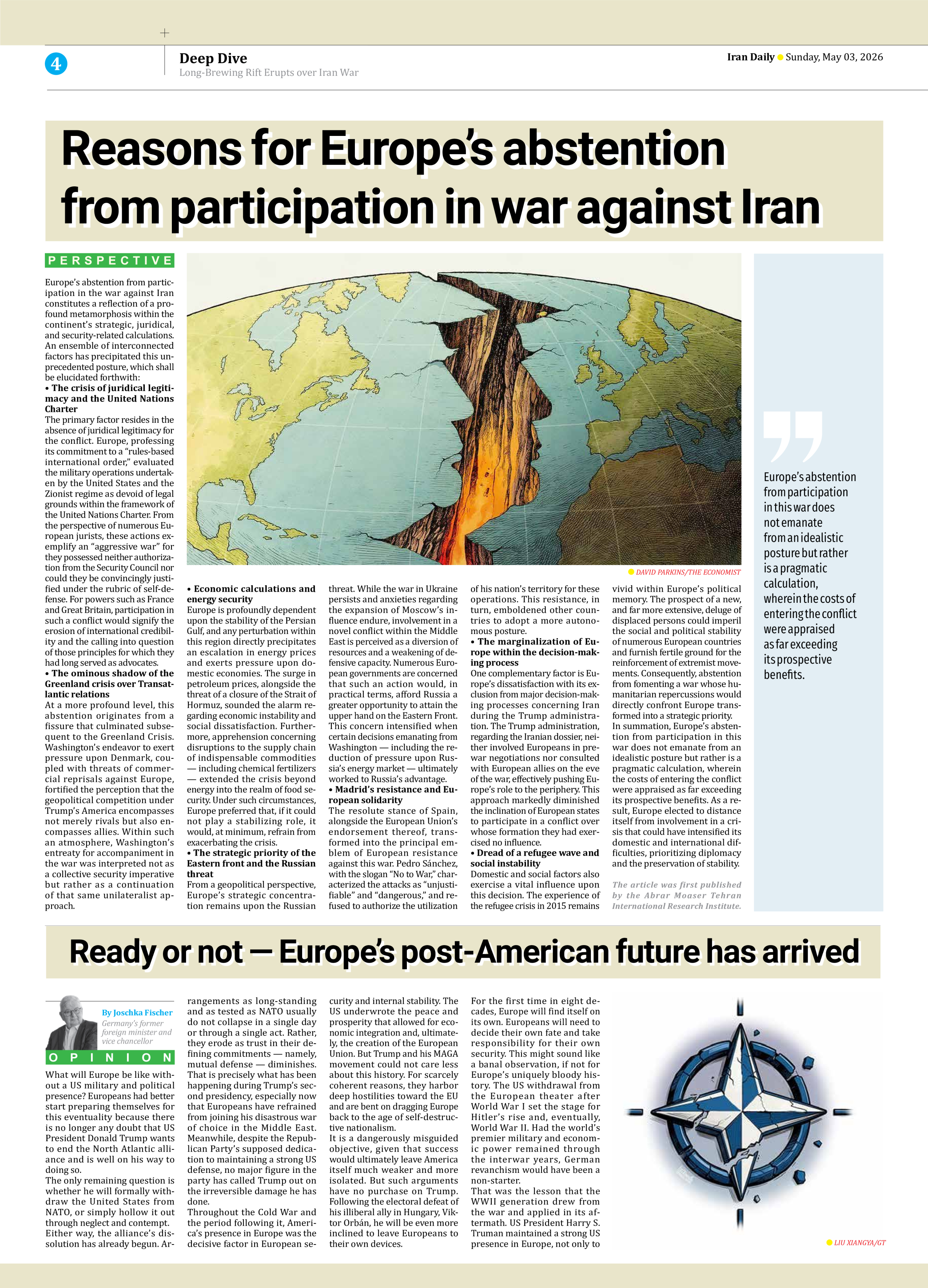
Europe’s abstention from participation in the war against Iran constitutes a reflection of a profound metamorphosis within the continent’s strategic, juridical, and security-related calculations. An ensemble of interconnected factors has precipitated this unprecedented posture, which shall be elucidated forthwith:
• The crisis of juridical legitimacy and the United Nations Charter
The primary factor resides in the absence of juridical legitimacy for the conflict. Europe, professing its commitment to a “rules-based international order,” evaluated the military operations undertaken by the United States and the Zionist regime as devoid of legal grounds within the framework of the United Nations Charter. From the perspective of numerous European jurists, these actions exemplify an “aggressive war” for they possessed neither authorization from the Security Council nor could they be convincingly justified under the rubric of self-defense. For powers such as France and Great Britain, participation in such a conflict would signify the erosion of international credibility and the calling into question of those principles for which they had long served as advocates.
• The ominous shadow of the Greenland crisis over Transatlantic relations
At a more profound level, this abstention originates from a fissure that culminated subsequent to the Greenland Crisis. Washington’s endeavor to exert pressure upon Denmark, coupled with threats of commercial reprisals against Europe, fortified the perception that the geopolitical competition under Trump’s America encompasses not merely rivals but also encompasses allies. Within such an atmosphere, Washington’s entreaty for accompaniment in the war was interpreted not as a collective security imperative but rather as a continuation of that same unilateralist approach.
• Economic calculations and energy security
Europe is profoundly dependent upon the stability of the Persian Gulf, and any perturbation within this region directly precipitates an escalation in energy prices and exerts pressure upon domestic economies. The surge in petroleum prices, alongside the threat of a closure of the Strait of Hormuz, sounded the alarm regarding economic instability and social dissatisfaction. Furthermore, apprehension concerning disruptions to the supply chain of indispensable commodities — including chemical fertilizers — extended the crisis beyond energy into the realm of food security. Under such circumstances, Europe preferred that, if it could not play a stabilizing role, it would, at minimum, refrain from exacerbating the crisis.
• The strategic priority of the Eastern front and the Russian threat
From a geopolitical perspective, Europe’s strategic concentration remains upon the Russian threat. While the war in Ukraine persists and anxieties regarding the expansion of Moscow’s influence endure, involvement in a novel conflict within the Middle East is perceived as a diversion of resources and a weakening of defensive capacity. Numerous European governments are concerned that such an action would, in practical terms, afford Russia a greater opportunity to attain the upper hand on the Eastern Front. This concern intensified when certain decisions emanating from Washington — including the reduction of pressure upon Russia’s energy market — ultimately worked to Russia’s advantage.
• Madrid’s resistance and European solidarity
The resolute stance of Spain, alongside the European Union’s endorsement thereof, transformed into the principal emblem of European resistance against this war. Pedro Sánchez, with the slogan “No to War,” characterized the attacks as “unjustifiable” and “dangerous,” and refused to authorize the utilization of his nation’s territory for these operations. This resistance, in turn, emboldened other countries to adopt a more autonomous posture.
• The marginalization of Europe within the decision-making process
One complementary factor is Europe’s dissatisfaction with its exclusion from major decision-making processes concerning Iran during the Trump administration. The Trump administration, regarding the Iranian dossier, neither involved Europeans in pre-war negotiations nor consulted with European allies on the eve of the war, effectively pushing Europe’s role to the periphery. This approach markedly diminished the inclination of European states to participate in a conflict over whose formation they had exercised no influence.
• Dread of a refugee wave and social instability
Domestic and social factors also exercise a vital influence upon this decision. The experience of the refugee crisis in 2015 remains vivid within Europe’s political memory. The prospect of a new, and far more extensive, deluge of displaced persons could imperil the social and political stability of numerous European countries and furnish fertile ground for the reinforcement of extremist movements. Consequently, abstention from fomenting a war whose humanitarian repercussions would directly confront Europe transformed into a strategic priority.
In summation, Europe’s abstention from participation in this war does not emanate from an idealistic posture but rather is a pragmatic calculation, wherein the costs of entering the conflict were appraised as far exceeding its prospective benefits. As a result, Europe elected to distance itself from involvement in a crisis that could have intensified its domestic and international difficulties, prioritizing diplomacy and the preservation of stability.
The article was first published by the Abrar Moaser Tehran
International Research Institute.