







Role of Iran’s land borders in nullifying maritime blockades
These days, the presence of United States naval warships in the vicinity of the Sea of Oman, along with the imposition of a maritime blockade against Iran, is an endeavor to restrict Iran’s access to global trade routes and to engender disruptions in supply chains, particularly within the sphere of oil sales revenues; a stratagem that seeks to amplify economic pressure on the country. In recent years, concurrently with the intensification of geopolitical transformations and the escalation of tensions within strategic waterways, the concept of a “maritime blockade” has once again metamorphosed into one of the paramount instruments within international equations. Experiences such as the United States’ action in imposing restrictions upon the oil exports of certain nations indicate that such policies may, in the short term, exert an influence upon the flow of commerce and energy exports. Nevertheless, the fundamental inquiry is whether Iran, endowed with a strategic position, extensive terrestrial and maritime frontiers, and numerous adjacent nations, is, in principle, a country susceptible to encirclement? And, should such conditions persist, what alternative passages and capacities does it possess for the continuation of commerce, the provision of public necessities, and the preservation of foreign currency revenue streams? The following exclusive interview, conducted by Iran Daily with Jalal Ebrahimi, the president of Iran-Turkey Commercial Council, scrutinizes the extent to which Iran is vulnerable to such pressures and what passages it possesses to navigate through these circumstances.
By Sadeq Dehqan
Staff writer
IRAN DAILY: Dr. Ebrahimi, in light of the current situation in the Strait of Hormuz and the imposition of a sort of maritime blockade by the US, does it appear that the adversary seeks, through this means, to constrict the economic arena for Iran?
EBRAHIMI: The truth is that perceiving Iran solely within the framework of a maritime blockade represents is incomplete. Iran, from long ago, due to its strategic position, has perpetually been exposed to greed and threats, both economically and militarily. Historically, from the Arab conquest to the invasion of Alexander of Macedonia, this territory has been an object of attention because of its abundant resources, verdure, and distinctive geographical location.
Within our territory, diverse products are cultivated, and numerous mineral resources are extractable. All these matters have caused the greedy powers across the globe to cast covetous glances toward Iran. During the Qajar period, as a consequence of negligence, portions of Azerbaijan were severed from us (subsequent to the Treaty of Turkmenchay). The same occurrence transpired concerning Afghanistan. These were all territories of the Iranian Plateau. The Iranian Plateau possessed an expanse of 2,648,760 square kilometers, of which, due to these very incompetencies of the dynasties of that era and foreign aggressions, we lost one million square kilometers.
The recent war, too, was waged, to some extent, under the pretext of and in covetousness of our oil and other strategic and advantageous interests and benefits, and, ultimately, the adversary has resorted to a maritime blockade.
However, Iran is not a nation with only one resource, so if, for example, our oil sales are obstructed or the entry of goods into our ports is prevented, we would not experience a crisis in terms of revenue and the provision of necessities. Every part of Iran possesses its own diverse products, and we possess numerous pathways for trade. Iran is a country with climatic diversity, abundant mineral resources, and fertile lands. Therefore, even if a portion of oil revenues is restricted, this does not signify economic collapse.
So, does Iran even constitute a country susceptible to encirclement?
As I’ve said, Iran, due to its vastness and abundant resources, possesses numerous products that are extractable and producible during different seasons of the year. On the other hand, because of its extensive maritime and terrestrial boundaries and numerous neighbors, Iran is not susceptible to encirclement. Numerous alternative transit and transport capacities exist for us.
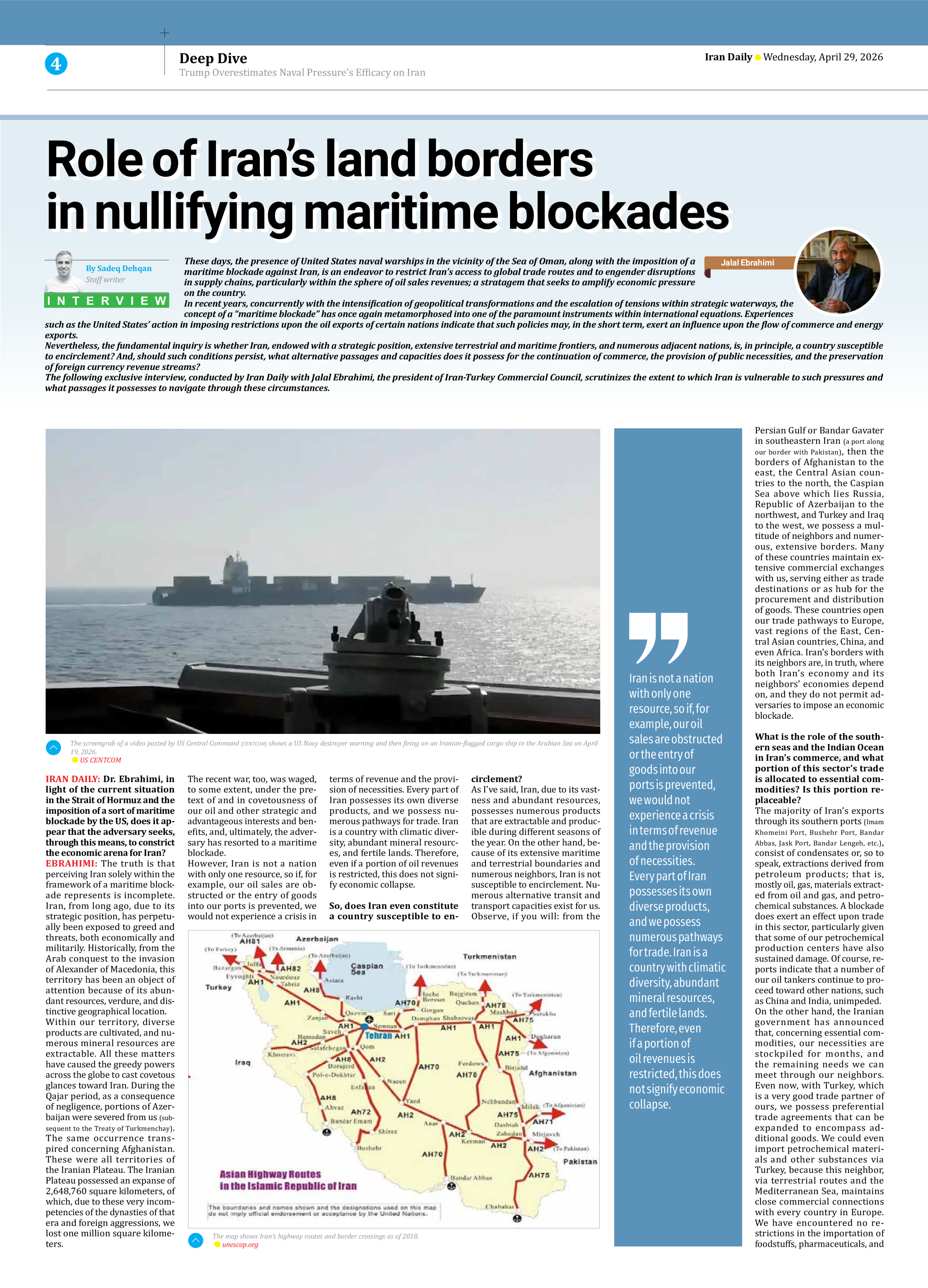
Observe, if you will: from the Persian Gulf or Bandar Gavater in southeastern Iran (a port along our border with Pakistan), then the borders of Afghanistan to the east, the Central Asian countries to the north, the Caspian Sea above which lies Russia, Republic of Azerbaijan to the northwest, and Turkey and Iraq to the west, we possess a multitude of neighbors and numerous, extensive borders. Many of these countries maintain extensive commercial exchanges with us, serving either as trade destinations or as hub for the procurement and distribution of goods. These countries open our trade pathways to Europe, vast regions of the East, Central Asian countries, China, and even Africa. Iran’s borders with its neighbors are, in truth, where both Iran’s economy and its neighbors’ economies depend on, and they do not permit adversaries to impose an economic blockade.
What is the role of the southern seas and the Indian Ocean in Iran’s commerce, and what portion of this sector’s trade is allocated to essential commodities? Is this portion replaceable?
The majority of Iran’s exports through its southern ports (Imam Khomeini Port, Bushehr Port, Bandar Abbas, Jask Port, Bandar Lengeh, etc.), consist of condensates or, so to speak, extractions derived from petroleum products; that is, mostly oil, gas, materials extracted from oil and gas, and petrochemical substances. A blockade does exert an effect upon trade in this sector, particularly given that some of our petrochemical production centers have also sustained damage. Of course, reports indicate that a number of our oil tankers continue to proceed toward other nations, such as China and India, unimpeded.
On the other hand, the Iranian government has announced that, concerning essential commodities, our necessities are stockpiled for months, and the remaining needs we can meet through our neighbors. Even now, with Turkey, which is a very good trade partner of ours, we possess preferential trade agreements that can be expanded to encompass additional goods. We could even import petrochemical materials and other substances via Turkey, because this neighbor, via terrestrial routes and the Mediterranean Sea, maintains close commercial connections with every country in Europe. We have encountered no restrictions in the importation of foodstuffs, pharmaceuticals, and other items from this western region. We just have to expand our governmental and private sector’s trade with neighboring countries and facilitate the work of economic attachés.
In this context, to what extent is the role of relations with neighboring countries, particularly Turkey, significant in neutralizing the impact of such sanctions?
Iran and Turkey share 500 kilometers of common border, consisting of the Bazargan border crossing, the Razi border crossing through which a railway line also passes and which constitutes the closest route to the city of Van from the city of Khoy, as well as the Sarv border crossing situated near the city of Urmia. So, along the Turkish route, we possess four entry and exit crossings, both rail and road, a rarity globally.
In truth, Iran is Europe’s chokepoint, and Europe’s trade route to the East and the Far East passes through Iran. Via the terrestrial borders of Iran and Turkey, we have 500 trucks entering and 500 to 700 trailers exiting daily. If we multiply the numbers of trailers by 22 tons (the cargo capacity per trailer), we have 11,000 tons entering and 11,000 to 15,000 tons exiting daily. If these routes operate on a 24-hour basis and customs operations is maintained, we can satisfy many of our necessities via Europe, the Mediterranean Sea basin, and North Africa.
On the other hand, in northern Iran, we possess extremely extensive commercial relations with the Russian Federation both via sea (the Caspian Sea, the Port of Astrakhan, and the northern ports of Iran) and via land (through Nakhchivan). Furthermore, through Turkey and the Turkish Express railway line, which is near the Razi border, we can connect to Europe.
In northeastern Iran, via the Bajgiran border, the Lotfabad border crossing at the Turkmenistan border near Ashgabat, and the exits toward Central Asia, we can both supply and receive necessities, especially foodstuffs. In the Turkmenistan region, meat and livestock products are very prominent. From Turkey itself, we also possess latitude in the protein domain. Additionally, from Afghanistan, we can procure livestock materials.
Are you saying that, in the realm of supplying essential commodities, even under conditions of a maritime blockade, no difficulty shall arise?
One must be realistic; a maritime blockade is not without effect. After all, we are a nation possessing the longest maritime lines along the coast of the Persian Gulf and the Sea of Oman, which connect to global routes (via the Indian Ocean, the Atlantic, or Bab-el-Mandeb). A maritime blockade will not be without effect, especially in domains such as the export of oil and petrochemical products, which is conducted predominantly from the southern ports. However, the crucial point is that this effect is not of such magnitude as to drive the country into an impasse. Iran can, via terrestrial routes and engagement with neighbors, satisfy a substantial portion of its necessities, particularly essential commodities.
Moreover, commercial interconnections with nations such as Russia, China, and India also furnish diverse pathways for importation and exportation. Observe the map of Iran right now; everywhere, there are border crossings for exit and entry. In the oil domain, we may encounter issues in the sale or purchase of petroleum, but concerning public necessities, we can fulfill our needs from every region and border crossing of the country.
In the energy domain, particularly oil and gas condensates, does the possibility exist to circumvent maritime restrictions?
In the energy domain, restrictions are more severe, but, again, solutions exist. A portion of transport can be effectuated via pipelines or terrestrial and rail routes, although these methods are more complex and costly compared to maritime trade.
Furthermore, exploiting the capacity of countries such as Turkey for the transfer of energy to Europe, and utilizing alternative routes toward the East, are among the strategies that can be effective in this regard and can, to some extent, compensate for these restrictions.