







Copy in clipboard...
Iran: US-Israeli strikes erode core principles of int’l system
Washington suffering from ‘maniacal hubris’
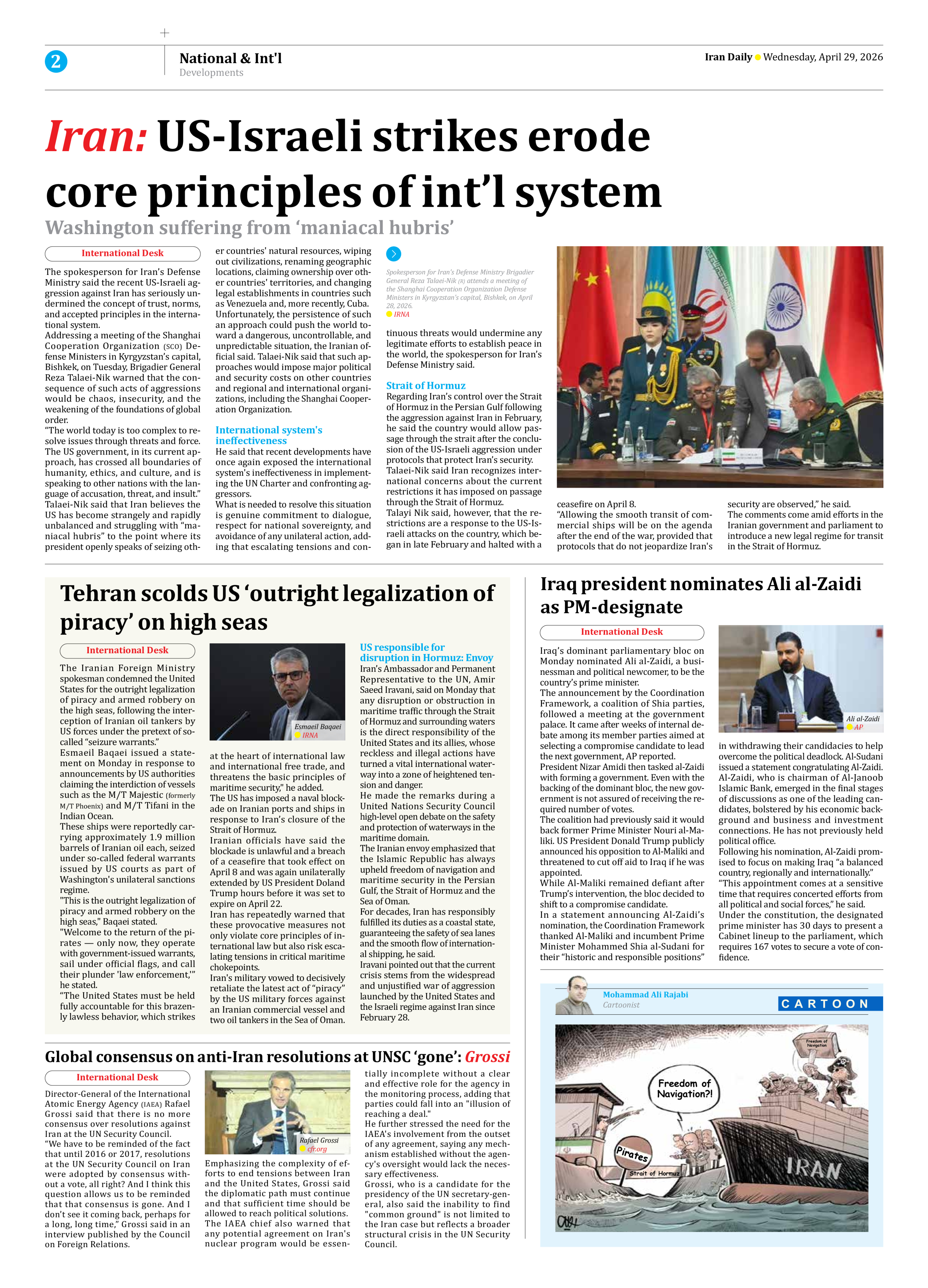
Addressing a meeting of the Shanghai Cooperation Organization (SCO) Defense Ministers in Kyrgyzstan’s capital, Bishkek, on Tuesday, Brigadier General Reza Talaei-Nik warned that the consequence of such acts of aggressions would be chaos, insecurity, and the weakening of the foundations of global order.
“The world today is too complex to resolve issues through threats and force. The US government, in its current approach, has crossed all boundaries of humanity, ethics, and culture, and is speaking to other nations with the language of accusation, threat, and insult.”
Talaei-Nik said that Iran believes the US has become strangely and rapidly unbalanced and struggling with “maniacal hubris” to the point where its president openly speaks of seizing other countries' natural resources, wiping out civilizations, renaming geographic locations, claiming ownership over other countries' territories, and changing legal establishments in countries such as Venezuela and, more recently, Cuba.
Unfortunately, the persistence of such an approach could push the world toward a dangerous, uncontrollable, and unpredictable situation, the Iranian official said. Talaei-Nik said that such approaches would impose major political and security costs on other countries and regional and international organizations, including the Shanghai Cooperation Organization.
International system's ineffectiveness
He said that recent developments have once again exposed the international system's ineffectiveness in implementing the UN Charter and confronting aggressors.
What is needed to resolve this situation is genuine commitment to dialogue, respect for national sovereignty, and avoidance of any unilateral action, adding that escalating tensions and continuous threats would undermine any legitimate efforts to establish peace in the world, the spokesperson for Iran’s Defense Ministry said.
Strait of Hormuz
Regarding Iran’s control over the Strait of Hormuz in the Persian Gulf following the aggression against Iran in February, he said the country would allow passage through the strait after the conclusion of the US-Israeli aggression under protocols that protect Iran’s security.
Talaei-Nik said Iran recognizes international concerns about the current restrictions it has imposed on passage through the Strait of Hormuz.
Talayi Nik said, however, that the restrictions are a response to the US-Israeli attacks on the country, which began in late February and halted with a ceasefire on April 8.
“Allowing the smooth transit of commercial ships will be on the agenda after the end of the war, provided that protocols that do not jeopardize Iran's security are observed,” he said.
The comments come amid efforts in the Iranian government and parliament to introduce a new legal regime for transit in the Strait of Hormuz.