





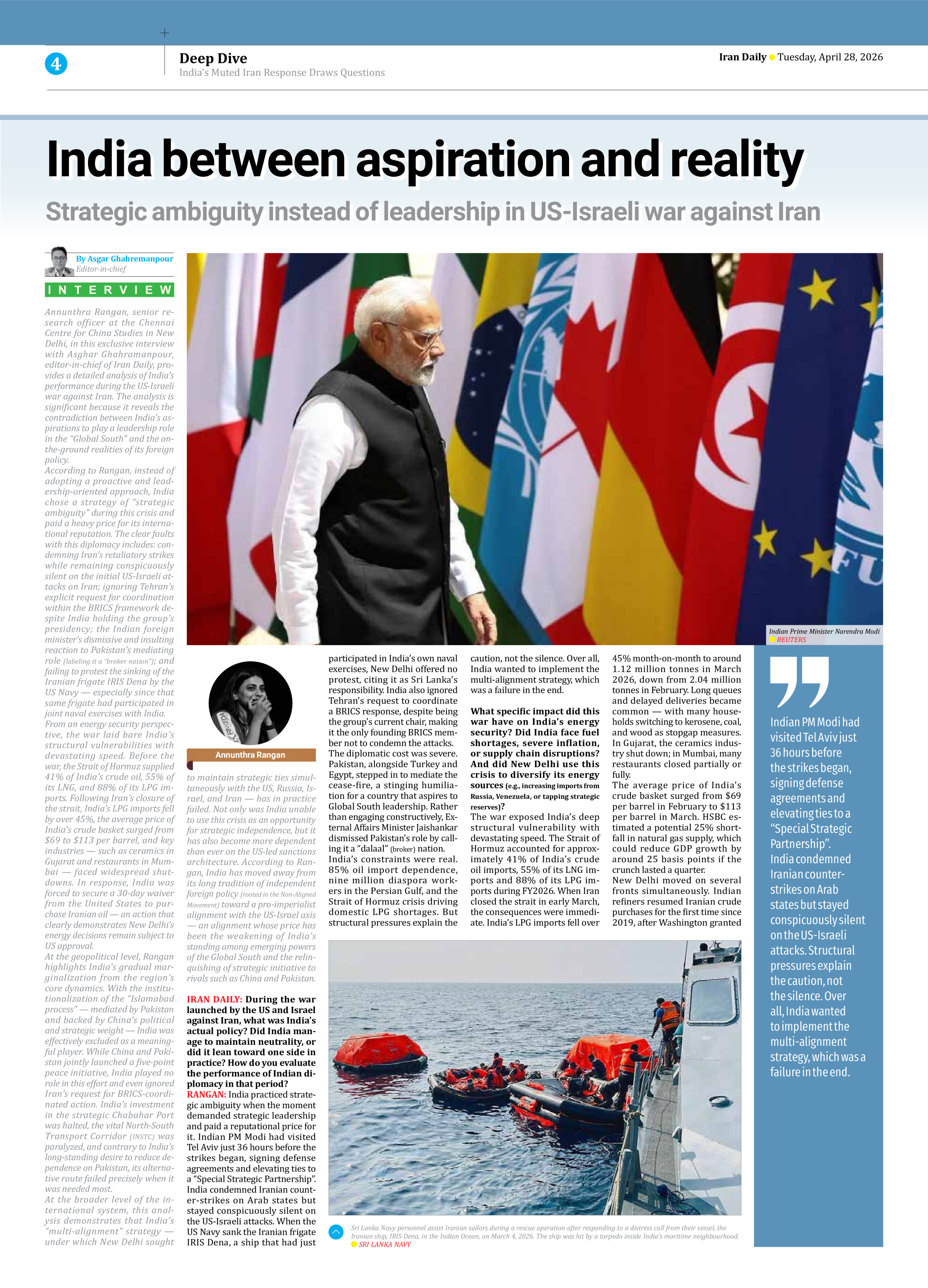


India between aspiration and reality
Strategic ambiguity instead of leadership in US-Israeli war against Iran
By Asgar Ghahremanpour
Editor-in-chief
Annunthra Rangan, senior research officer at the Chennai Centre for China Studies in New Delhi, in this exclusive interview with Asghar Ghahramanpour, editor-in-chief of Iran Daily, provides a detailed analysis of India’s performance during the US-Israeli war against Iran. The analysis is significant because it reveals the contradiction between India’s aspirations to play a leadership role in the “Global South” and the on-the-ground realities of its foreign policy.
According to Rangan, instead of adopting a proactive and leadership-oriented approach, India chose a strategy of “strategic ambiguity” during this crisis and paid a heavy price for its international reputation. The clear faults with this diplomacy includes: condemning Iran’s retaliatory strikes while remaining conspicuously silent on the initial US-Israeli attacks on Iran; ignoring Tehran’s explicit request for coordination within the BRICS framework despite India holding the group’s presidency; the Indian foreign minister’s dismissive and insulting reaction to Pakistan’s mediating role (labeling it a “broker nation”); and failing to protest the sinking of the Iranian frigate IRIS Dena by the US Navy — especially since that same frigate had participated in joint naval exercises with India.
From an energy security perspective, the war laid bare India’s structural vulnerabilities with devastating speed. Before the war, the Strait of Hormuz supplied 41% of India’s crude oil, 55% of its LNG, and 88% of its LPG imports. Following Iran’s closure of the strait, India’s LPG imports fell by over 45%, the average price of India’s crude basket surged from $69 to $113 per barrel, and key industries — such as ceramics in Gujarat and restaurants in Mumbai — faced widespread shutdowns. In response, India was forced to secure a 30-day waiver from the United States to purchase Iranian oil — an action that clearly demonstrates New Delhi’s energy decisions remain subject to US approval.
At the geopolitical level, Rangan highlights India’s gradual marginalization from the region’s core dynamics. With the institutionalization of the “Islamabad process” — mediated by Pakistan and backed by China’s political and strategic weight — India was effectively excluded as a meaningful player. While China and Pakistan jointly launched a five-point peace initiative, India played no role in this effort and even ignored Iran’s request for BRICS-coordinated action. India’s investment in the strategic Chabahar Port was halted, the vital North-South Transport Corridor (INSTC) was paralyzed, and contrary to India’s long-standing desire to reduce dependence on Pakistan, its alternative route failed precisely when it was needed most.
At the broader level of the international system, this analysis demonstrates that India’s “multi-alignment” strategy — under which New Delhi sought to maintain strategic ties simultaneously with the US, Russia, Israel, and Iran — has in practice failed. Not only was India unable to use this crisis as an opportunity for strategic independence, but it has also become more dependent than ever on the US-led sanctions architecture. According to Rangan, India has moved away from its long tradition of independent foreign policy (rooted in the Non-Aligned Movement) toward a pro-imperialist alignment with the US-Israel axis — an alignment whose price has been the weakening of India’s standing among emerging powers of the Global South and the relinquishing of strategic initiative to rivals such as China and Pakistan.
IRAN DAILY: During the war launched by the US and Israel against Iran, what was India’s actual policy? Did India manage to maintain neutrality, or did it lean toward one side in practice? How do you evaluate the performance of Indian diplomacy in that period?
RANGAN: India practiced strategic ambiguity when the moment demanded strategic leadership and paid a reputational price for it. Indian PM Modi had visited Tel Aviv just 36 hours before the strikes began, signing defense agreements and elevating ties to a “Special Strategic Partnership”. India condemned Iranian counter-strikes on Arab states but stayed conspicuously silent on the US-Israeli attacks. When the US Navy sank the Iranian frigate IRIS Dena, a ship that had just participated in India’s own naval exercises, New Delhi offered no protest, citing it as Sri Lanka’s responsibility. India also ignored Tehran’s request to coordinate a BRICS response, despite being the group’s current chair, making it the only founding BRICS member not to condemn the attacks.
The diplomatic cost was severe. Pakistan, alongside Turkey and Egypt, stepped in to mediate the cease-fire, a stinging humiliation for a country that aspires to Global South leadership. Rather than engaging constructively, External Affairs Minister Jaishankar dismissed Pakistan’s role by calling it a “dalaal” (broker) nation.
India’s constraints were real. 85% oil import dependence, nine million diaspora workers in the Persian Gulf, and the Strait of Hormuz crisis driving domestic LPG shortages. But structural pressures explain the caution, not the silence. Over all, India wanted to implement the multi-alignment strategy, which was a failure in the end.
What specific impact did this war have on India’s energy security? Did India face fuel shortages, severe inflation, or supply chain disruptions? And did New Delhi use this crisis to diversify its energy sources (e.g., increasing imports from Russia, Venezuela, or tapping strategic reserves)?
The war exposed India’s deep structural vulnerability with devastating speed. The Strait of Hormuz accounted for approximately 41% of India’s crude oil imports, 55% of its LNG imports and 88% of its LPG imports during FY2026. When Iran closed the strait in early March, the consequences were immediate. India’s LPG imports fell over 45% month-on-month to around 1.12 million tonnes in March 2026, down from 2.04 million tonnes in February. Long queues and delayed deliveries became common — with many households switching to kerosene, coal, and wood as stopgap measures. In Gujarat, the ceramics industry shut down; in Mumbai, many restaurants closed partially or fully.
The average price of India’s crude basket surged from $69 per barrel in February to $113 per barrel in March. HSBC estimated a potential 25% shortfall in natural gas supply, which could reduce GDP growth by around 25 basis points if the crunch lasted a quarter.
New Delhi moved on several fronts simultaneously. Indian refiners resumed Iranian crude purchases for the first time since 2019, after Washington granted a 30-day waiver. Russian crude gained further import share, and Indian refiners also increased purchases from West Africa and Latin America. The Indian Navy launched Operation Urja Suraksha, deploying over five warships to escort Indian-flagged cargo ships in the region. India also installed piped gas connections to 580,000 new households in March alone to reduce cylinder dependence.
Now that a cease-fire is in place and Iran and the US are at the negotiating table, what role can India play in these talks? Can India act as a mediator or facilitator, or does it remain under Western pressure?
The window for India to act as a mediator in the Iran-US talks has already closed, and India itself shut it. Mediation requires trust from both sides. India condemned strikes on American bases without mentioning Iran, while refusing to condemn the assassination of Ayatollah Khamenei. Tehran has no reason to view India as a neutral broker. A mediator that stays silent while one side kills your Supreme Leader is not a mediator — it’s a bystander wearing neutrality as a costume.
The Islamabad Talks on April 11–12 were moderated by Pakistan, with the US team led by VP JD Vance, Witkoff, and Kushner, and Iran’s team led by Parliamentary Speaker Qalibaf and Foreign Minister Araghchi. The “Islamabad process” is now institutionalized. Just recently, Iran’s Foreign Minister Araghchi was in Pakistan meeting Pakistani officials as part of their ongoing mediation.
India resumed Iranian crude imports only after Washington issued a 30-day waiver, meaning India’s energy decisions are already subject to US approval. A country that needs American permission to buy oil cannot simultaneously position itself as an independent mediator between America and Iran. Mediation requires proactive diplomacy. India’s entire posture has been reactive — waiting, watching, and hedging. The emergence of Pakistan as the primary back-channel interlocutor is a stinging strategic setback for New Delhi. However, India will work its way to balance the situation in the coming days.
During the war, did India’s cooperation with China on Iran-related issues (e.g., in the UN Security Council or through diplomatic channels) increase, or did geopolitical rivalries prevent coordination? And in the current negotiation context, do India and China hold aligned positions?
China took a clear, activist position from day one. Beijing publicly condemned the US-Israeli strikes, provided limited material assistance to Iran, and let Iran leverage BeiDou navigation systems to direct attacks across the region. At the UNSC, China and Russia vetoed the Bahrain-sponsored Hormuz resolution, calling it biased against Iran.
Diplomatically, China played a key role in convincing Iran to accept Pakistan’s two-week cease-fire proposal, with Pakistan providing the practical channel and China providing political weight and strategic backing. China and Pakistan jointly launched a five-point peace initiative calling for an immediate cease-fire, halt to infrastructure attacks, and reopening of the Strait of Hormuz.
India sat on the opposite end of the spectrum. While China partnered with Pakistan to drive the cease-fire process, India was conspicuously absent. There was no India-China joint statement, no coordinated BRICS initiative, and no shared diplomatic track. India ignored Tehran’s request to coordinate through BRICS despite being the group’s chair, while China was simultaneously co-authoring cease-fire proposals with Pakistan.
Today, the cease-fire remains fragile, with the Islamabad Talks having ended without a deal on the Strait of Hormuz and Iran’s nuclear program. China remains actively engaged in back-channel diplomacy. India remains a bystander. Their positions are not aligned. China seeks to preserve Iranian leverage; India focuses more regarding the Strait reopened to restore its energy supply, regardless of the broader political outcome.
Given possible damage to the Chabahar Port’s infrastructure during the war, what plans does India have for its reconstruction or replacement? Has New Delhi used this opportunity to reduce dependence on Pakistan and expand the North-South Corridor?
The Indian Budget for 2026–27, released just weeks before the strikes, had already slashed the allocation for Chabahar to zero. With the US sanctions waiver on Chabahar expired on April 26, 2026, India has been forced to consider temporarily divesting its stake in India Ports Global Chabahar Free Zone to an Iranian entity, with a condition that the stake be returned once sanctions are lifted. India has already pumped nearly $120 million into the port. New Delhi insists it does not plan to completely exit as there are plans to expand connectivity through a rail link.
The critical Chabahar-Zahedan railway line, slated for 2026 completion, now faces indefinite delays as Iran shifts focus from civil engineering to wartime mobilization. Transit insurance and security costs along the corridor have skyrocketed. Rather than seizing the crisis to reduce Pakistan dependence, India finds its Pakistan bypass route paralyzed precisely when it needs it most. All Indian investments in Chabahar are now on hold while China, which faces no such sanctions pressure, remains relentless in pursuing regional connectivity.
The INSTC route is 30% cheaper and 40% shorter than the traditional Suez Canal route, a transformative corridor India has spent decades trying to build. The war has not prompted India to double down; it has forced an embarrassing tactical retreat, with New Delhi surrendering leverage it spent years accumulating, under pressure from the very partner, Washington whose strategic alignment it has been cultivating.
How has the conduct of the US and Israel in this war affected the perception of Western reliability among Indian political elites? Does India remain committed to its strategic partnerships with the US and Israel, or is it moving toward a more independent foreign policy (reminiscent of the Non-Aligned Movement era)?
India’s positions on Israel, Iran, Russia, and trade have converged with Washington even where they contradicted Indian interests, yet Washington offered nothing in return during India’s energy crisis. The IRIS Dena episode crystallized this: former Indian Navy chief admiral Arun Prakash stated publicly that an American nuclear submarine had been operating in waters close to India for days without New Delhi being informed, and called on the government to formally convey its displeasure to Washington. India is moving away from its tradition of independent foreign policy toward a pro-imperialist alignment, increasingly tethered to the strategic priorities of the United States and Israel. The UAE-India-Israel axis may grow tighter after the war and that Pakistan’s temporary mediation role does not represent a structural shift.
India is not pivoting back to NAM-era non-alignment. But the war has measurably eroded elite confidence in the US as a dependable crisis partner, with analysts noting that the assumption of the US as a dependable partner in moments of crisis has been repeatedly tested, making India likely to diversify partnerships that outlast the current conflict. The result is less a strategic rupture than a quiet recalibration, deepening hedging while publicly maintaining all partnerships.
In a post-sanctions scenario (should the negotiations succeed), what priorities will India have toward Iran? Will New Delhi quickly try to restore economic and transit ties with Tehran to pre-war levels, or will it define a new framework of cooperation?
The port remains India’s anchor in Iran. With the US sanctions waiver on Chabahar expired on April 26, 2026, India is considering temporarily transferring its stake to an Iranian entity but with a guarantee that the stake reverts to India once sanctions are lifted. This maneuver reveals New Delhi’s core strategy: preserve the foothold at all costs, even symbolically. Post-sanctions, India will move quickly to restore operational control and push the long-delayed Chabahar-Zahedan rail link, which would unlock the full INSTC to Central Asia and Russia.
India will seek to revive Iranian crude imports and reopen talks on the Farzad-B gas field, where ONGC Videsh holds discovery rights. However, any serious Indian engagement with Iran now operates inside a US-led sanctions architecture that can reprice commercial behavior almost overnight, meaning Indian banks, insurers, and refiners will move cautiously even after formal sanctions relief.
India’s likely policy is persistence under constraint, preserving Chabahar, limiting exposure, avoiding major new bets, and holding on to Iran as a diminished but still usable option. This is a narrower, more pragmatic Iran policy than the transformative gateway New Delhi once envisioned — honest about limits, but strategically indispensable.