







Doidoukh carpet secures GI recognition through WIPO
The handwoven carpet of Doidoukh village in Iran’s North Khorasan Province has been granted geographical indication (GI) recognition through the World Intellectual Property Organization (WIPO), marking a significant step in protecting this traditional craft and strengthening its position in international markets, a provincial official said.
Mehdi Keramati, director general of Industry, Mine and Trade in North Khorasan, said the achievement came after sustained follow-up efforts and coordination between the National Carpet Center of Iran, the Industrial Property Office, and the provincial Department of Industry, Mine and Trade, according to chtn.ir.
He noted that the Doidoukh handwoven carpet, which had previously been listed on Iran’s national heritage register, will now be recognized among member states of the Lisbon Agreement as an artistic product with a clearly defined regional identity.
Keramati described the international GI recognition of the Doidoukh carpet as a turning point in the history of the province’s carpet industry, saying it could pave the way for broader international support for the region’s distinctive patterns and designs.
He added that this achievement will play an important role in enhancing the status of the province’s carpets at both national and international levels while creating greater motivation for those active in the sector.
Keramati emphasized that the international registration of geographical indications is one of the most important legal tools for protecting cultural heritage and indigenous brands worldwide. He expressed hope that the move would contribute to economic growth and the expansion of export markets for Doidoukh handwoven carpets.
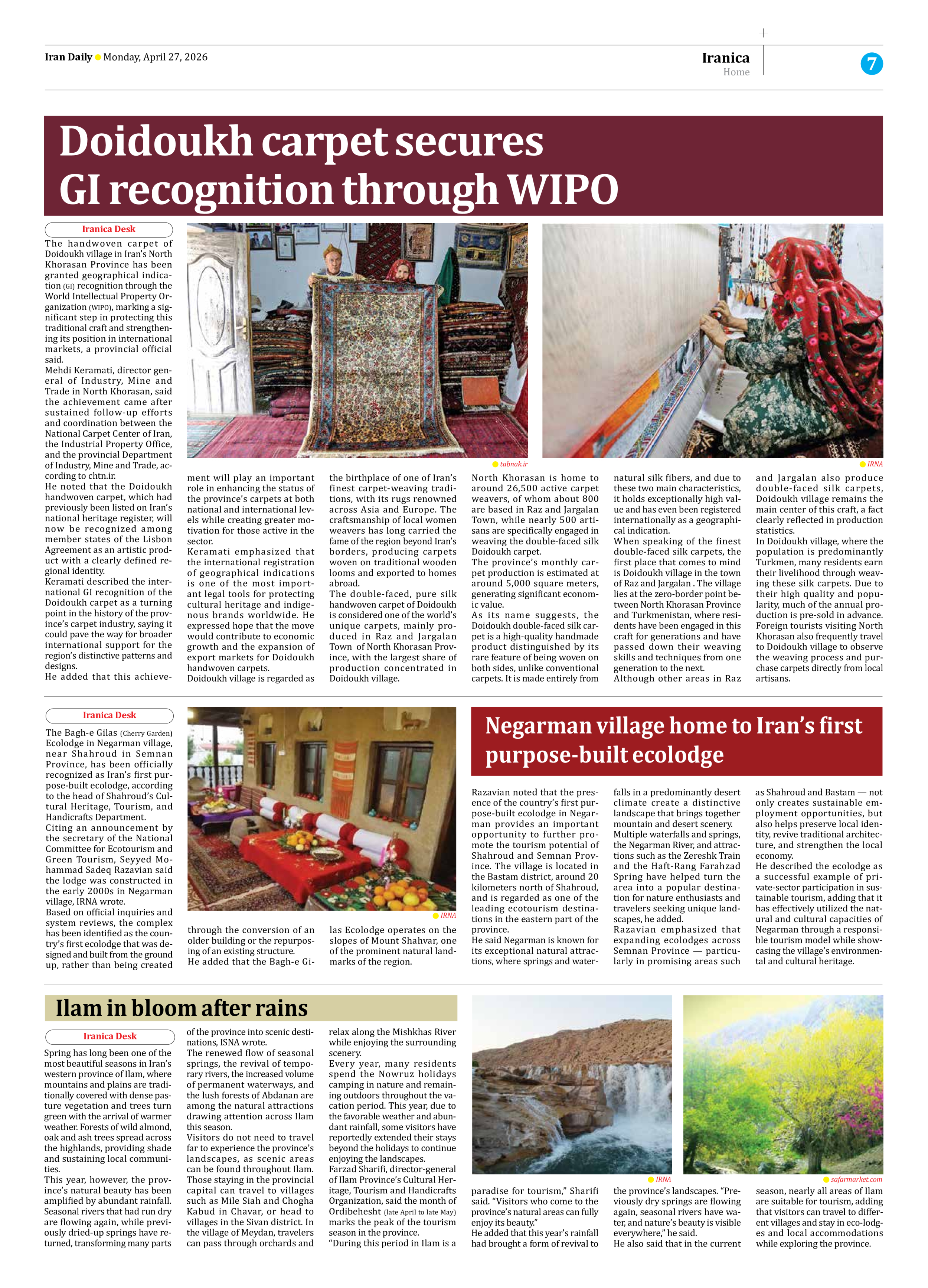
Doidoukh village is regarded as the birthplace of one of Iran’s finest carpet-weaving traditions, with its rugs renowned across Asia and Europe. The craftsmanship of local women weavers has long carried the fame of the region beyond Iran’s borders, producing carpets woven on traditional wooden looms and exported to homes abroad.
The double-faced, pure silk handwoven carpet of Doidoukh is considered one of the world’s unique carpets, mainly produced in Raz and Jargalan Town of North Khorasan Province, with the largest share of production concentrated in Doidoukh village.
North Khorasan is home to around 26,500 active carpet weavers, of whom about 800 are based in Raz and Jargalan Town, while nearly 500 artisans are specifically engaged in weaving the double-faced silk Doidoukh carpet.
The province’s monthly carpet production is estimated at around 5,000 square meters, generating significant economic value.
As its name suggests, the Doidoukh double-faced silk carpet is a high-quality handmade product distinguished by its rare feature of being woven on both sides, unlike conventional carpets. It is made entirely from natural silk fibers, and due to these two main characteristics, it holds exceptionally high value and has even been registered internationally as a geographical indication.
When speaking of the finest double-faced silk carpets, the first place that comes to mind is Doidoukh village in the town of Raz and Jargalan . The village lies at the zero-border point between North Khorasan Province and Turkmenistan, where residents have been engaged in this craft for generations and have passed down their weaving skills and techniques from one generation to the next.
Although other areas in Raz and Jargalan also produce double-faced silk carpets, Doidoukh village remains the main center of this craft, a fact clearly reflected in production statistics.
In Doidoukh village, where the population is predominantly Turkmen, many residents earn their livelihood through weaving these silk carpets. Due to their high quality and popularity, much of the annual production is pre-sold in advance. Foreign tourists visiting North Khorasan also frequently travel to Doidoukh village to observe the weaving process and purchase carpets directly from local artisans.