







Copy in clipboard...
FM: US military presence uncorks chaos; regional convergence advised
Iranian Foreign Minister Abbas Araghchi said the experience of the war against Iran showed that the US military presence in regional countries has served only to generate insecurity and division, urging regional states to pursue indigenous collective security arrangements free from American interference.
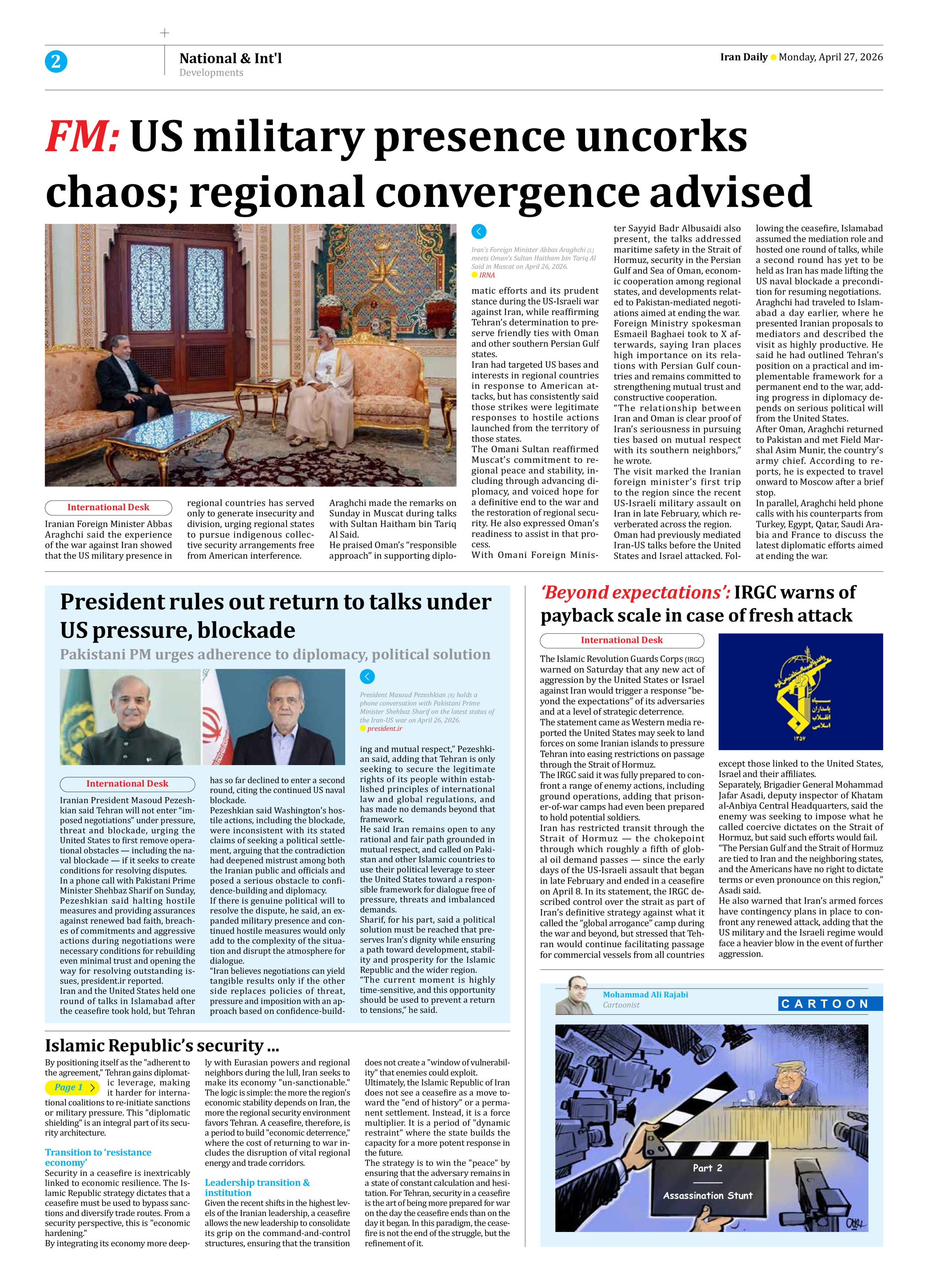
Araghchi made the remarks on Sunday in Muscat during talks with Sultan Haitham bin Tariq Al Said.
He praised Oman’s “responsible approach” in supporting diplomatic efforts and its prudent stance during the US-Israeli war against Iran, while reaffirming Tehran’s determination to preserve friendly ties with Oman and other southern Persian Gulf states.
Iran had targeted US bases and interests in regional countries in response to American attacks, but has consistently said those strikes were legitimate responses to hostile actions launched from the territory of those states.
The Omani Sultan reaffirmed Muscat’s commitment to regional peace and stability, including through advancing diplomacy, and voiced hope for a definitive end to the war and the restoration of regional security. He also expressed Oman’s readiness to assist in that process.
With Omani Foreign Minister Sayyid Badr Albusaidi also present, the talks addressed maritime safety in the Strait of Hormuz, security in the Persian Gulf and Sea of Oman, economic cooperation among regional states, and developments related to Pakistan-mediated negotiations aimed at ending the war.
Foreign Ministry spokesman Esmaeil Baghaei took to X afterwards, saying Iran places high importance on its relations with Persian Gulf countries and remains committed to strengthening mutual trust and constructive cooperation.
“The relationship between Iran and Oman is clear proof of Iran’s seriousness in pursuing ties based on mutual respect with its southern neighbors,” he wrote.
The visit marked the Iranian foreign minister’s first trip to the region since the recent US-Israeli military assault on Iran in late February, which reverberated across the region.
Oman had previously mediated Iran-US talks before the United States and Israel attacked. Following the ceasefire, Islamabad assumed the mediation role and hosted one round of talks, while a second round has yet to be held as Iran has made lifting the US naval blockade a precondition for resuming negotiations.
Araghchi had traveled to Islamabad a day earlier, where he presented Iranian proposals to mediators and described the visit as highly productive. He said he had outlined Tehran’s position on a practical and implementable framework for a permanent end to the war, adding progress in diplomacy depends on serious political will from the United States.
After Oman, Araghchi returned to Pakistan and met Field Marshal Asim Munir, the country’s army chief. According to reports, he is expected to travel onward to Moscow after a brief stop.
In parallel, Araghchi held phone calls with his counterparts from Turkey, Egypt, Qatar, Saudi Arabia and France to discuss the latest diplomatic efforts aimed at ending the war.