







Iran turns heritage damage into call for renewal
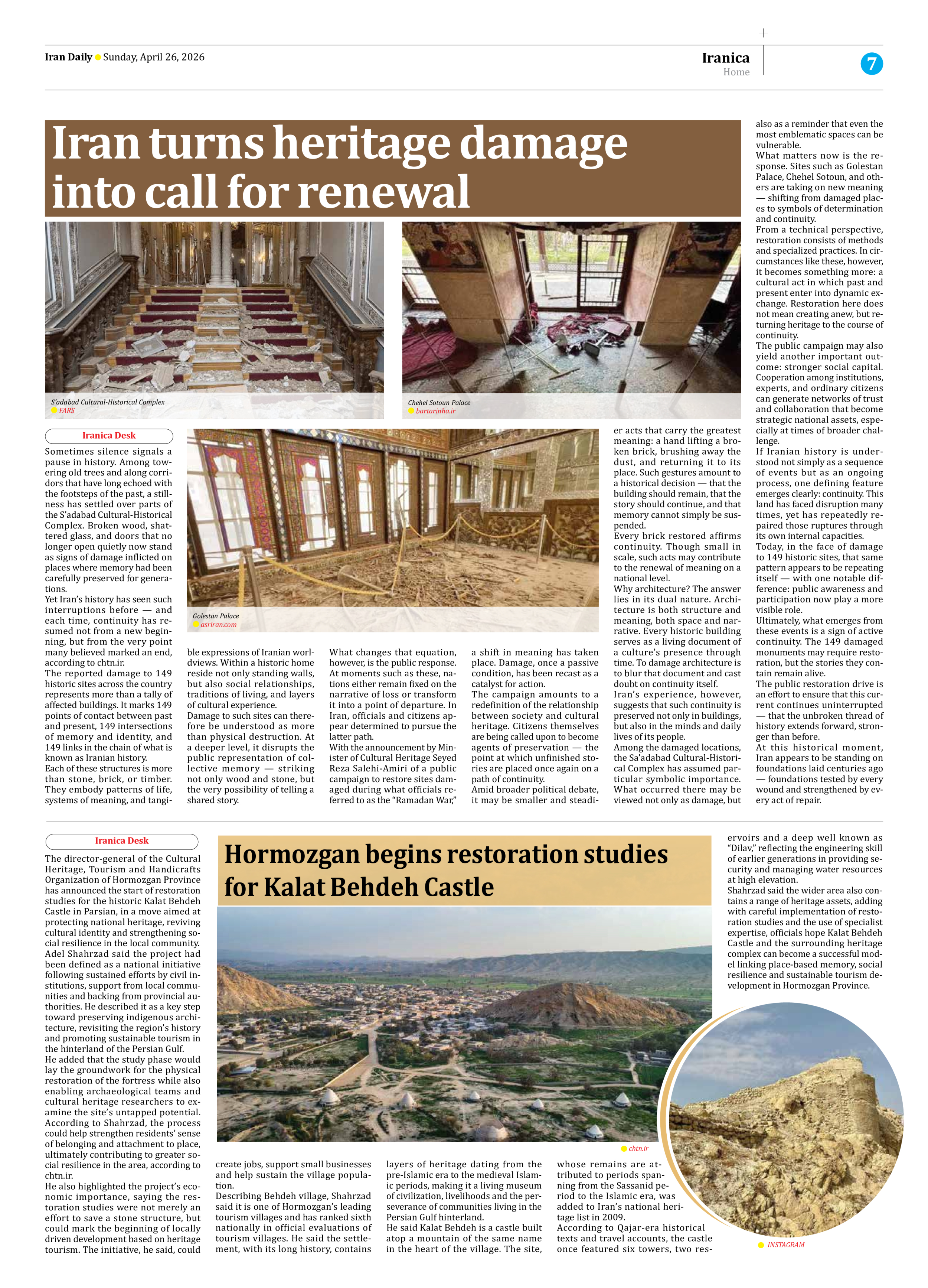
Sometimes silence signals a pause in history. Among towering old trees and along corridors that have long echoed with the footsteps of the past, a stillness has settled over parts of the S’adabad Cultural-Historical Complex. Broken wood, shattered glass, and doors that no longer open quietly now stand as signs of damage inflicted on places where memory had been carefully preserved for generations.
Yet Iran’s history has seen such interruptions before — and each time, continuity has resumed not from a new beginning, but from the very point many believed marked an end, according to chtn.ir.
The reported damage to 149 historic sites across the country represents more than a tally of affected buildings. It marks 149 points of contact between past and present, 149 intersections of memory and identity, and 149 links in the chain of what is known as Iranian history.
Each of these structures is more than stone, brick, or timber. They embody patterns of life, systems of meaning, and tangible expressions of Iranian worldviews. Within a historic home reside not only standing walls, but also social relationships, traditions of living, and layers of cultural experience.
Damage to such sites can therefore be understood as more than physical destruction. At a deeper level, it disrupts the public representation of collective memory — striking not only wood and stone, but the very possibility of telling a shared story.
What changes that equation, however, is the public response. At moments such as these, nations either remain fixed on the narrative of loss or transform it into a point of departure. In Iran, officials and citizens appear determined to pursue the latter path.
With the announcement by Minister of Cultural Heritage Seyed Reza Salehi-Amiri of a public campaign to restore sites damaged during what officials referred to as the “Ramadan War,” a shift in meaning has taken place. Damage, once a passive condition, has been recast as a catalyst for action.
The campaign amounts to a redefinition of the relationship between society and cultural heritage. Citizens themselves are being called upon to become agents of preservation — the point at which unfinished stories are placed once again on a path of continuity.
Amid broader political debate, it may be smaller and steadier acts that carry the greatest meaning: a hand lifting a broken brick, brushing away the dust, and returning it to its place. Such gestures amount to a historical decision — that the building should remain, that the story should continue, and that memory cannot simply be suspended.
Every brick restored affirms continuity. Though small in scale, such acts may contribute to the renewal of meaning on a national level.
Why architecture? The answer lies in its dual nature. Architecture is both structure and meaning, both space and narrative. Every historic building serves as a living document of a culture’s presence through time. To damage architecture is to blur that document and cast doubt on continuity itself.
Iran’s experience, however, suggests that such continuity is preserved not only in buildings, but also in the minds and daily lives of its people.
Among the damaged locations, the Sa’adabad Cultural-Historical Complex has assumed particular symbolic importance. What occurred there may be viewed not only as damage, but also as a reminder that even the most emblematic spaces can be vulnerable.
What matters now is the response. Sites such as Golestan Palace, Chehel Sotoun, and others are taking on new meaning — shifting from damaged places to symbols of determination and continuity.
From a technical perspective, restoration consists of methods and specialized practices. In circumstances like these, however, it becomes something more: a cultural act in which past and present enter into dynamic exchange. Restoration here does not mean creating anew, but returning heritage to the course of continuity.
The public campaign may also yield another important outcome: stronger social capital. Cooperation among institutions, experts, and ordinary citizens can generate networks of trust and collaboration that become strategic national assets, especially at times of broader challenge.
If Iranian history is understood not simply as a sequence of events but as an ongoing process, one defining feature emerges clearly: continuity. This land has faced disruption many times, yet has repeatedly repaired those ruptures through its own internal capacities.
Today, in the face of damage to 149 historic sites, that same pattern appears to be repeating itself — with one notable difference: public awareness and participation now play a more visible role.
Ultimately, what emerges from these events is a sign of active continuity. The 149 damaged monuments may require restoration, but the stories they contain remain alive.
The public restoration drive is an effort to ensure that this current continues uninterrupted — that the unbroken thread of history extends forward, stronger than before.
At this historical moment, Iran appears to be standing on foundations laid centuries ago — foundations tested by every wound and strengthened by every act of repair.