







Iranian football at crossroads over women’s presence at Asian Games
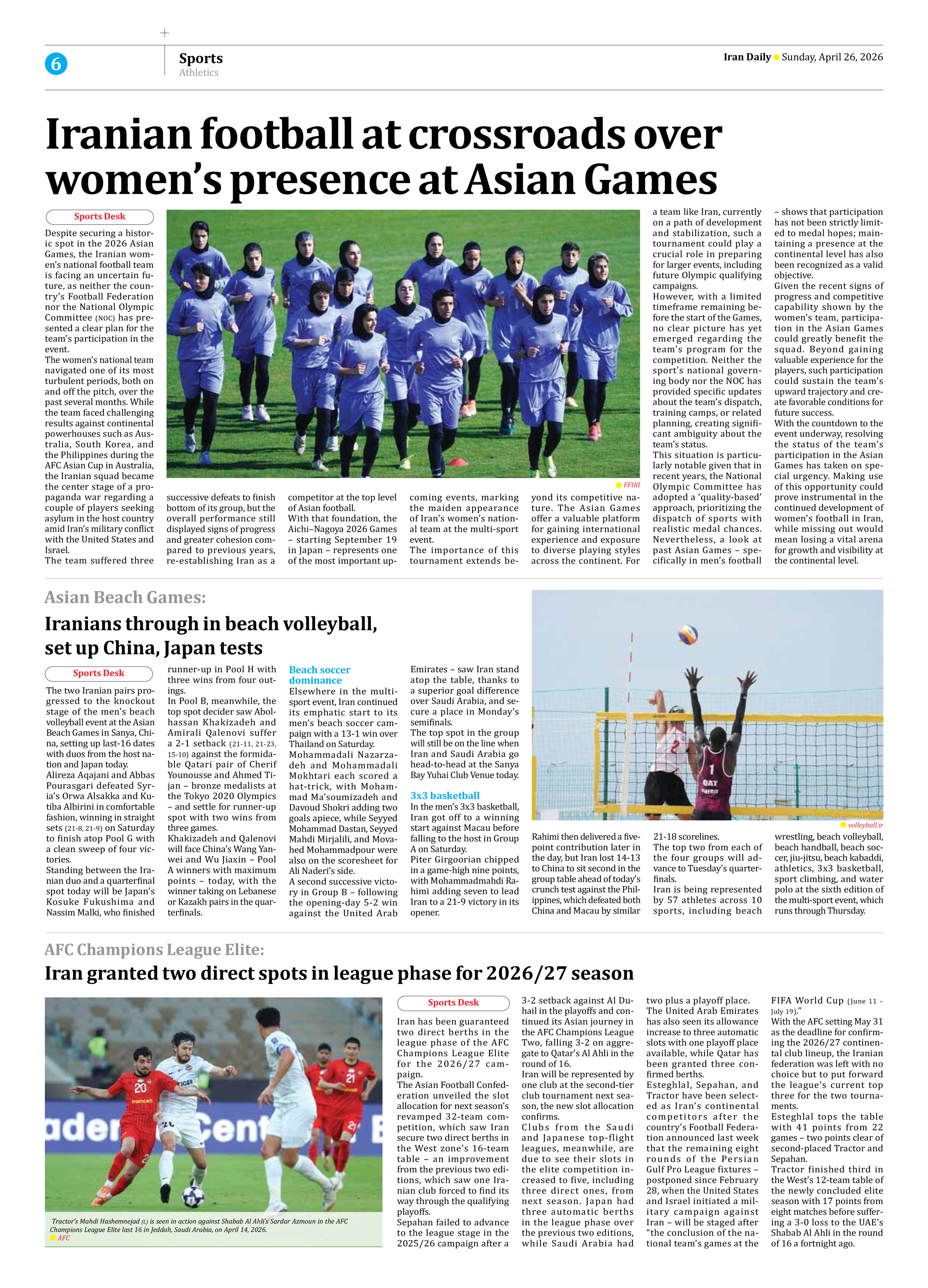
Despite securing a historic spot in the 2026 Asian Games, the Iranian women’s national football team is facing an uncertain future, as neither the country’s Football Federation nor the National Olympic Committee (NOC) has presented a clear plan for the team’s participation in the event.
The women’s national team navigated one of its most turbulent periods, both on and off the pitch, over the past several months. While the team faced challenging results against continental powerhouses such as Australia, South Korea, and the Philippines during the AFC Asian Cup in Australia, the Iranian squad became the center stage of a propaganda war regarding a couple of players seeking asylum in the host country amid Iran’s military conflict with the United States and Israel.
The team suffered three successive defeats to finish bottom of its group, but the overall performance still displayed signs of progress and greater cohesion compared to previous years, re-establishing Iran as a competitor at the top level of Asian football.
With that foundation, the Aichi–Nagoya 2026 Games – starting September 19 in Japan – represents one of the most important upcoming events, marking the maiden appearance of Iran’s women’s national team at the multi-sport event.
The importance of this tournament extends beyond its competitive nature. The Asian Games offer a valuable platform for gaining international experience and exposure to diverse playing styles across the continent. For a team like Iran, currently on a path of development and stabilization, such a tournament could play a crucial role in preparing for larger events, including future Olympic qualifying campaigns.
However, with a limited timeframe remaining before the start of the Games, no clear picture has yet emerged regarding the team’s program for the competition. Neither the sport’s national governing body nor the NOC has provided specific updates about the team’s dispatch, training camps, or related planning, creating significant ambiguity about the team’s status.
This situation is particularly notable given that in recent years, the National Olympic Committee has adopted a ‘quality-based’ approach, prioritizing the dispatch of sports with realistic medal chances. Nevertheless, a look at past Asian Games – specifically in men’s football – shows that participation has not been strictly limited to medal hopes; maintaining a presence at the continental level has also been recognized as a valid objective.
Given the recent signs of progress and competitive capability shown by the women’s team, participation in the Asian Games could greatly benefit the squad. Beyond gaining valuable experience for the players, such participation could sustain the team’s upward trajectory and create favorable conditions for future success.
With the countdown to the event underway, resolving the status of the team’s participation in the Asian Games has taken on special urgency. Making use of this opportunity could prove instrumental in the continued development of women’s football in Iran, while missing out would mean losing a vital arena for growth and visibility at the continental level.