







From perceived threat to diplomatic opportunity
Redefining role of diaspora as honorary ambassadors of Iran
By Ashkan Pirzadeh
Strategic affairs analyst
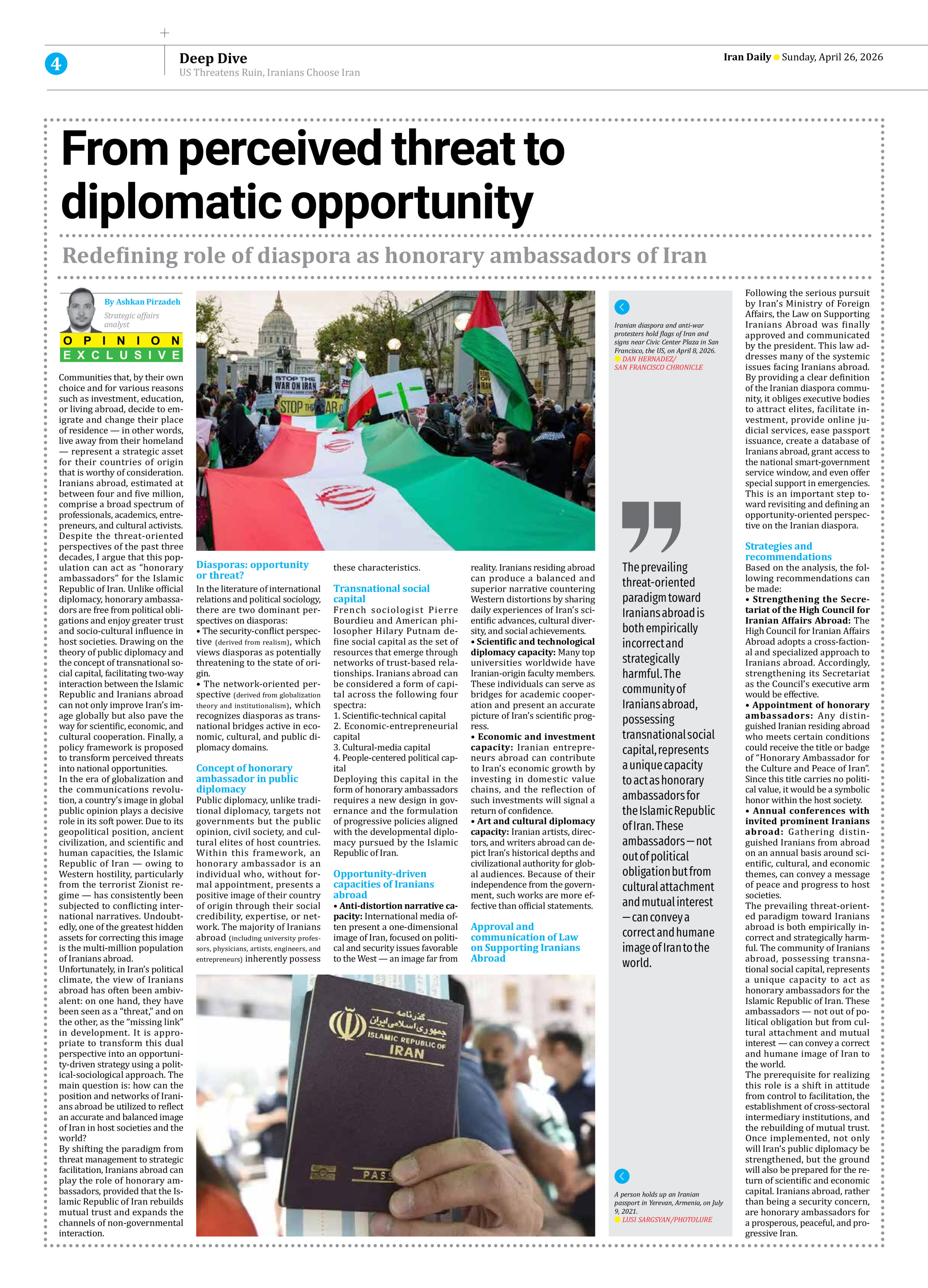
Communities that, by their own choice and for various reasons such as investment, education, or living abroad, decide to emigrate and change their place of residence — in other words, live away from their homeland — represent a strategic asset for their countries of origin that is worthy of consideration. Iranians abroad, estimated at between four and five million, comprise a broad spectrum of professionals, academics, entrepreneurs, and cultural activists.
Despite the threat-oriented perspectives of the past three decades, I argue that this population can act as “honorary ambassadors” for the Islamic Republic of Iran. Unlike official diplomacy, honorary ambassadors are free from political obligations and enjoy greater trust and socio-cultural influence in host societies. Drawing on the theory of public diplomacy and the concept of transnational social capital, facilitating two-way interaction between the Islamic Republic and Iranians abroad can not only improve Iran’s image globally but also pave the way for scientific, economic, and cultural cooperation. Finally, a policy framework is proposed to transform perceived threats into national opportunities.
In the era of globalization and the communications revolution, a country’s image in global public opinion plays a decisive role in its soft power. Due to its geopolitical position, ancient civilization, and scientific and human capacities, the Islamic Republic of Iran — owing to Western hostility, particularly from the terrorist Zionist regime — has consistently been subjected to conflicting international narratives. Undoubtedly, one of the greatest hidden assets for correcting this image is the multi-million population of Iranians abroad.
Unfortunately, in Iran’s political climate, the view of Iranians abroad has often been ambivalent: on one hand, they have been seen as a “threat,” and on the other, as the “missing link” in development. It is appropriate to transform this dual perspective into an opportunity-driven strategy using a political-sociological approach. The main question is: how can the position and networks of Iranians abroad be utilized to reflect an accurate and balanced image of Iran in host societies and the world?
By shifting the paradigm from threat management to strategic facilitation, Iranians abroad can play the role of honorary ambassadors, provided that the Islamic Republic of Iran rebuilds mutual trust and expands the channels of non-governmental interaction.
Diasporas: opportunity or threat?
In the literature of international relations and political sociology, there are two dominant perspectives on diasporas:
• The security-conflict perspective (derived from realism), which views diasporas as potentially threatening to the state of origin.
• The network-oriented perspective (derived from globalization theory and institutionalism), which recognizes diasporas as transnational bridges active in economic, cultural, and public diplomacy domains.
Concept of honorary ambassador in public diplomacy
Public diplomacy, unlike traditional diplomacy, targets not governments but the public opinion, civil society, and cultural elites of host countries. Within this framework, an honorary ambassador is an individual who, without formal appointment, presents a positive image of their country of origin through their social credibility, expertise, or network. The majority of Iranians abroad (including university professors, physicians, artists, engineers, and entrepreneurs) inherently possess these characteristics.
Transnational social capital
French sociologist Pierre Bourdieu and American philosopher Hilary Putnam define social capital as the set of resources that emerge through networks of trust-based relationships. Iranians abroad can be considered a form of capital across the following four spectra:
1. Scientific-technical capital
2. Economic-entrepreneurial capital
3. Cultural-media capital
4. People-centered political capital
Deploying this capital in the form of honorary ambassadors requires a new design in governance and the formulation of progressive policies aligned with the developmental diplomacy pursued by the Islamic Republic of Iran.
Opportunity-driven capacities of Iranians abroad
• Anti-distortion narrative capacity: International media often present a one‑dimensional image of Iran, focused on political and security issues favorable to the West — an image far from reality. Iranians residing abroad can produce a balanced and superior narrative countering Western distortions by sharing daily experiences of Iran’s scientific advances, cultural diversity, and social achievements.
• Scientific and technological diplomacy capacity: Many top universities worldwide have Iranian‑origin faculty members. These individuals can serve as bridges for academic cooperation and present an accurate picture of Iran’s scientific progress.
• Economic and investment capacity: Iranian entrepreneurs abroad can contribute to Iran’s economic growth by investing in domestic value chains, and the reflection of such investments will signal a return of confidence.
• Art and cultural diplomacy capacity: Iranian artists, directors, and writers abroad can depict Iran’s historical depths and civilizational authority for global audiences. Because of their independence from the government, such works are more effective than official statements.
Approval and communication of Law on Supporting Iranians Abroad
Following the serious pursuit by Iran’s Ministry of Foreign Affairs, the Law on Supporting Iranians Abroad was finally approved and communicated by the president. This law addresses many of the systemic issues facing Iranians abroad. By providing a clear definition of the Iranian diaspora community, it obliges executive bodies to attract elites, facilitate investment, provide online judicial services, ease passport issuance, create a database of Iranians abroad, grant access to the national smart-government service window, and even offer special support in emergencies. This is an important step toward revisiting and defining an opportunity‑oriented perspective on the Iranian diaspora.
Strategies and recommendations
Based on the analysis, the following recommendations can be made:
• Strengthening the Secretariat of the High Council for Iranian Affairs Abroad: The High Council for Iranian Affairs Abroad adopts a cross‑factional and specialized approach to Iranians abroad. Accordingly, strengthening its Secretariat as the Council’s executive arm would be effective.
• Appointment of honorary ambassadors: Any distinguished Iranian residing abroad who meets certain conditions could receive the title or badge of “Honorary Ambassador for the Culture and Peace of Iran”. Since this title carries no political value, it would be a symbolic honor within the host society.
• Annual conferences with invited prominent Iranians abroad: Gathering distinguished Iranians from abroad on an annual basis around scientific, cultural, and economic themes, can convey a message of peace and progress to host societies.
The prevailing threat‑oriented paradigm toward Iranians abroad is both empirically incorrect and strategically harmful. The community of Iranians abroad, possessing transnational social capital, represents a unique capacity to act as honorary ambassadors for the Islamic Republic of Iran. These ambassadors — not out of political obligation but from cultural attachment and mutual interest — can convey a correct and humane image of Iran to the world.
The prerequisite for realizing this role is a shift in attitude from control to facilitation, the establishment of cross‑sectoral intermediary institutions, and the rebuilding of mutual trust. Once implemented, not only will Iran’s public diplomacy be strengthened, but the ground will also be prepared for the return of scientific and economic capital. Iranians abroad, rather than being a security concern, are honorary ambassadors for a prosperous, peaceful, and progressive Iran.