







TPO launches new cargo corridors, economic war command
Iran's Trade Promotion Organization (TPO) announced the selection and operational testing of new cargo transit corridors while reviving previously closed routes, as the country implements measures to maintain trade flows amid ongoing regional tensions following a 40-day US-Israeli war on the country.
Mohammad Ali Dehqan Dehnavi, head of the TPO, also announced the establishment of an economic war management headquarters at the Ministry of Industry, Mine and Trade. "The Ministry of Industry, Mine and Trade has taken various measures to prevent disruption in the export and import cycle, including expediting customs clearance, extending deadlines for currency commitments, and renewing trade cards," he said, according to Mehr news agency.
"This committee emphasizes the private sector's role in maintaining the supply chain of basic goods," the deputy minister added.
During the Ramadan War that began on February 28, efforts were made to create alternative routes for goods to enter the country, Dehnavi said.
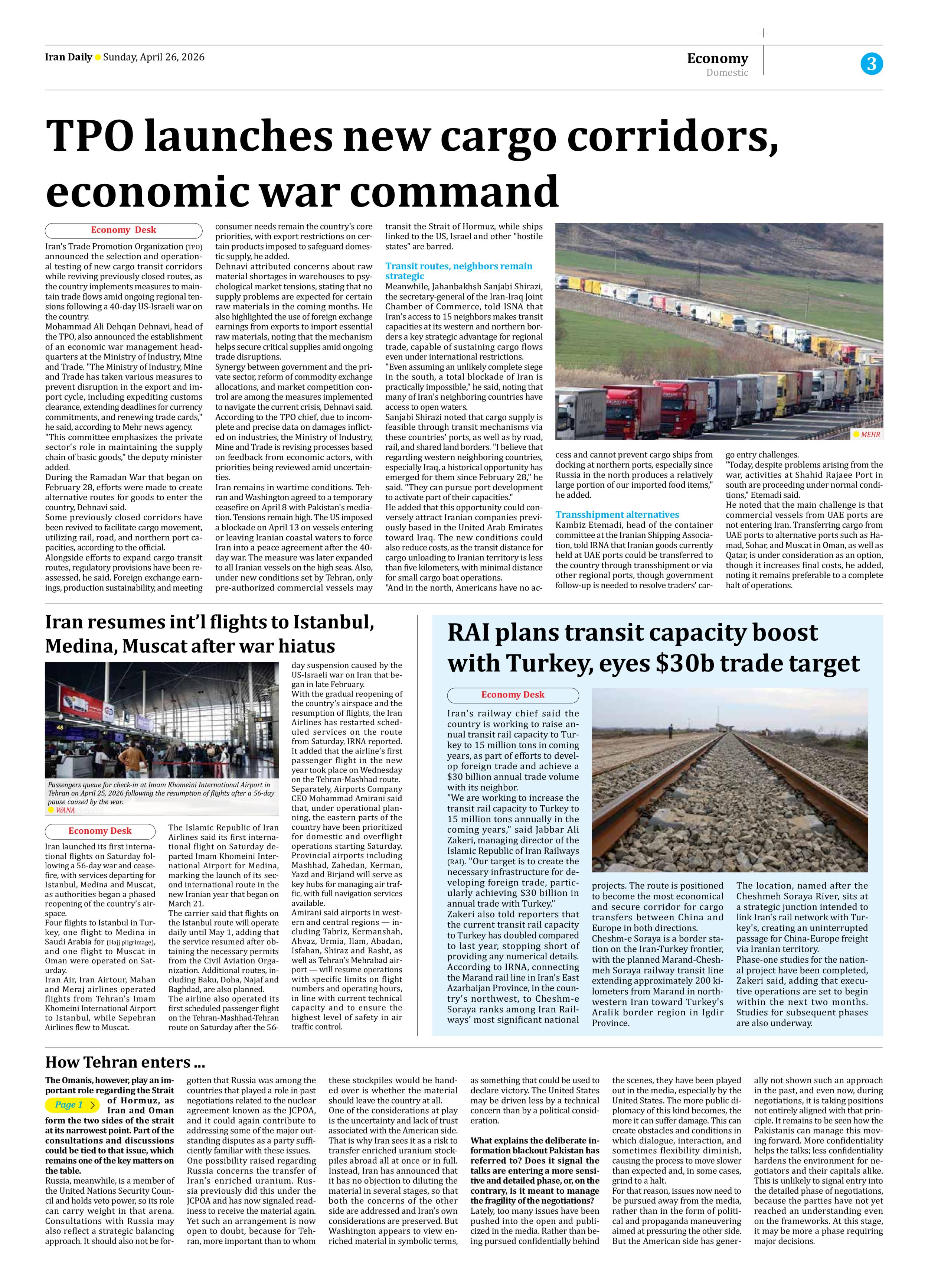
Some previously closed corridors have been revived to facilitate cargo movement, utilizing rail, road, and northern port capacities, according to the official.
Alongside efforts to expand cargo transit routes, regulatory provisions have been reassessed, he said. Foreign exchange earnings, production sustainability, and meeting consumer needs remain the country's core priorities, with export restrictions on certain products imposed to safeguard domestic supply, he added.
Dehnavi attributed concerns about raw material shortages in warehouses to psychological market tensions, stating that no supply problems are expected for certain raw materials in the coming months. He also highlighted the use of foreign exchange earnings from exports to import essential raw materials, noting that the mechanism helps secure critical supplies amid ongoing trade disruptions.
Synergy between government and the private sector, reform of commodity exchange allocations, and market competition control are among the measures implemented to navigate the current crisis, Dehnavi said.
According to the TPO chief, due to incomplete and precise data on damages inflicted on industries, the Ministry of Industry, Mine and Trade is revising processes based on feedback from economic actors, with priorities being reviewed amid uncertainties.
Iran remains in wartime conditions. Tehran and Washington agreed to a temporary ceasefire on April 8 with Pakistan's mediation. Tensions remain high. The US imposed a blockade on April 13 on vessels entering or leaving Iranian coastal waters to force Iran into a peace agreement after the 40-day war. The measure was later expanded to all Iranian vessels on the high seas. Also, under new conditions set by Tehran, only pre-authorized commercial vessels may transit the Strait of Hormuz, while ships linked to the US, Israel and other "hostile states" are barred.
Transit routes, neighbors remain strategic
Meanwhile, Jahanbakhsh Sanjabi Shirazi, the secretary-general of the Iran-Iraq Joint Chamber of Commerce, told ISNA that Iran's access to 15 neighbors makes transit capacities at its western and northern borders a key strategic advantage for regional trade, capable of sustaining cargo flows even under international restrictions.
"Even assuming an unlikely complete siege in the south, a total blockade of Iran is practically impossible," he said, noting that many of Iran's neighboring countries have access to open waters.
Sanjabi Shirazi noted that cargo supply is feasible through transit mechanisms via these countries' ports, as well as by road, rail, and shared land borders. "I believe that regarding western neighboring countries, especially Iraq, a historical opportunity has emerged for them since February 28," he said. "They can pursue port development to activate part of their capacities."
He added that this opportunity could conversely attract Iranian companies previously based in the United Arab Emirates toward Iraq. The new conditions could also reduce costs, as the transit distance for cargo unloading to Iranian territory is less than five kilometers, with minimal distance for small cargo boat operations.
"And in the north, Americans have no access and cannot prevent cargo ships from docking at northern ports, especially since Russia in the north produces a relatively large portion of our imported food items," he added.
Transshipment alternatives
Kambiz Etemadi, head of the container committee at the Iranian Shipping Association, told IRNA that Iranian goods currently held at UAE ports could be transferred to the country through transshipment or via other regional ports, though government follow-up is needed to resolve traders' cargo entry challenges.
"Today, despite problems arising from the war, activities at Shahid Rajaee Port in south are proceeding under normal conditions," Etemadi said.
He noted that the main challenge is that commercial vessels from UAE ports are not entering Iran. Transferring cargo from UAE ports to alternative ports such as Hamad, Sohar, and Muscat in Oman, as well as Qatar, is under consideration as an option, though it increases final costs, he added, noting it remains preferable to a complete halt of operations.