





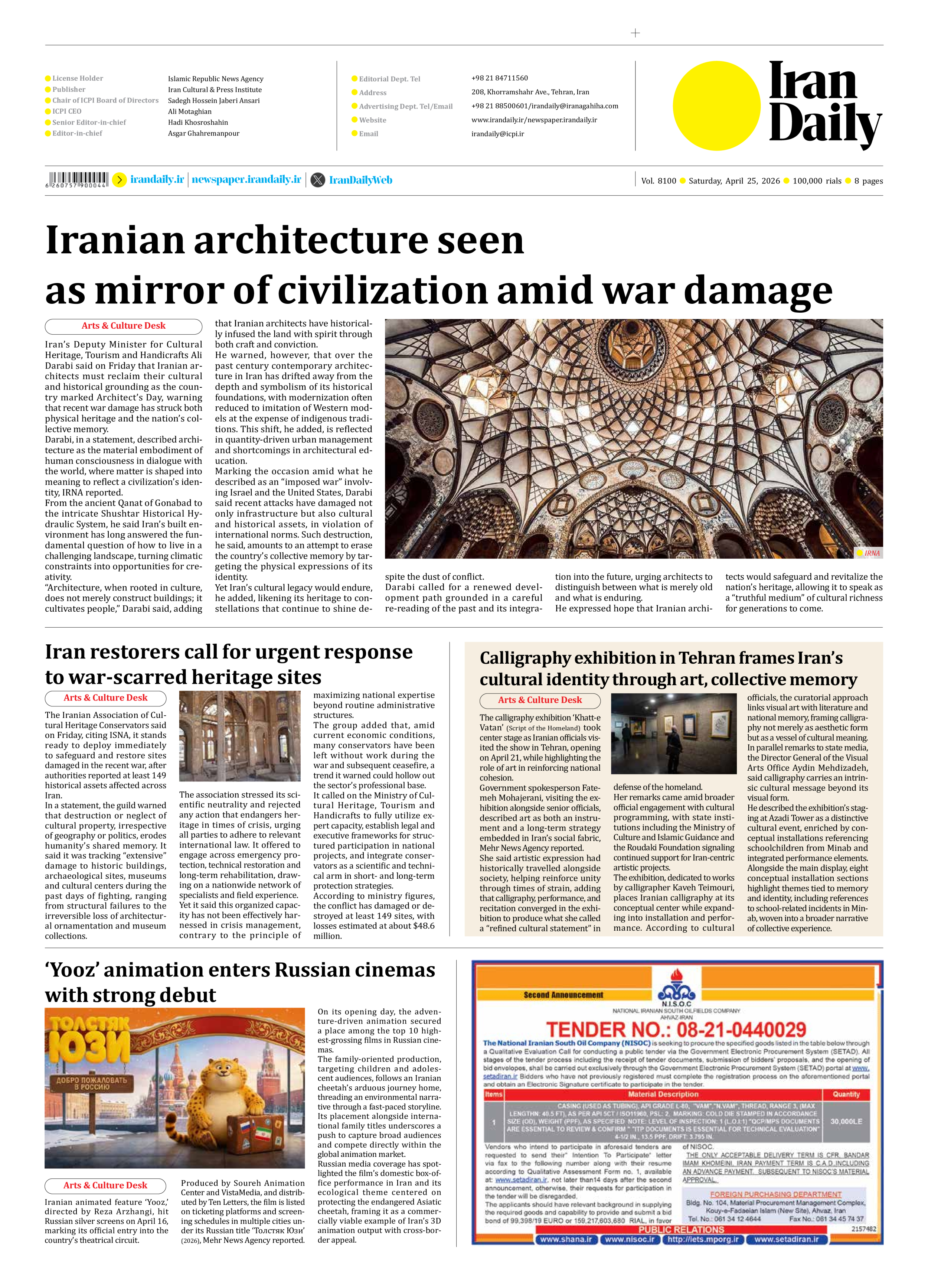


Iranian architecture seen as mirror of civilization amid war damage
Iran’s Deputy Minister for Cultural Heritage, Tourism and Handicrafts Ali Darabi said on Friday that Iranian architects must reclaim their cultural and historical grounding as the country marked Architect’s Day, warning that recent war damage has struck both physical heritage and the nation’s collective memory.
Darabi, in a statement, described architecture as the material embodiment of human consciousness in dialogue with the world, where matter is shaped into meaning to reflect a civilization’s identity, IRNA reported.
From the ancient Qanat of Gonabad to the intricate Shushtar Historical Hydraulic System, he said Iran’s built environment has long answered the fundamental question of how to live in a challenging landscape, turning climatic constraints into opportunities for creativity.
“Architecture, when rooted in culture, does not merely construct buildings; it cultivates people,” Darabi said, adding that Iranian architects have historically infused the land with spirit through both craft and conviction.
He warned, however, that over the past century contemporary architecture in Iran has drifted away from the depth and symbolism of its historical foundations, with modernization often reduced to imitation of Western models at the expense of indigenous traditions. This shift, he added, is reflected in quantity-driven urban management and shortcomings in architectural education.
Marking the occasion amid what he described as an “imposed war” involving Israel and the United States, Darabi said recent attacks have damaged not only infrastructure but also cultural and historical assets, in violation of international norms. Such destruction, he said, amounts to an attempt to erase the country’s collective memory by targeting the physical expressions of its identity.
Yet Iran’s cultural legacy would endure, he added, likening its heritage to constellations that continue to shine despite the dust of conflict.
Darabi called for a renewed development path grounded in a careful re-reading of the past and its integration into the future, urging architects to distinguish between what is merely old and what is enduring.
He expressed hope that Iranian architects would safeguard and revitalize the nation’s heritage, allowing it to speak as a “truthful medium” of cultural richness for generations to come.