







Hormozgan’s hot springs; Iran’s therapeutic treasure
The natural hot springs of Hormozgan Province represent some of Iran’s most valuable geological assets, combining scenic beauty with significant therapeutic properties. According to provincial statistics, 31 natural springs have been identified across the region, of which eight are cold mineral springs, while the remainder are thermal and predominantly sulfurous in composition.
These springs, nestled among rare mountain landscapes and picturesque valleys, have become destinations for both nature enthusiasts and health tourists seeking relief from various ailments. The mineral content — particularly sulfur compounds — has made them especially sought-after for treating skin diseases, rheumatism, joint pain, and certain respiratory conditions, according to chtn.ir.
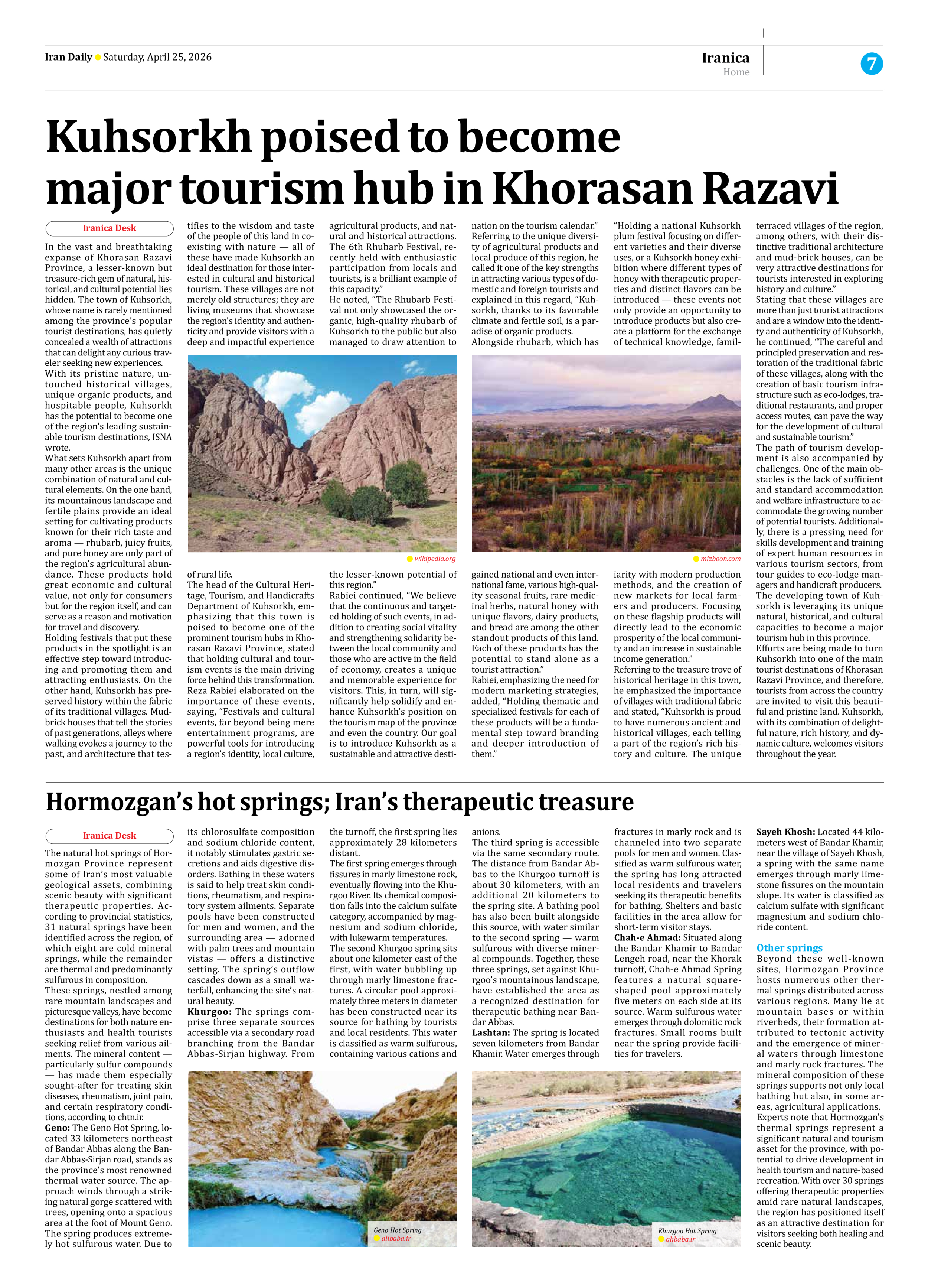
Geno: The Geno Hot Spring, located 33 kilometers northeast of Bandar Abbas along the Bandar Abbas-Sirjan road, stands as the province’s most renowned thermal water source. The approach winds through a striking natural gorge scattered with trees, opening onto a spacious area at the foot of Mount Geno. The spring produces extremely hot sulfurous water. Due to its chlorosulfate composition and sodium chloride content, it notably stimulates gastric secretions and aids digestive disorders. Bathing in these waters is said to help treat skin conditions, rheumatism, and respiratory system ailments. Separate pools have been constructed for men and women, and the surrounding area — adorned with palm trees and mountain vistas — offers a distinctive setting. The spring’s outflow cascades down as a small waterfall, enhancing the site’s natural beauty.
Khurgoo: The springs comprise three separate sources accessible via a secondary road branching from the Bandar Abbas-Sirjan highway. From the turnoff, the first spring lies approximately 28 kilometers distant.
The first spring emerges through fissures in marly limestone rock, eventually flowing into the Khurgoo River. Its chemical composition falls into the calcium sulfate category, accompanied by magnesium and sodium chloride, with lukewarm temperatures.
The second Khurgoo spring sits about one kilometer east of the first, with water bubbling up through marly limestone fractures. A circular pool approximately three meters in diameter has been constructed near its source for bathing by tourists and local residents. This water is classified as warm sulfurous, containing various cations and anions.
The third spring is accessible via the same secondary route. The distance from Bandar Abbas to the Khurgoo turnoff is about 30 kilometers, with an additional 20 kilometers to the spring site. A bathing pool has also been built alongside this source, with water similar to the second spring — warm sulfurous with diverse mineral compounds. Together, these three springs, set against Khurgoo’s mountainous landscape, have established the area as a recognized destination for therapeutic bathing near Bandar Abbas.
Lashtan: The spring is located seven kilometers from Bandar Khamir. Water emerges through fractures in marly rock and is channeled into two separate pools for men and women. Classified as warm sulfurous water, the spring has long attracted local residents and travelers seeking its therapeutic benefits for bathing. Shelters and basic facilities in the area allow for short-term visitor stays.
Chah-e Ahmad: Situated along the Bandar Khamir to Bandar Lengeh road, near the Khorak turnoff, Chah-e Ahmad Spring features a natural square-shaped pool approximately five meters on each side at its source. Warm sulfurous water emerges through dolomitic rock fractures. Small rooms built near the spring provide facilities for travelers.
Sayeh Khosh: Located 44 kilometers west of Bandar Khamir, near the village of Sayeh Khosh, a spring with the same name emerges through marly limestone fissures on the mountain slope. Its water is classified as calcium sulfate with significant magnesium and sodium chloride content.
Other springs
Beyond these well-known sites, Hormozgan Province hosts numerous other thermal springs distributed across various regions. Many lie at mountain bases or within riverbeds, their formation attributed to tectonic activity and the emergence of mineral waters through limestone and marly rock fractures. The mineral composition of these springs supports not only local bathing but also, in some areas, agricultural applications.
Experts note that Hormozgan’s thermal springs represent a significant natural and tourism asset for the province, with potential to drive development in health tourism and nature-based recreation. With over 30 springs offering therapeutic properties amid rare natural landscapes, the region has positioned itself as an attractive destination for visitors seeking both healing and scenic beauty.