







Jask Port busts US blockade, funnels oil to China
CBI pockets first revenue from Hormuz transit tolls
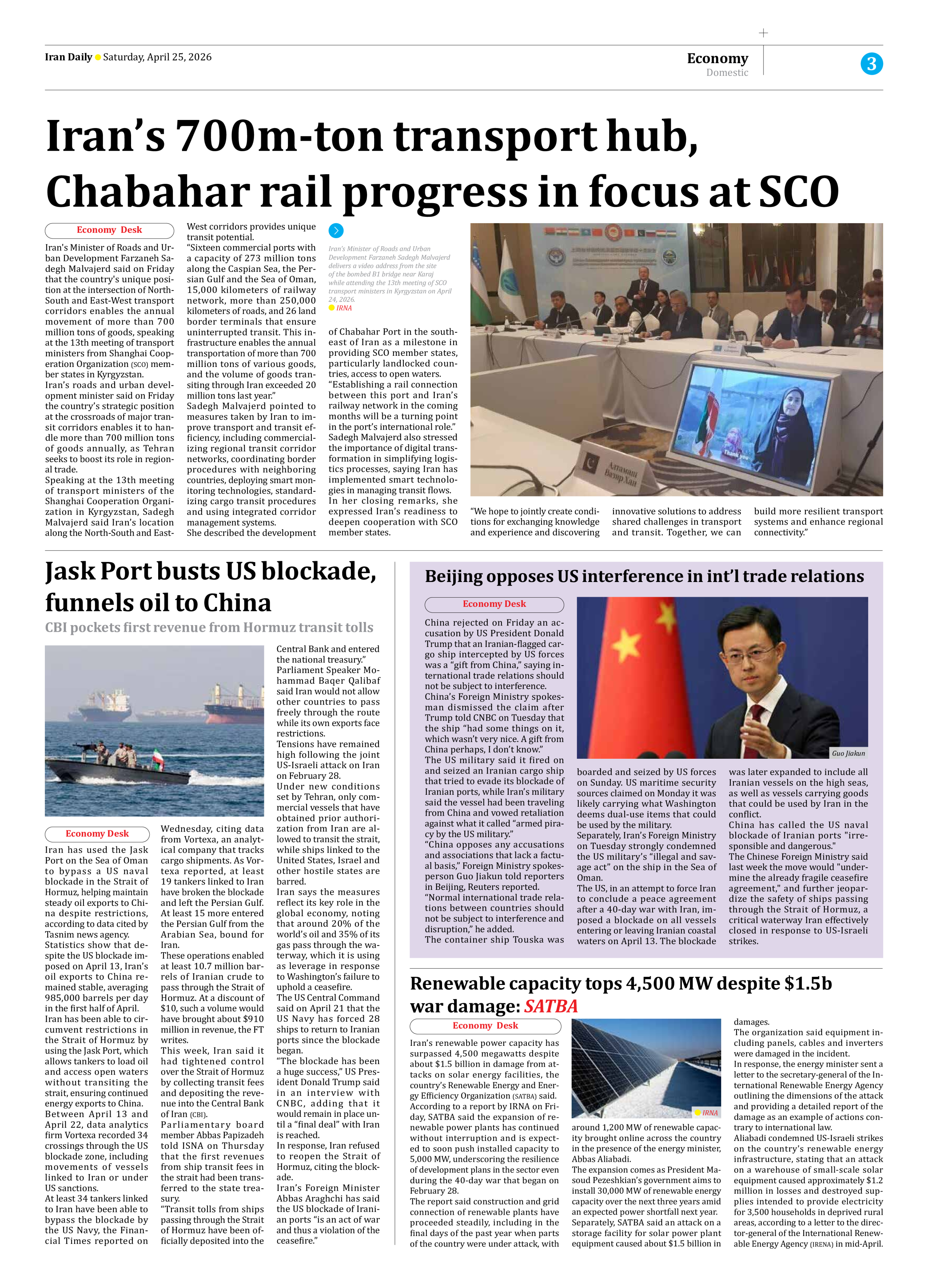
Iran has used the Jask Port on the Sea of Oman to bypass a US naval blockade in the Strait of Hormuz, helping maintain steady oil exports to China despite restrictions, according to data cited by Tasnim news agency.
Statistics show that despite the US blockade imposed on April 13, Iran’s oil exports to China remained stable, averaging 985,000 barrels per day in the first half of April.
Iran has been able to circumvent restrictions in the Strait of Hormuz by using the Jask Port, which allows tankers to load oil and access open waters without transiting the strait, ensuring continued energy exports to China.
Between April 13 and April 22, data analytics firm Vortexa recorded 34 crossings through the US blockade zone, including movements of vessels linked to Iran or under US sanctions.
At least 34 tankers linked to Iran have been able to bypass the blockade by the US Navy, the Financial Times reported on Wednesday, citing data from Vortexa, an analytical company that tracks cargo shipments. As Vortexa reported, at least 19 tankers linked to Iran have broken the blockade and left the Persian Gulf. At least 15 more entered the Persian Gulf from the Arabian Sea, bound for Iran.
These operations enabled at least 10.7 million barrels of Iranian crude to pass through the Strait of Hormuz. At a discount of $10, such a volume would have brought about $910 million in revenue, the FT writes.
This week, Iran said it had tightened control over the Strait of Hormuz by collecting transit fees and depositing the revenue into the Central Bank of Iran (CBI).
Parliamentary board member Abbas Papizadeh told ISNA on Thursday that the first revenues from ship transit fees in the strait had been transferred to the state treasury.
“Transit tolls from ships passing through the Strait of Hormuz have been officially deposited into the Central Bank and entered the national treasury.”
Parliament Speaker Mohammad Baqer Qalibaf said Iran would not allow other countries to pass freely through the route while its own exports face restrictions.
Tensions have remained high following the joint US-Israeli attack on Iran on February 28.
Under new conditions set by Tehran, only commercial vessels that have obtained prior authorization from Iran are allowed to transit the strait, while ships linked to the United States, Israel and other hostile states are barred.
Iran says the measures reflect its key role in the global economy, noting that around 20% of the world’s oil and 35% of its gas pass through the waterway, which it is using as leverage in response to Washington’s failure to uphold a ceasefire.
The US Central Command said on April 21 that the US Navy has forced 28 ships to return to Iranian ports since the blockade began.
“The blockade has been a huge success,” US President Donald Trump said in an interview with CNBC, adding that it would remain in place until a “final deal” with Iran is reached.
In response, Iran refused to reopen the Strait of Hormuz, citing the blockade.
Iran’s Foreign Minister Abbas Araghchi has said the US blockade of Iranian ports “is an act of war and thus a violation of the ceasefire.”