







Redesigning role of Strait of Hormuz in tech cold war
By Mehdi Rouhani
Researcher
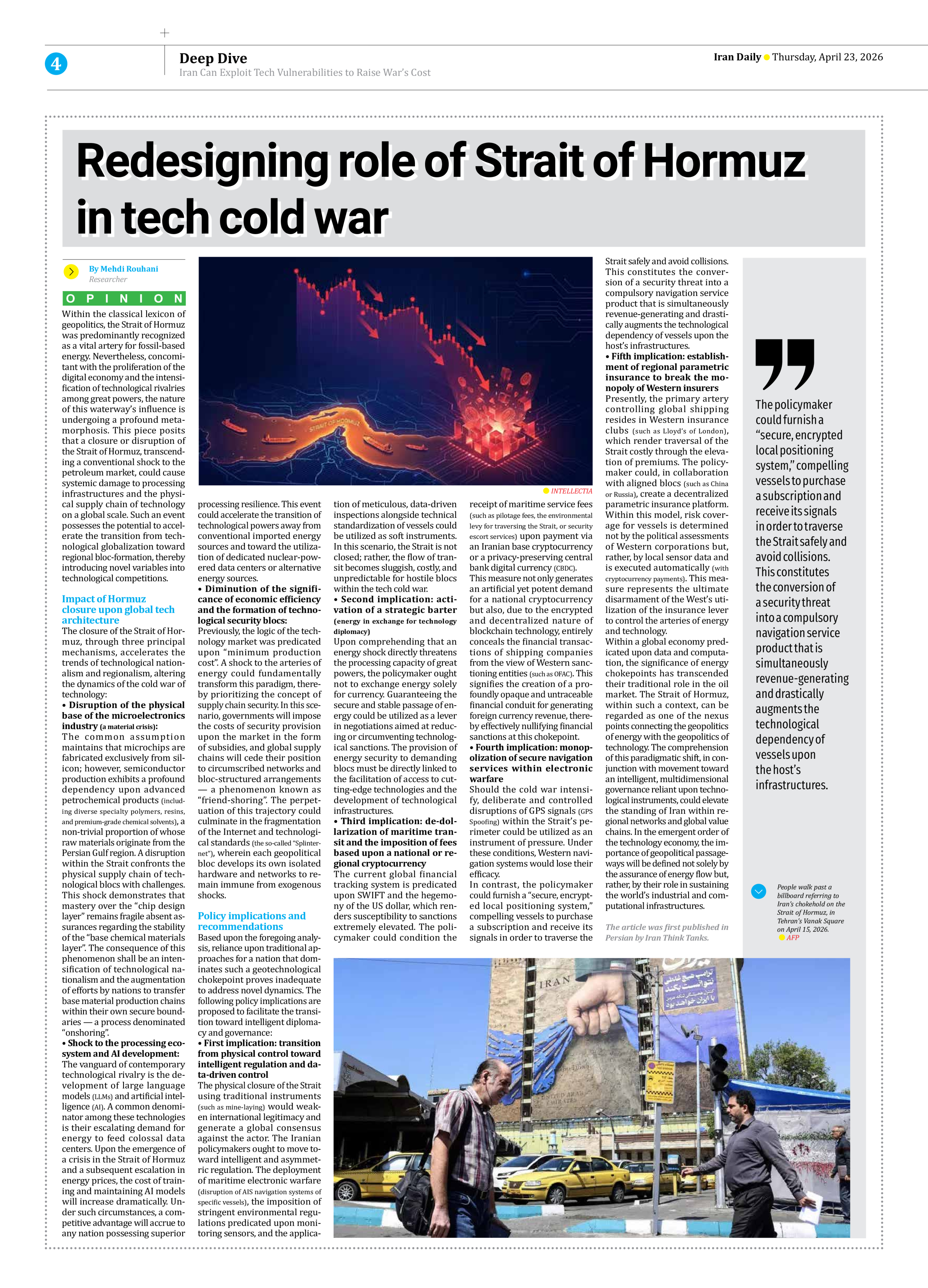
Within the classical lexicon of geopolitics, the Strait of Hormuz was predominantly recognized as a vital artery for fossil-based energy. Nevertheless, concomitant with the proliferation of the digital economy and the intensification of technological rivalries among great powers, the nature of this waterway’s influence is undergoing a profound metamorphosis. This piece posits that a closure or disruption of the Strait of Hormuz, transcending a conventional shock to the petroleum market, could cause systemic damage to processing infrastructures and the physical supply chain of technology on a global scale. Such an event possesses the potential to accelerate the transition from technological globalization toward regional bloc-formation, thereby introducing novel variables into technological competitions.
Impact of Hormuz closure upon global tech architecture
The closure of the Strait of Hormuz, through three principal mechanisms, accelerates the trends of technological nationalism and regionalism, altering the dynamics of the cold war of technology:
• Disruption of the physical base of the microelectronics industry (a material crisis):
The common assumption maintains that microchips are fabricated exclusively from silicon; however, semiconductor production exhibits a profound dependency upon advanced petrochemical products (including diverse specialty polymers, resins, and premium-grade chemical solvents), a non-trivial proportion of whose raw materials originate from the Persian Gulf region. A disruption within the Strait confronts the physical supply chain of technological blocs with challenges. This shock demonstrates that mastery over the “chip design layer” remains fragile absent assurances regarding the stability of the “base chemical materials layer”. The consequence of this phenomenon shall be an intensification of technological nationalism and the augmentation of efforts by nations to transfer base material production chains within their own secure boundaries — a process denominated “onshoring”.
• Shock to the processing ecosystem and AI development:
The vanguard of contemporary technological rivalry is the development of large language models (LLMs) and artificial intelligence (AI). A common denominator among these technologies is their escalating demand for energy to feed colossal data centers. Upon the emergence of a crisis in the Strait of Hormuz and a subsequent escalation in energy prices, the cost of training and maintaining AI models will increase dramatically. Under such circumstances, a competitive advantage will accrue to any nation possessing superior processing resilience. This event could accelerate the transition of technological powers away from conventional imported energy sources and toward the utilization of dedicated nuclear-powered data centers or alternative energy sources.
• Diminution of the significance of economic efficiency and the formation of technological security blocs:
Previously, the logic of the technology market was predicated upon “minimum production cost”. A shock to the arteries of energy could fundamentally transform this paradigm, thereby prioritizing the concept of supply chain security. In this scenario, governments will impose the costs of security provision upon the market in the form of subsidies, and global supply chains will cede their position to circumscribed networks and bloc-structured arrangements — a phenomenon known as “friend-shoring”. The perpetuation of this trajectory could culminate in the fragmentation of the Internet and technological standards (the so-called “Splinternet”), wherein each geopolitical bloc develops its own isolated hardware and networks to remain immune from exogenous shocks.
Policy implications and recommendations
Based upon the foregoing analysis, reliance upon traditional approaches for a nation that dominates such a geotechnological chokepoint proves inadequate to address novel dynamics. The following policy implications are proposed to facilitate the transition toward intelligent diplomacy and governance:
• First implication: transition from physical control toward intelligent regulation and data-driven control
The physical closure of the Strait using traditional instruments (such as mine-laying) would weaken international legitimacy and generate a global consensus against the actor. The Iranian policymakers ought to move toward intelligent and asymmetric regulation. The deployment of maritime electronic warfare (disruption of AIS navigation systems of specific vessels), the imposition of stringent environmental regulations predicated upon monitoring sensors, and the application of meticulous, data-driven inspections alongside technical standardization of vessels could be utilized as soft instruments. In this scenario, the Strait is not closed; rather, the flow of transit becomes sluggish, costly, and unpredictable for hostile blocs within the tech cold war.
• Second implication: activation of a strategic barter (energy in exchange for technology diplomacy)
Upon comprehending that an energy shock directly threatens the processing capacity of great powers, the policymaker ought not to exchange energy solely for currency. Guaranteeing the secure and stable passage of energy could be utilized as a lever in negotiations aimed at reducing or circumventing technological sanctions. The provision of energy security to demanding blocs must be directly linked to the facilitation of access to cutting-edge technologies and the development of technological infrastructures.
• Third implication: de-dollarization of maritime transit and the imposition of fees based upon a national or regional cryptocurrency
The current global financial tracking system is predicated upon SWIFT and the hegemony of the US dollar, which renders susceptibility to sanctions extremely elevated. The policymaker could condition the receipt of maritime service fees (such as pilotage fees, the environmental levy for traversing the Strait, or security escort services) upon payment via an Iranian base cryptocurrency or a privacy-preserving central bank digital currency (CBDC).
This measure not only generates an artificial yet potent demand for a national cryptocurrency but also, due to the encrypted and decentralized nature of blockchain technology, entirely conceals the financial transactions of shipping companies from the view of Western sanctioning entities (such as OFAC). This signifies the creation of a profoundly opaque and untraceable financial conduit for generating foreign currency revenue, thereby effectively nullifying financial sanctions at this chokepoint.
• Fourth implication: monopolization of secure navigation services within electronic warfare
Should the cold war intensify, deliberate and controlled disruptions of GPS signals (GPS Spoofing) within the Strait’s perimeter could be utilized as an instrument of pressure. Under these conditions, Western navigation systems would lose their efficacy.
In contrast, the policymaker could furnish a “secure, encrypted local positioning system,” compelling vessels to purchase a subscription and receive its signals in order to traverse the Strait safely and avoid collisions. This constitutes the conversion of a security threat into a compulsory navigation service product that is simultaneously revenue-generating and drastically augments the technological dependency of vessels upon the host’s infrastructures.
• Fifth implication: establishment of regional parametric insurance to break the monopoly of Western insurers
Presently, the primary artery controlling global shipping resides in Western insurance clubs (such as Lloyd’s of London), which render traversal of the Strait costly through the elevation of premiums. The policymaker could, in collaboration with aligned blocs (such as China or Russia), create a decentralized parametric insurance platform. Within this model, risk coverage for vessels is determined not by the political assessments of Western corporations but, rather, by local sensor data and is executed automatically (with cryptocurrency payments). This measure represents the ultimate disarmament of the West’s utilization of the insurance lever to control the arteries of energy and technology.
Within a global economy predicated upon data and computation, the significance of energy chokepoints has transcended their traditional role in the oil market. The Strait of Hormuz, within such a context, can be regarded as one of the nexus points connecting the geopolitics of energy with the geopolitics of technology. The comprehension of this paradigmatic shift, in conjunction with movement toward an intelligent, multidimensional governance reliant upon technological instruments, could elevate the standing of Iran within regional networks and global value chains. In the emergent order of the technology economy, the importance of geopolitical passageways will be defined not solely by the assurance of energy flow but, rather, by their role in sustaining the world’s industrial and computational infrastructures.
The article was first published in Persian by Iran Think Tanks.