







Copy in clipboard...
‘The Heart of Iran’: HEGTA’s national social initiative brings hope back to children’s hearts
Alireza Tabesh, CEO of HEGTA, said, “in these days when so many hearts are grieving, with the participation and cooperation of organizations such as the House of Cinema, the House of Theater, Iran Music House, the Stationary Manufacturers Union Society of Iran, and the Peyk-e Tahrir group, we consider it our duty to create a new atmosphere of hope, solidarity, and creation for children. Art is the common language of all Iranians, and by partnering with a range of the country’s cultural and artistic institutions, we aim to help increase people’s resilience and build a brighter future for the next generation.”
‘The Heart of Iran’ program
The CEO of HEGTA stated, “under this initiative, a series of programs have been planned, centered around children’s drawing under the slogan ‘We build the future with colors,’ completing a puzzle of the ‘Map of Iran’ focusing on images of historical and natural heritage alongside the names of various cities of our country, as well as designing artistic performances and helping to organize them nationwide with the assistance of civil associations and institutions.”
He emphasized, “these programs will be carried out across the extensive network of HEGTA’s hotels, trains, and tourism centers, as well as in schools, cultural centers, and public events, in coordination and collaboration with relevant authorities throughout Iran.”
Tabesh said, “the goal of this initiative is not merely to hold a cultural event; rather, we want to create a collective experience, one in which children learn that hope can be kept alive through colors, art, empathy, and resilience.”
First of its kind in Tehran
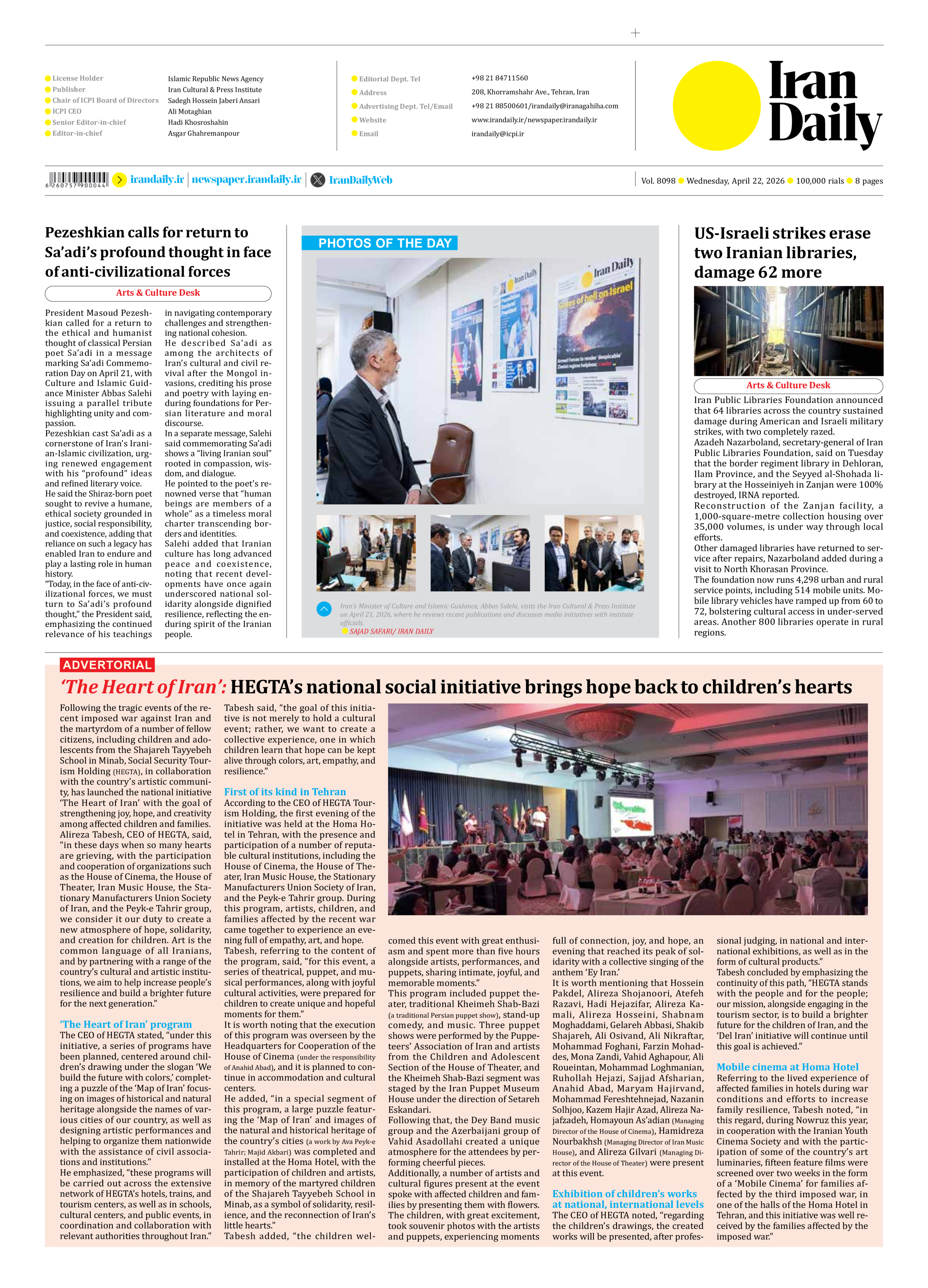
According to the CEO of HEGTA Tourism Holding, the first evening of the initiative was held at the Homa Hotel in Tehran, with the presence and participation of a number of reputable cultural institutions, including the House of Cinema, the House of Theater, Iran Music House, the Stationary Manufacturers Union Society of Iran, and the Peyk-e Tahrir group. During this program, artists, children, and families affected by the recent war came together to experience an evening full of empathy, art, and hope.
Tabesh, referring to the content of the program, said, “for this event, a series of theatrical, puppet, and musical performances, along with joyful cultural activities, were prepared for children to create unique and hopeful moments for them.”
It is worth noting that the execution of this program was overseen by the Headquarters for Cooperation of the House of Cinema (under the responsibility of Anahid Abad), and it is planned to continue in accommodation and cultural centers.
He added, “in a special segment of this program, a large puzzle featuring the ‘Map of Iran’ and images of the natural and historical heritage of the country’s cities (a work by Ava Peyk-e Tahrir; Majid Akbari) was completed and installed at the Homa Hotel, with the participation of children and artists, in memory of the martyred children of the Shajareh Tayyebeh School in Minab, as a symbol of solidarity, resilience, and the reconnection of Iran’s little hearts.”
Tabesh added, “the children welcomed this event with great enthusiasm and spent more than five hours alongside artists, performances, and puppets, sharing intimate, joyful, and memorable moments.”
This program included puppet theater, traditional Kheimeh Shab-Bazi (a traditional Persian puppet show), stand-up comedy, and music. Three puppet shows were performed by the Puppeteers’ Association of Iran and artists from the Children and Adolescent Section of the House of Theater, and the Kheimeh Shab-Bazi segment was staged by the Iran Puppet Museum House under the direction of Setareh Eskandari.
Following that, the Dey Band music group and the Azerbaijani group of Vahid Asadollahi created a unique atmosphere for the attendees by performing cheerful pieces.
Additionally, a number of artists and cultural figures present at the event spoke with affected children and families by presenting them with flowers. The children, with great excitement, took souvenir photos with the artists and puppets, experiencing moments full of connection, joy, and hope, an evening that reached its peak of solidarity with a collective singing of the anthem ‘Ey Iran.’
It is worth mentioning that Hossein Pakdel, Alireza Shojanoori, Atefeh Razavi, Hadi Hejazifar, Alireza Kamali, Alireza Hosseini, Shabnam Moghaddami, Gelareh Abbasi, Shakib Shajareh, Ali Osivand, Ali Nikraftar, Mohammad Foghani, Farzin Mohaddes, Mona Zandi, Vahid Aghapour, Ali Roueintan, Mohammad Loghmanian, Ruhollah Hejazi, Sajjad Afsharian, Anahid Abad, Maryam Hajirvand, Mohammad Fereshtehnejad, Nazanin Solhjoo, Kazem Hajir Azad, Alireza Najafzadeh, Homayoun As’adian (Managing Director of the House of Cinema), Hamidreza Nourbakhsh (Managing Director of Iran Music House), and Alireza Gilvari (Managing Director of the House of Theater) were present at this event.
Exhibition of children’s works at national, international levels
The CEO of HEGTA noted, “regarding the children’s drawings, the created works will be presented, after professional judging, in national and international exhibitions, as well as in the form of cultural products.”
Tabesh concluded by emphasizing the continuity of this path, “HEGTA stands with the people and for the people; our mission, alongside engaging in the tourism sector, is to build a brighter future for the children of Iran, and the ‘Del Iran’ initiative will continue until this goal is achieved.”
Mobile cinema at Homa Hotel
Referring to the lived experience of affected families in hotels during war conditions and efforts to increase family resilience, Tabesh noted, “in this regard, during Nowruz this year, in cooperation with the Iranian Youth Cinema Society and with the participation of some of the country’s art luminaries, fifteen feature films were screened over two weeks in the form of a ‘Mobile Cinema’ for families affected by the third imposed war, in one of the halls of the Homa Hotel in Tehran, and this initiative was well received by the families affected by the imposed war.”