







Major museum expansion wraps up in West Azarbaijan Province
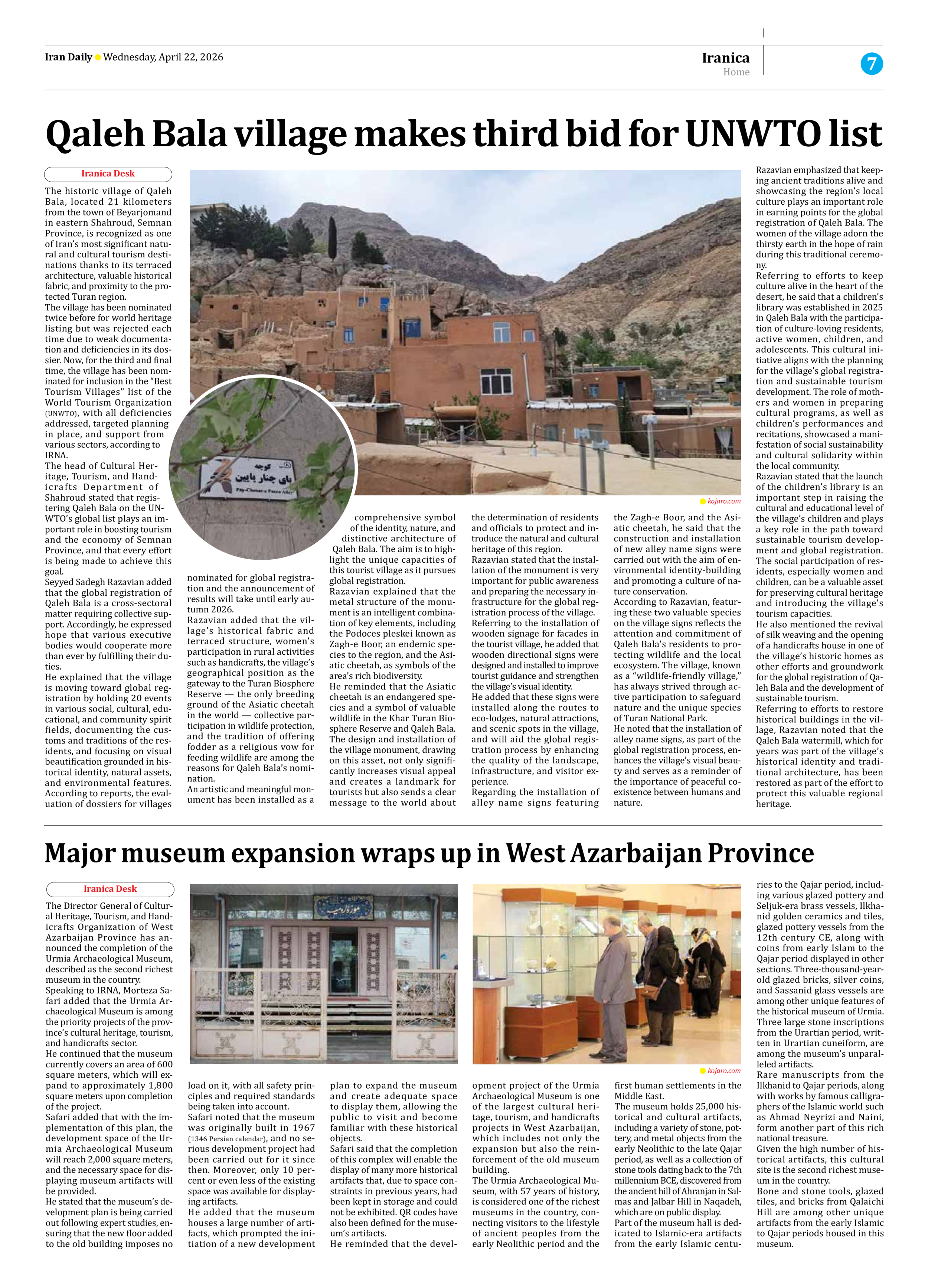
The Director General of Cultural Heritage, Tourism, and Handicrafts Organization of West Azarbaijan Province has announced the completion of the Urmia Archaeological Museum, described as the second richest museum in the country.
Speaking to IRNA, Morteza Safari added that the Urmia Archaeological Museum is among the priority projects of the province’s cultural heritage, tourism, and handicrafts sector.
He continued that the museum currently covers an area of 600 square meters, which will expand to approximately 1,800 square meters upon completion of the project.
Safari added that with the implementation of this plan, the development space of the Urmia Archaeological Museum will reach 2,000 square meters, and the necessary space for displaying museum artifacts will be provided.
He stated that the museum’s development plan is being carried out following expert studies, ensuring that the new floor added to the old building imposes no load on it, with all safety principles and required standards being taken into account.
Safari noted that the museum was originally built in 1967 (1346 Persian calendar), and no serious development project had been carried out for it since then. Moreover, only 10 percent or even less of the existing space was available for displaying artifacts.
He added that the museum houses a large number of artifacts, which prompted the initiation of a new development plan to expand the museum and create adequate space to display them, allowing the public to visit and become familiar with these historical objects.
Safari said that the completion of this complex will enable the display of many more historical artifacts that, due to space constraints in previous years, had been kept in storage and could not be exhibited. QR codes have also been defined for the museum’s artifacts.
He reminded that the development project of the Urmia Archaeological Museum is one of the largest cultural heritage, tourism, and handicrafts projects in West Azarbaijan, which includes not only the expansion but also the reinforcement of the old museum building.
The Urmia Archaeological Museum, with 57 years of history, is considered one of the richest museums in the country, connecting visitors to the lifestyle of ancient peoples from the early Neolithic period and the first human settlements in the Middle East.
The museum holds 25,000 historical and cultural artifacts, including a variety of stone, pottery, and metal objects from the early Neolithic to the late Qajar period, as well as a collection of stone tools dating back to the 7th millennium BCE, discovered from the ancient hill of Ahranjan in Salmas and Jalbar Hill in Naqadeh, which are on public display.
Part of the museum hall is dedicated to Islamic-era artifacts from the early Islamic centuries to the Qajar period, including various glazed pottery and Seljuk-era brass vessels, Ilkhanid golden ceramics and tiles, glazed pottery vessels from the 12th century CE, along with coins from early Islam to the Qajar period displayed in other sections. Three-thousand-year-old glazed bricks, silver coins, and Sassanid glass vessels are among other unique features of the historical museum of Urmia.
Three large stone inscriptions from the Urartian period, written in Urartian cuneiform, are among the museum’s unparalleled artifacts.
Rare manuscripts from the Ilkhanid to Qajar periods, along with works by famous calligraphers of the Islamic world such as Ahmad Neyrizi and Naini, form another part of this rich national treasure.
Given the high number of historical artifacts, this cultural site is the second richest museum in the country.
Bone and stone tools, glazed tiles, and bricks from Qalaichi Hill are among other unique artifacts from the early Islamic to Qajar periods housed in this museum.