







War of attrition, Strait of Hormuz, energy economy
How regional crisis could shake global financial chain
Senior energy researcher
Military conflict in the Persian Gulf should not be understood merely as a battlefield or missile confrontation. It should instead be analyzed as an economic conflict centered on energy. In this framework, the prolongation of war, rising defense expenditures, disruption of critical infrastructure, increasing oil and refined product prices, and potential threats to energy transit through the Strait of Hormuz are all treated as variables capable of placing severe pressure on Western economies, particularly that of the United States.
The core argument is that in today’s global order, military power without a stable foundation of energy and capital does not produce absolute strategic advantage. The longer a war lasts, the higher the costs of replacing weapons systems, maintaining interception capabilities, insuring transportation routes, and supplying fuel to both importing and consuming economies. From this perspective, a prolonged conflict in the Persian Gulf could evolve into a global energy shock, one that would not only deepen inflation and stagnation, but could also trigger a chain of financial crises, debt stress, and even the bursting of asset bubbles, including those in technology and artificial intelligence.
In recent years, energy security has once again become one of the central pillars of global geopolitics. Although the world economy appears to be moving toward digitalization, services, data, and artificial intelligence, its underlying infrastructure remains deeply dependent on oil, gas, transit corridors, maritime insurance, and geostrategic stability.
This article, by emphasizing stock market declines, rising energy prices, the erosion of military capacity, and media restrictions, seeks to show that war in the Persian Gulf is not decided solely on the battlefield. Its outcome is also shaped by energy markets, financial markets, and the cost structure of the global economy.
From an analytical standpoint, such an approach is significant because modern warfare is more deeply intertwined with economics than ever before. If military victory could once be defined in relatively independent terms, today the sustainability of military operations, the financial stability of governments, access to energy, and the social tolerance for wartime costs have all become essential parts of the equation.
Theoretical framework
Energy analysis as the core of conflict interpretation: A scientific analysis of such claims can be built around an “energy security–war economy” framework. This framework rests on four main components:
Energy as infrastructure of power: Even in the technological age, advanced economies remain dependent on affordable and stable energy for transportation, production, military logistics, supply chains, and core industries. Any disruption in oil and gas supply or pricing generates consequences that extend far beyond the energy sector itself.
Asymmetric cost of war: This analysis highlights the cost gap between relatively inexpensive offensive tools and far more expensive defensive systems—for example, the use of lower-cost drones against highly costly interceptors. From the standpoint of defense economics, this is highly consequential. If one side can, at relatively low cost, force the other to continuously expend high-value resources, the conflict effectively becomes a war of budgetary attrition.
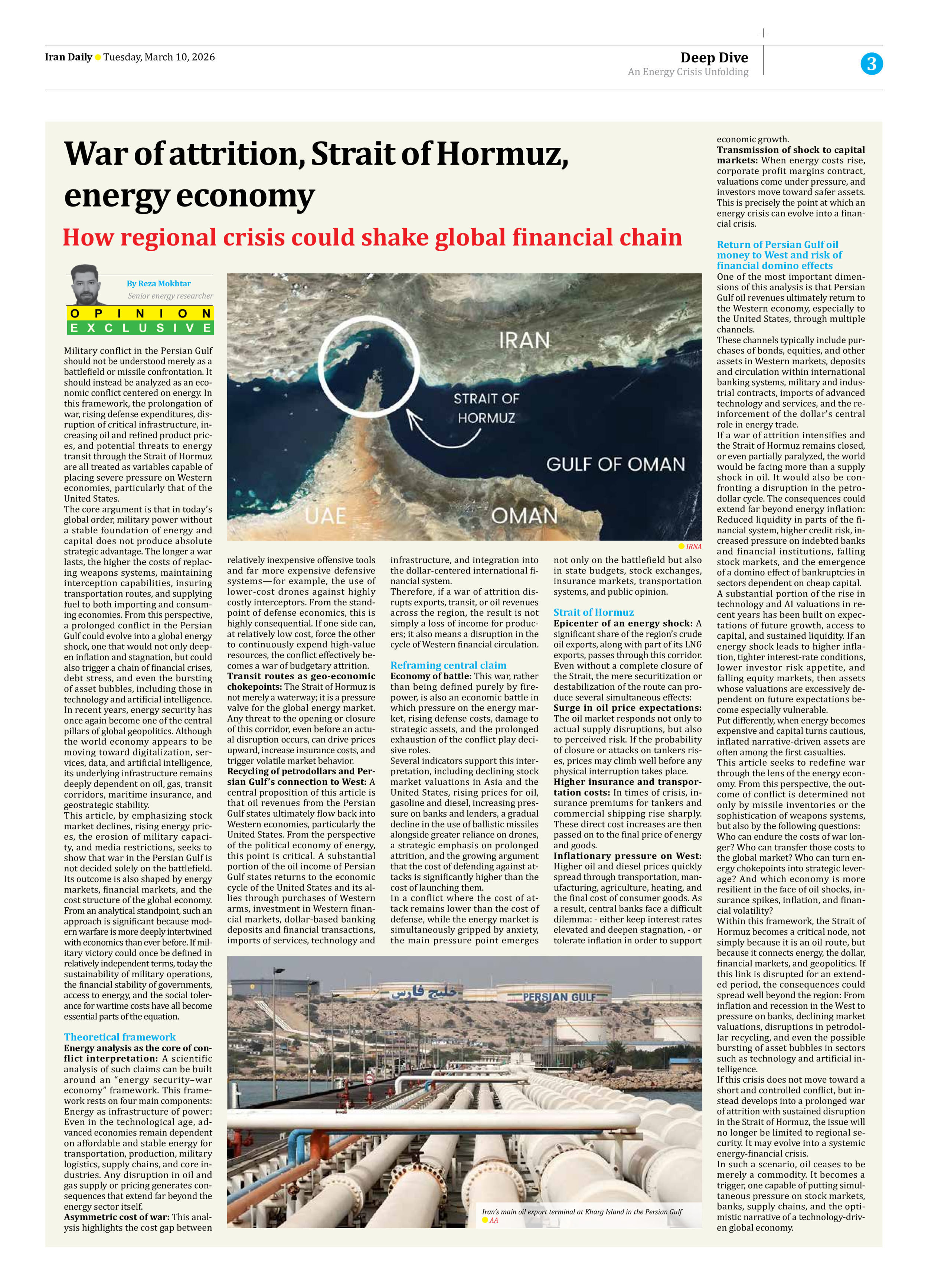
Transit routes as geo-economic chokepoints: The Strait of Hormuz is not merely a waterway; it is a pressure valve for the global energy market. Any threat to the opening or closure of this corridor, even before an actual disruption occurs, can drive prices upward, increase insurance costs, and trigger volatile market behavior.
Recycling of petrodollars and Persian Gulf’s connection to West: A central proposition of this article is that oil revenues from the Persian Gulf states ultimately flow back into Western economies, particularly the United States. From the perspective of the political economy of energy, this point is critical. A substantial portion of the oil income of Persian Gulf states returns to the economic cycle of the United States and its allies through purchases of Western arms, investment in Western financial markets, dollar-based banking deposits and financial transactions, imports of services, technology and infrastructure, and integration into the dollar-centered international financial system.
Therefore, if a war of attrition disrupts exports, transit, or oil revenues across the region, the result is not simply a loss of income for producers; it also means a disruption in the cycle of Western financial circulation.
Reframing central claim
Economy of battle: This war, rather than being defined purely by firepower, is also an economic battle in which pressure on the energy market, rising defense costs, damage to strategic assets, and the prolonged exhaustion of the conflict play decisive roles.
Several indicators support this interpretation, including declining stock market valuations in Asia and the United States, rising prices for oil, gasoline and diesel, increasing pressure on banks and lenders, a gradual decline in the use of ballistic missiles alongside greater reliance on drones, a strategic emphasis on prolonged attrition, and the growing argument that the cost of defending against attacks is significantly higher than the cost of launching them.
In a conflict where the cost of attack remains lower than the cost of defense, while the energy market is simultaneously gripped by anxiety, the main pressure point emerges not only on the battlefield but also in state budgets, stock exchanges, insurance markets, transportation systems, and public opinion.
Strait of Hormuz
Epicenter of an energy shock: A significant share of the region’s crude oil exports, along with part of its LNG exports, passes through this corridor. Even without a complete closure of the Strait, the mere securitization or destabilization of the route can produce several simultaneous effects:
Surge in oil price expectations: The oil market responds not only to actual supply disruptions, but also to perceived risk. If the probability of closure or attacks on tankers rises, prices may climb well before any physical interruption takes place.
Higher insurance and transportation costs: In times of crisis, insurance premiums for tankers and commercial shipping rise sharply. These direct cost increases are then passed on to the final price of energy and goods.
Inflationary pressure on West: Higher oil and diesel prices quickly spread through transportation, manufacturing, agriculture, heating, and the final cost of consumer goods. As a result, central banks face a difficult dilemma: - either keep interest rates elevated and deepen stagnation, - or tolerate inflation in order to support economic growth.
Transmission of shock to capital markets: When energy costs rise, corporate profit margins contract, valuations come under pressure, and investors move toward safer assets. This is precisely the point at which an energy crisis can evolve into a financial crisis.
Return of Persian Gulf oil money to West and risk of financial domino effects
One of the most important dimensions of this analysis is that Persian Gulf oil revenues ultimately return to the Western economy, especially to the United States, through multiple channels.
These channels typically include purchases of bonds, equities, and other assets in Western markets, deposits and circulation within international banking systems, military and industrial contracts, imports of advanced technology and services, and the reinforcement of the dollar’s central role in energy trade.
If a war of attrition intensifies and the Strait of Hormuz remains closed, or even partially paralyzed, the world would be facing more than a supply shock in oil. It would also be confronting a disruption in the petrodollar cycle. The consequences could extend far beyond energy inflation: Reduced liquidity in parts of the financial system, higher credit risk, increased pressure on indebted banks and financial institutions, falling stock markets, and the emergence of a domino effect of bankruptcies in sectors dependent on cheap capital.
A substantial portion of the rise in technology and AI valuations in recent years has been built on expectations of future growth, access to capital, and sustained liquidity. If an energy shock leads to higher inflation, tighter interest-rate conditions, lower investor risk appetite, and falling equity markets, then assets whose valuations are excessively dependent on future expectations become especially vulnerable.
Put differently, when energy becomes expensive and capital turns cautious, inflated narrative-driven assets are often among the first casualties.
This article seeks to redefine war through the lens of the energy economy. From this perspective, the outcome of conflict is determined not only by missile inventories or the sophistication of weapons systems, but also by the following questions:
Who can endure the costs of war longer? Who can transfer those costs to the global market? Who can turn energy chokepoints into strategic leverage? And which economy is more resilient in the face of oil shocks, insurance spikes, inflation, and financial volatility?
Within this framework, the Strait of Hormuz becomes a critical node, not simply because it is an oil route, but because it connects energy, the dollar, financial markets, and geopolitics. If this link is disrupted for an extended period, the consequences could spread well beyond the region: From inflation and recession in the West to pressure on banks, declining market valuations, disruptions in petrodollar recycling, and even the possible bursting of asset bubbles in sectors such as technology and artificial intelligence.
If this crisis does not move toward a short and controlled conflict, but instead develops into a prolonged war of attrition with sustained disruption in the Strait of Hormuz, the issue will no longer be limited to regional security. It may evolve into a systemic energy-financial crisis.
In such a scenario, oil ceases to be merely a commodity. It becomes a trigger, one capable of putting simultaneous pressure on stock markets, banks, supply chains, and the optimistic narrative of a technology-driven global economy.