







New Leader, New Blood
Branches of power, Armed Forces, people pledge allegiance to Ayatollah Seyyed Mojtaba Khamenei
Ayatollah Seyyed Mojtaba Khamenei was appointed as the new Leader of Iran by the Assembly of Experts on Monday.
The selection was made amid an ongoing war declared after a joint US-Israeli attack on February 28 resulted in the martyrdom of former Leader Ayatollah Seyyed Ali Khamenei.
The Assembly of Experts said in a statement that despite the “serious wartime conditions and direct threats and operations by the US and Israel against this popular body”, it immediately initiated the process of convening an extraordinary session to prevent a leadership vacuum within the country.
“After thorough and extensive deliberations, and utilizing Article 108 of the Constitution… today’s extraordinary session (Sunday) appointed Ayatollah Seyyed Mojtaba Hosseini Khamenei as the third Leader of the Islamic Republic of Iran, based on the overwhelming vote of the esteemed members of the Assembly of Experts,” the statement read.
Prior to the Assembly’s decision, in accordance with Article 111 of the Constitution, the Islamic Republic had established a temporary leadership council comprised of President Masoud Pezeshkian, Judiciary Chief Gholamhossein Mohseni Ejeie, and Ayatollah Alireza Arafi, a member of the Guardian Council.
Ayatollah Mojtaba Khamenei, the martyred Leader’s second son, was born in Mashhad in 1969. He studied in theological schools in Tehran and Qom and served in the front lines during the eight-year Iran-Iraq War (1980-88).
He has advanced theological studies under prominent clerics, including his father, and is a popular instructor at the Qom Seminary. His innovative teaching methods have contributed to the growth of his classes into one of the most vibrant in Qom.
Beyond his academic pursuits, Ayatollah Khamenei maintains strong ties with influential religious figures in Qom and Mashhad, as well as with military commanders and leaders of the resistance movement.
Heralding new era of pride & power
Following the announcement, various officials and organizations issued statements expressing their support for the new leadership.
President Pezeshkian hailed the appointment as “heralding a new era of pride and power for the Iranian nation.”
He added that this “valuable selection” reflects the will of the Islamic nation to strengthen national unity, which serves as a steadfast dam protecting the Iranian nation against the plots of its enemies.
Pezeshkian underlined Iran’s historical resilience and its ability to overcome challenges through collective wisdom, faith, and persistent effort.
“We will undoubtedly overcome the current challenges through the wise leadership of the new Leader and with a spirit of trust, empathy and widespread popular resistance,” he said.
Judiciary chief Ejeie described the Assembly’s decision as “hope-inspiring and defining” for the continuation and growth of the Islamic Republic.
He urged national unity and obedience to the new leadership, stating, “The country is currently engaged in a campaign against a savage enemy steeped in endless miscalculations”, and victory depends on allegiance and rallying around the Leader.
Parliament Speaker Mohammad Baqer Qalibaf called the decision a “sound and precise” measure that soothed the grievous loss of the former leader, effectively thwarting the hopes of Iran’s enemies.
He described the new leader as a devout, capable, and knowledgeable figure, familiar with the nation’s challenges and committed to the revolution’s new approach.
Members of parliament also issued a separate statement, declaring Ayatollah Khamenei the most deserving individual to lead the nation. They pledged full cooperation and support for the new Leader.
Ali Larijani, Secretary of the Supreme National Security Council, said the selection dashed the hopes of “warmongering enemies” while inspiring hope in the rights-seeking Iranian people.
Separately, the Islamic Revolution Guards Corps (IRGC) released a statement calling the appointment a “new dawn” and the beginning of a new stage in the revolution. The IRGC reaffirmed its commitment to supporting the new leadership and safeguarding the revolution’s values.
The Iranian Army and the Ministry of Defense also issued statements pledging allegiance and readiness to implement the new leader’s directives.
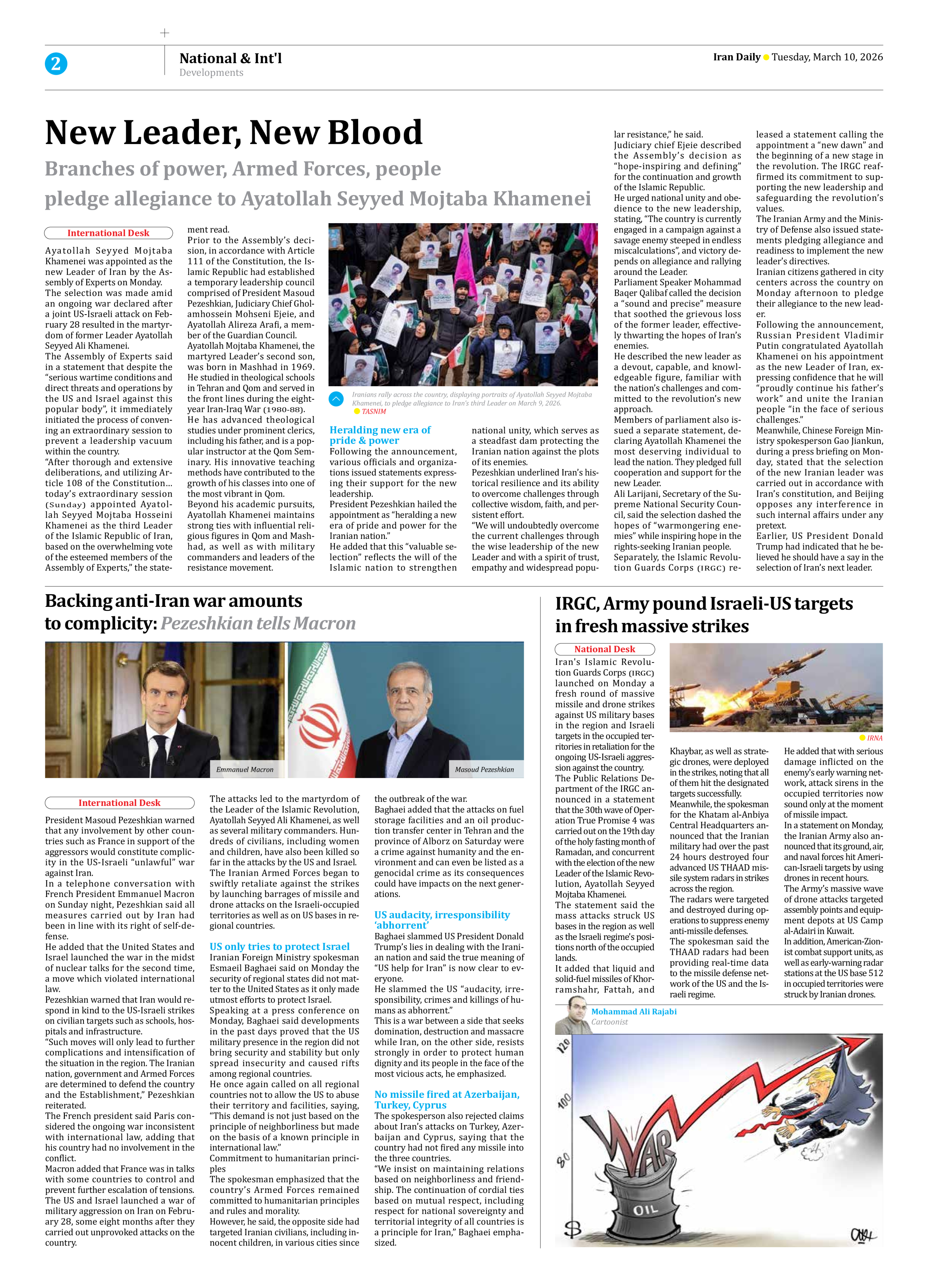
Iranian citizens gathered in city centers across the country on Monday afternoon to pledge their allegiance to the new leader.
Following the announcement, Russian President Vladimir Putin congratulated Ayatollah Khamenei on his appointment as the new Leader of Iran, expressing confidence that he will “proudly continue his father’s work” and unite the Iranian people “in the face of serious challenges.”
Meanwhile, Chinese Foreign Ministry spokesperson Gao Jiankun, during a press briefing on Monday, stated that the selection of the new Iranian leader was carried out in accordance with Iran’s constitution, and Beijing opposes any interference in such internal affairs under any pretext.
Earlier, US President Donald Trump had indicated that he believed he should have a say in the selection of Iran’s next leader.