







Rereading United States’ 2025 National Security Strategy, 2026 National Defense Strategy
Strategy of terror production
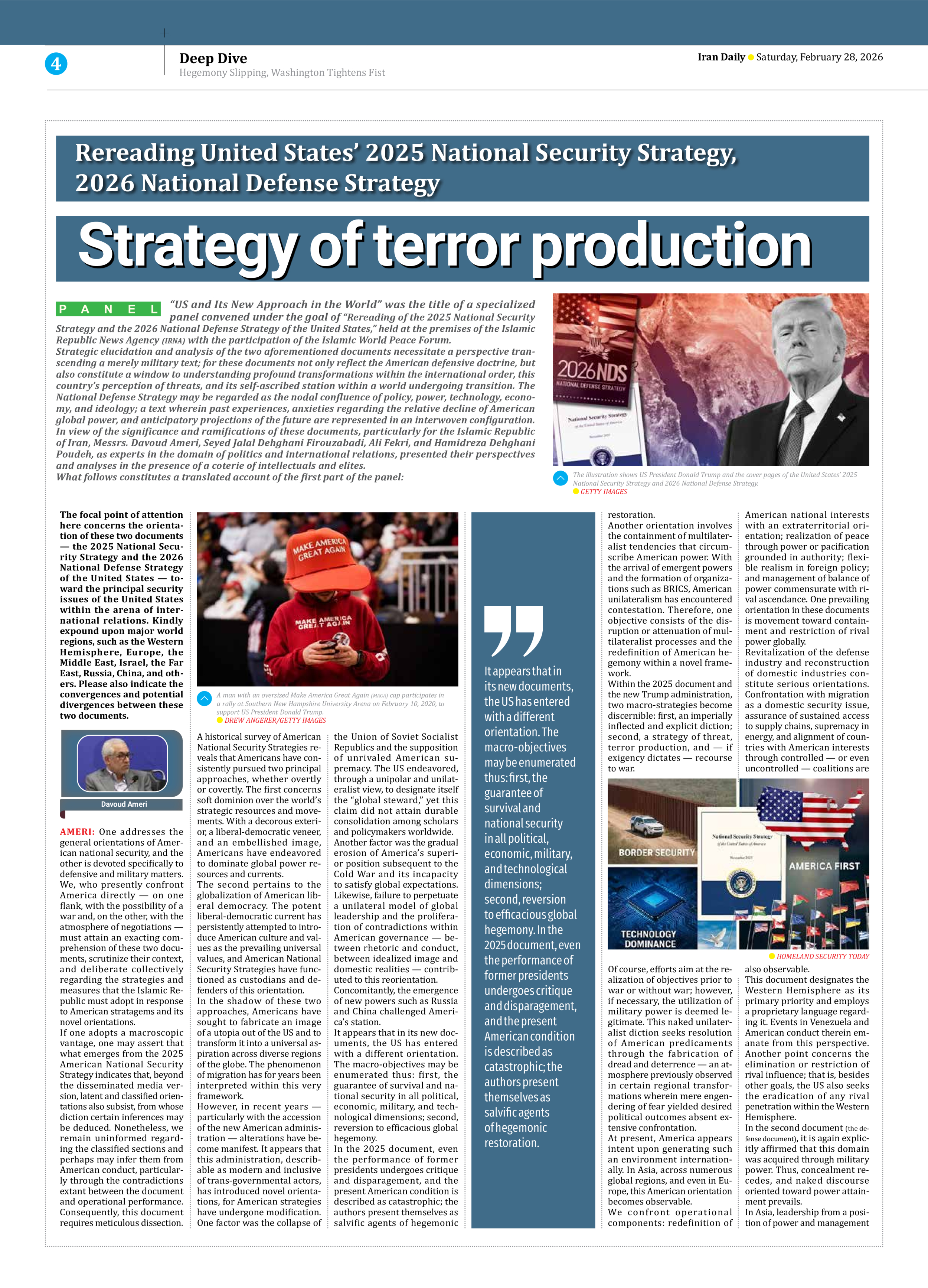
“US and Its New Approach in the World” was the title of a specialized panel convened under the goal of “Rereading of the 2025 National Security Strategy and the 2026 National Defense Strategy of the United States,” held at the premises of the Islamic Republic News Agency (IRNA) with the participation of the Islamic World Peace Forum. Strategic elucidation and analysis of the two aforementioned documents necessitate a perspective transcending a merely military text; for these documents not only reflect the American defensive doctrine, but also constitute a window to understanding profound transformations within the international order, this country’s perception of threats, and its self-ascribed station within a world undergoing transition. The National Defense Strategy may be regarded as the nodal confluence of policy, power, technology, economy, and ideology; a text wherein past experiences, anxieties regarding the relative decline of American global power, and anticipatory projections of the future are represented in an interwoven configuration. In view of the significance and ramifications of these documents, particularly for the Islamic Republic of Iran, Messrs. Davoud Ameri, Seyed Jalal Dehghani Firouzabadi, Ali Fekri, and Hamidreza Dehghani Poudeh, as experts in the domain of politics and international relations, presented their perspectives and analyses in the presence of a coterie of intellectuals and elites. What follows constitutes a translated account of the first part of the panel:
The focal point of attention here concerns the orientation of these two documents — the 2025 National Security Strategy and the 2026 National Defense Strategy of the United States — toward the principal security issues of the United States within the arena of international relations. Kindly expound upon major world regions, such as the Western Hemisphere, Europe, the Middle East, Israel, the Far East, Russia, China, and others. Please also indicate the convergences and potential divergences between these two documents.
AMERI: One addresses the general orientations of American national security, and the other is devoted specifically to defensive and military matters. We, who presently confront America directly — on one flank, with the possibility of a war and, on the other, with the atmosphere of negotiations — must attain an exacting comprehension of these two documents, scrutinize their context, and deliberate collectively regarding the strategies and measures that the Islamic Republic must adopt in response to American stratagems and its novel orientations.
If one adopts a macroscopic vantage, one may assert that what emerges from the 2025 American National Security Strategy indicates that, beyond the disseminated media version, latent and classified orientations also subsist, from whose diction certain inferences may be deduced. Nonetheless, we remain uninformed regarding the classified sections and perhaps may infer them from American conduct, particularly through the contradictions extant between the document and operational performance. Consequently, this document requires meticulous dissection.
A historical survey of American National Security Strategies reveals that Americans have consistently pursued two principal approaches, whether overtly or covertly. The first concerns soft dominion over the world’s strategic resources and movements. With a decorous exterior, a liberal-democratic veneer, and an embellished image, Americans have endeavored to dominate global power resources and currents.
The second pertains to the globalization of American liberal democracy. The potent liberal-democratic current has persistently attempted to introduce American culture and values as the prevailing universal values, and American National Security Strategies have functioned as custodians and defenders of this orientation.
In the shadow of these two approaches, Americans have sought to fabricate an image of a utopia out of the US and to transform it into a universal aspiration across diverse regions of the globe. The phenomenon of migration has for years been interpreted within this very framework.
However, in recent years — particularly with the accession of the new American administration — alterations have become manifest. It appears that this administration, describable as modern and inclusive of trans-governmental actors, has introduced novel orientations, for American strategies have undergone modification. One factor was the collapse of the Union of Soviet Socialist Republics and the supposition of unrivaled American supremacy. The US endeavored, through a unipolar and unilateralist view, to designate itself the “global steward,” yet this claim did not attain durable consolidation among scholars and policymakers worldwide.
Another factor was the gradual erosion of America’s superior position subsequent to the Cold War and its incapacity to satisfy global expectations. Likewise, failure to perpetuate a unilateral model of global leadership and the proliferation of contradictions within American governance — between rhetoric and conduct, between idealized image and domestic realities — contributed to this reorientation.
Concomitantly, the emergence of new powers such as Russia and China challenged America’s station.
It appears that in its new documents, the US has entered with a different orientation. The macro-objectives may be enumerated thus: first, the guarantee of survival and national security in all political, economic, military, and technological dimensions; second, reversion to efficacious global hegemony.
In the 2025 document, even the performance of former presidents undergoes critique and disparagement, and the present American condition is described as catastrophic; the authors present themselves as salvific agents of hegemonic restoration.
Another orientation involves the containment of multilateralist tendencies that circumscribe American power. With the arrival of emergent powers and the formation of organizations such as BRICS, American unilateralism has encountered contestation. Therefore, one objective consists of the disruption or attenuation of multilateralist processes and the redefinition of American hegemony within a novel framework.
Within the 2025 document and the new Trump administration, two macro-strategies become discernible: first, an imperially inflected and explicit diction; second, a strategy of threat, terror production, and — if exigency dictates — recourse to war.
Of course, efforts aim at the realization of objectives prior to war or without war; however, if necessary, the utilization of military power is deemed legitimate. This naked unilateralist diction seeks resolution of American predicaments through the fabrication of dread and deterrence — an atmosphere previously observed in certain regional transformations wherein mere engendering of fear yielded desired political outcomes absent extensive confrontation.
At present, America appears intent upon generating such an environment internationally. In Asia, across numerous global regions, and even in Europe, this American orientation becomes observable.
We confront operational components: redefinition of American national interests with an extraterritorial orientation; realization of peace through power or pacification grounded in authority; flexible realism in foreign policy; and management of balance of power commensurate with rival ascendance. One prevailing orientation in these documents is movement toward containment and restriction of rival power globally.
Revitalization of the defense industry and reconstruction of domestic industries constitute serious orientations. Confrontation with migration as a domestic security issue, assurance of sustained access to supply chains, supremacy in energy, and alignment of countries with American interests through controlled — or even uncontrolled — coalitions are also observable.
This document designates the Western Hemisphere as its primary priority and employs a proprietary language regarding it. Events in Venezuela and American conduct therein emanate from this perspective. Another point concerns the elimination or restriction of rival influence; that is, besides other goals, the US also seeks the eradication of any rival penetration within the Western Hemisphere.
In the second document (the defense document), it is again explicitly affirmed that this domain was acquired through military power. Thus, concealment recedes, and naked discourse oriented toward power attainment prevails.
In Asia, leadership from a position of power and management of geopolitical and economic competition are emphasized. Regarding Europe, prior to publication of this document, I indicated in a report in March 2025 that Americans had effectively moved past a unified Europe and no longer regarded it as an autonomous actor in international interventions. This document does not recognize a unified and puissant Europe, yet encourages European states toward independence, effectively pursuing power division within Europe.
In light of these two documents — especially the second, which accentuates military and defensive orientation — military power is introduced as a legitimizing force. The National Defense Strategy endeavors, in fact, to confer legitimacy upon American military actions and to embellish them.
For us in the Islamic Republic — an influential actor in global transformations and presently confronted simultaneously with negotiation and escalating American threat — precise comprehension proves indispensable. We must formulate our strategies vis-à-vis these orientations and deliberate upon them.
Please explain the orientation, differences, and similarities of these documents, their perspective toward diverse global regions, including our own, and evaluate the actual performance of the current administration of the United States relative to these documents.
DEHGHANI FIROUZABADI: The American National Strategy and its Defense Strategy are interrelated; the National Security Strategy presides over the National Defense Strategy. The latter possesses a more operational and military aspect and is implemented within the American bureaucratic structure.
In the Defense Strategy, the foremost objective is the restoration of America’s position. Although official American diction seldom employs the term “hegemony,” restoration of past greatness is posited within the framework of the “America First” slogan.
The document implicitly acknowledges the United States’ fall from its prior station and asserts the necessity of revivification. It indicates that the liberal international order — from which America benefited — enabled others, particularly China, to utilize globalization and global commerce without incurring costs.
From the authors’ vantage, certain American allies have engaged in gratuitous security dependence and must assume greater financial responsibility.
The spirit of the document entails redefinition of America’s role and position within the international system — that is, redefinition of national interests — alongside delegation of greater responsibility to allies and adoption of selective interventionism.
This orientation does not constitute isolationism, but rather limited, efficacious, and selective globalism — intervention where vital American interests necessitate it.
From a theoretical perspective, although pragmatism or moderated realism is invoked, in practice, numerous realist principles appear manifest: state-centrism, power-centrism — especially military power — and avoidance of war concomitant with maximal deterrence, particularly vis-à-vis China.
The slogan “peace through strength” and the hints of seeking absolute superiority articulated there indicate that the US must possess and preserve superiority across all domains of national power — military, economic, and technological. The concept of power balance appears within the deterrence framework as well. The Defense Strategy explicitly affirms that unilateral action has frequently benefited American national interests. Unlike the past, wherein unilateralism proved contentious, it is now explicitly defended as the optimal means of securing American security and interests.
Another dimension involves novel economic nationalism emphasizing three components: energy dominance, trade balance including through tariff war, and reinforcement of domestic industry with repatriation of production capacity.
A salient distinction from prior documents is explicit repudiation of the liberal international order and practical transcendence of foundational principles of international law, such as national sovereignty, non-intervention, non-use of force, and inviolability of borders. Recent actions reinforce the perception that prior foundations of international relations encounter challenge.
These two documents may be regarded as a manifesto of the new Trump administration’s orientation; in aggregate, no profound contradiction appears between them and the performance of the current US administration.
Initially, some concluded superficially that our region had forfeited significance in American higher-order documents; however, this inference appears imprecise.
DEHGHANI FIROUZABADI: Although the document asserts that a country assigning priority to everything effectively possesses no priority, regarding the Middle East, four explicit objectives are enumerated: prevention of domination of regional energy resources by a hostile state, guarantee of Israel’s security, preservation of freedom of navigation including in the Red Sea and the Strait of Hormuz, and prevention of extensive regional instability.
Therefore, one cannot assert complete diminution of the Middle East’s or Iran’s significance; rather, the framework and modality of engagement have transformed. Even if the Middle East’s position has declined in certain levels, in other dimensions, its importance has not diminished; indeed, for America, Iran has acquired heightened significance.
Some inferred diminution based upon quantitative content analysis — counting mentions of Iran — yet frequency of reference does not constitute a decisive metric of importance. As with China and Russia, Iran independently retains significance within the document.
I have even stated that Iran resides at the nucleus of the American National Security Strategy. In the National Defense Strategy as well, Iran is explicitly addressed; though characterized as weakened, it remains within the threat-construction framework. Consequently, one must not conclude that Iran has forfeited value within American security and defense prioritization. American practical conduct corroborates this assessment.
Dr. Fekri, kindly continue, particularly regarding the United States’ competition with China and the securitization of the economy, including tariffs as a security instrument.
FEKRI: The American National Security Strategy is prepared pursuant to an annual legal obligation. The Goldwater–Nichols Act of 1986 obligates publication. In 1986, proximate to the terminal years of the Soviet Union, the objective was the evaluation of international transformations within a specified temporal interval, the delineation of a desired world, and the specification of the trajectory toward it, so that all American institutions and even external actors comprehend America’s direction.
During the Cold War, emphasis centered on existential war with the Soviet Union. After its collapse, globalization and democracy promotion — concepts presently criticized — occupied the core.
After the September 11 attacks, concepts of preemptive action and counterterrorism entered the documents. At the time, it was frequently stressed that globalization has enemies that can threaten the United States’ national security, thereby necessitating confrontation. During the Obama period, counterterrorism persisted, with augmented emphasis upon coalitions, diplomacy, and international cooperation.
Since circa 2010, the return to Asia and strategic competition with China entered the documents. In a global investment forum in China, the American treasury secretary and the Chinese commerce minister engaged in open disputation. The American official alleged that China’s currency manipulation and intellectual property violations were hurting American domestic production; the Chinese minister attributed the issue to a weakened American production structure, adding that if the value of Yuan increases, another country will replace China. This indicated that structural competition was forming.
Thereafter, strategic competition with China assumed prominence. In Trump’s first term, China and Russia were designated principal rivals, followed by Iran and North Korea.
Regarding the 2025 document, the US has concluded that within the global economic contest of the past two decades, it has experienced relative decline — not absolute debility, but comparative deceleration vis-à-vis rivals whose growth velocity surpassed its. Projects such as “America First” were devised to reverse this trajectory through production repatriation and economic reconstruction.
In Trump’s first term, one policy entailed insecurity generation around emergent powers: NATO eastward expansion, Middle Eastern transformations, Afghanistan developments, South China Sea tensions, extensive sanctions against Iran, and evolution from crippling sanctions to smart sanctions and maximum pressure. Yet this containment policy did not yield desired outcomes.
In the new document, America asserts that it must possess complete dominion over the Western Hemisphere and manage all contradictions therein. Issues such as the Panama Canal, developments in Venezuela, Greenland, and even Canada’s and Mexico’s relations with China and Europe become intelligible within this framework. America seeks to transform its periphery into a stable and exclusive pole of future economic power.
This constitutes the desired world: restoration of primary economic centrality and recovery of lost or declining authority — namely, the MAGA project. For reentry into this domain, the American periphery must become entirely secure and unilateral. Since competition remains inevitable, it must be displaced elsewhere.
Hence, pressure upon Iran, the Middle East, and Asia intensifies; tensions must be transferred elsewhere while the Western Hemisphere becomes homogeneous and exclusively American.
From the Chinese perspective, however, substantial credence is not accorded to the operationalization of this document as previous security documents likewise did not culminate in their intended outcomes, and states traversed episodic waves of pressure.
Please elaborate on Trump’s utilization of tariffs.
FEKRI: I construe tariffs within the rubric of unilateral coercive measures. In one context, the US imposes sanctions; in another, tariffs; elsewhere, licensing requirements via the Department of Commerce. Each region encounters measures calibrated to its conditions. Concerning Iran, sanctions are deemed most efficacious. Regarding China and Europe — especially China — tariffs are emphasized because unilateral sanctions lack equivalent efficacy. Moreover, efforts also aim at augmenting energy costs and production factor costs for China so that Chinese commodities, owing to elevated production inputs, forfeit, for instance, 20% of competitive capacity relative to goods produced in the Western Hemisphere.
Do they genuinely believe globalization has harmed America?
FEKRI: Yes, they explicitly assert that countries such as China, Russia, India, and even smaller states exploited globalization’s advantages and ascended while America receded within the power hierarchy. Hence, their solution is the reversal of this trajectory.
Today, international institutions — whose norms Europeans originally constructed yet Americans defended — are questioned and progressively excised from the international arena.
The article first appeared in
Persian on IRNA.