







Any Iranian-American war may rapidly expand: Expert
Amid the persistent tensions surrounding the indirect negotiations between Iran and the United States, and with the next round approaching in the coming days, it has become necessary to examine expert assessments regarding the prospects of reaching a deal, the extent of Iran’s capacity to administer a war of wills, and the strategic challenges in the region. Within this framework, the website of Al-Alam News Network conducted an interview with Dr. Rahim Kathir, an Arab university professor, researcher, and author on regional affairs, who presented an in-depth reading of the forthcoming round of negotiations and the foremost strategic and diplomatic challenges. Dr. Rahim Kathir holds a PhD in Arabic Language and Literature and a Master’s degree in Middle Eastern Graduate Studies. The following is the translated text of the interview with Dr. Kathir:
An upcoming round of indirect negotiations has been announced to take place in the coming days. Do you believe it constitutes the “last opportunity”?
KATHIR: To regard the negotiations as the “last opportunity” in a decisive or terminal sense is erroneous because this expression forms part of the manufacture of atmosphere at which Washington excels in the administration of conflict.
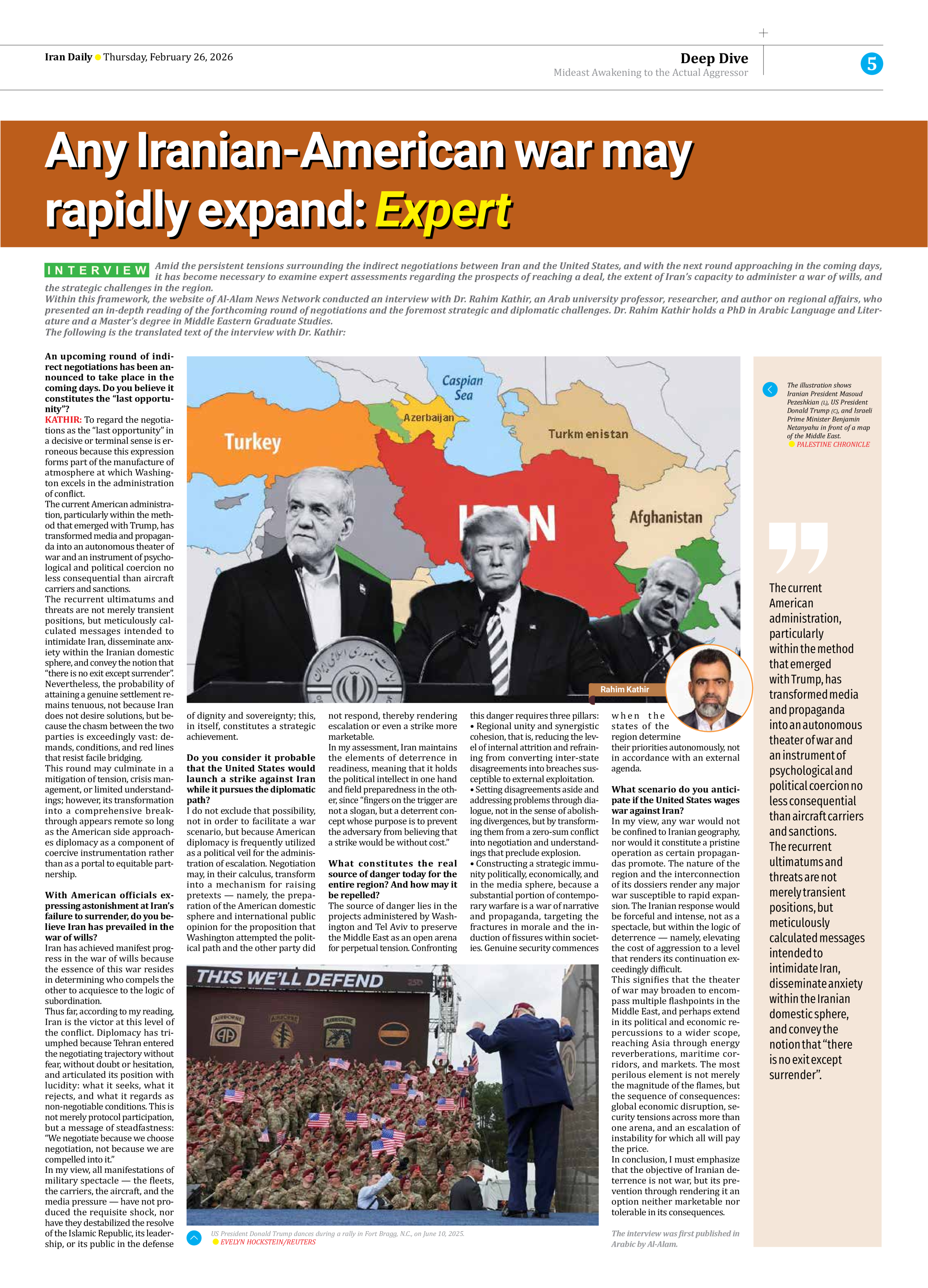
The current American administration, particularly within the method that emerged with Trump, has transformed media and propaganda into an autonomous theater of war and an instrument of psychological and political coercion no less consequential than aircraft carriers and sanctions.
The recurrent ultimatums and threats are not merely transient positions, but meticulously calculated messages intended to intimidate Iran, disseminate anxiety within the Iranian domestic sphere, and convey the notion that “there is no exit except surrender”.
Nevertheless, the probability of attaining a genuine settlement remains tenuous, not because Iran does not desire solutions, but because the chasm between the two parties is exceedingly vast: demands, conditions, and red lines that resist facile bridging.
This round may culminate in a mitigation of tension, crisis management, or limited understandings; however, its transformation into a comprehensive breakthrough appears remote so long as the American side approaches diplomacy as a component of coercive instrumentation rather than as a portal to equitable partnership.
With American officials expressing astonishment at Iran’s failure to surrender, do you believe Iran has prevailed in the war of wills?
Iran has achieved manifest progress in the war of wills because the essence of this war resides in determining who compels the other to acquiesce to the logic of subordination.
Thus far, according to my reading, Iran is the victor at this level of the conflict. Diplomacy has triumphed because Tehran entered the negotiating trajectory without fear, without doubt or hesitation, and articulated its position with lucidity: what it seeks, what it rejects, and what it regards as non-negotiable conditions. This is not merely protocol participation, but a message of steadfastness: “We negotiate because we choose negotiation, not because we are compelled into it.”
In my view, all manifestations of military spectacle — the fleets, the carriers, the aircraft, and the media pressure — have not produced the requisite shock, nor have they destabilized the resolve of the Islamic Republic, its leadership, or its public in the defense of dignity and sovereignty; this, in itself, constitutes a strategic achievement.
Do you consider it probable that the United States would launch a strike against Iran while it pursues the diplomatic path?
I do not exclude that possibility, not in order to facilitate a war scenario, but because American diplomacy is frequently utilized as a political veil for the administration of escalation. Negotiation may, in their calculus, transform into a mechanism for raising pretexts — namely, the preparation of the American domestic sphere and international public opinion for the proposition that Washington attempted the political path and the other party did not respond, thereby rendering escalation or even a strike more marketable.
In my assessment, Iran maintains the elements of deterrence in readiness, meaning that it holds the political intellect in one hand and field preparedness in the other, since “fingers on the trigger are not a slogan, but a deterrent concept whose purpose is to prevent the adversary from believing that a strike would be without cost.”
What constitutes the real source of danger today for the entire region? And how may it be repelled?
The source of danger lies in the projects administered by Washington and Tel Aviv to preserve the Middle East as an open arena for perpetual tension. Confronting this danger requires three pillars:
• Regional unity and synergistic cohesion, that is, reducing the level of internal attrition and refraining from converting inter-state disagreements into breaches susceptible to external exploitation.
• Setting disagreements aside and addressing problems through dialogue, not in the sense of abolishing divergences, but by transforming them from a zero-sum conflict into negotiation and understandings that preclude explosion.
• Constructing a strategic immunity politically, economically, and in the media sphere, because a substantial portion of contemporary warfare is a war of narrative and propaganda, targeting the fractures in morale and the induction of fissures within societies. Genuine security commences when the states of the region determine their priorities autonomously, not in accordance with an external agenda.
What scenario do you anticipate if the United States wages war against Iran?
In my view, any war would not be confined to Iranian geography, nor would it constitute a pristine operation as certain propagandas promote. The nature of the region and the interconnection of its dossiers render any major war susceptible to rapid expansion. The Iranian response would be forceful and intense, not as a spectacle, but within the logic of deterrence — namely, elevating the cost of aggression to a level that renders its continuation exceedingly difficult.
This signifies that the theater of war may broaden to encompass multiple flashpoints in the Middle East, and perhaps extend in its political and economic repercussions to a wider scope, reaching Asia through energy reverberations, maritime corridors, and markets. The most perilous element is not merely the magnitude of the flames, but the sequence of consequences: global economic disruption, security tensions across more than one arena, and an escalation of instability for which all will pay the price.
In conclusion, I must emphasize that the objective of Iranian deterrence is not war, but its prevention through rendering it an option neither marketable nor tolerable in its consequences.
The interview was first published in Arabic by Al-Alam.