







Deal within reach if diplomacy takes priority, Iran FM says ahead of Geneva talks
Grossi: Necessary elements for deal on the table
Iran’s Foreign Minister Abbas Araghchi said a deal with the United States is attainable provided diplomacy is given priority, as Tehran and Washington gear up for a third round of negotiations in Geneva on Thursday.
In a post late Tuesday on X, Araghchi described the ongoing talks as a “historic opportunity” to secure an “unprecedented agreement” that would address mutual concerns and protect shared interests. He said the upcoming round would build on understandings reached previously, adding that Iran would return to the negotiating table determined to reach a fair and balanced deal “as quickly as possible.”
The Iranian foreign minister also reiterated Tehran’s long-standing position that the country would “under no circumstances” develop nuclear weapons, while stressing that Iranians would never relinquish their right to peaceful nuclear technology. He added that Iran would defend its sovereignty with resolve but would pursue a peaceful solution to disputes through negotiations.
Full sincerity
and good faith
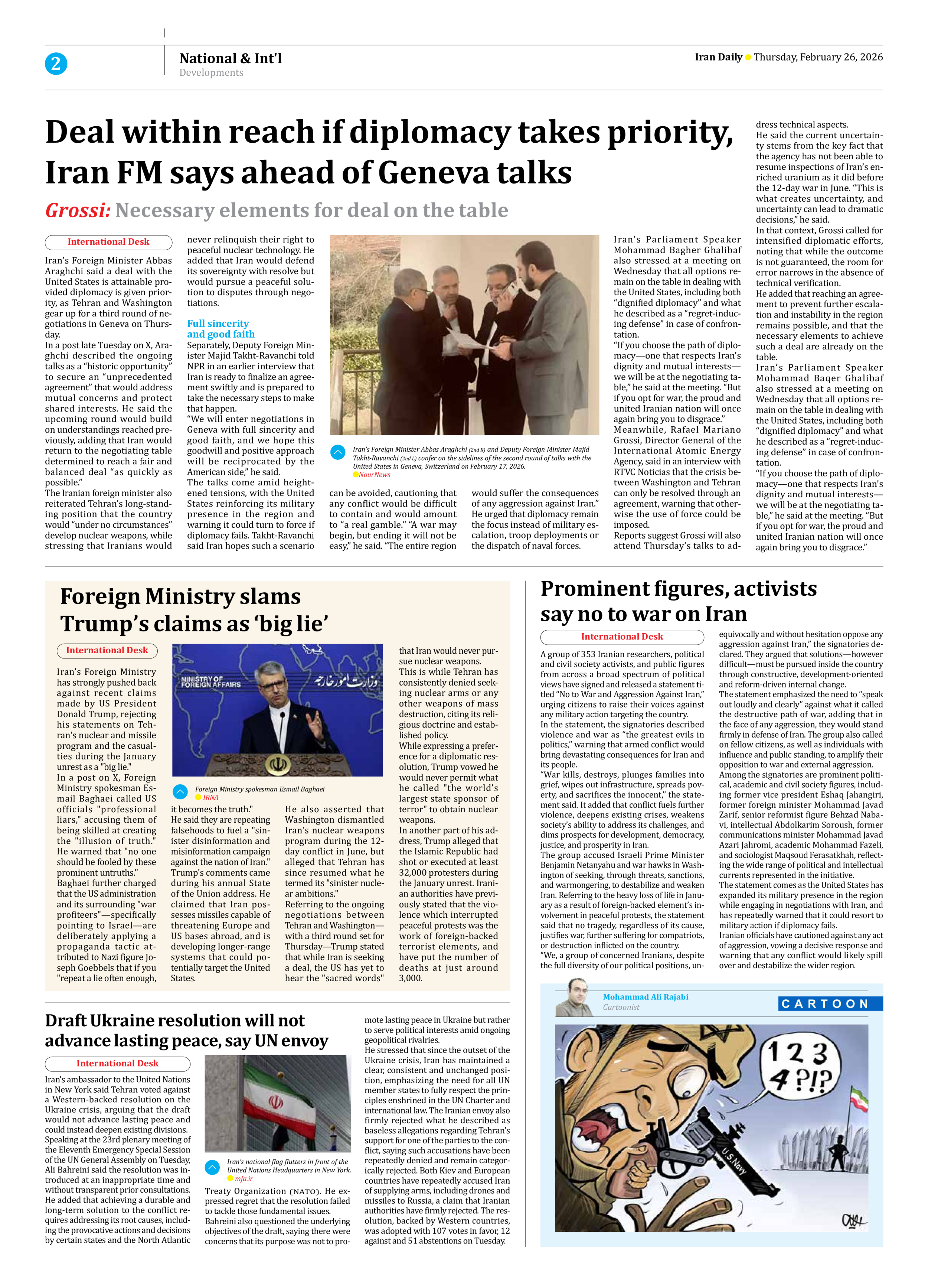
Separately, Deputy Foreign Minister Majid Takht-Ravanchi told NPR in an earlier interview that Iran is ready to finalize an agreement swiftly and is prepared to take the necessary steps to make that happen.
“We will enter negotiations in Geneva with full sincerity and good faith, and we hope this goodwill and positive approach will be reciprocated by the American side,” he said.
The talks come amid heightened tensions, with the United States reinforcing its military presence in the region and warning it could turn to force if diplomacy fails. Takht-Ravanchi said Iran hopes such a scenario can be avoided, cautioning that any conflict would be difficult to contain and would amount to “a real gamble.” “A war may begin, but ending it will not be easy,” he said. “The entire region would suffer the consequences of any aggression against Iran.” He urged that diplomacy remain the focus instead of military escalation, troop deployments or the dispatch of naval forces.
Iran’s Parliament Speaker Mohammad Bagher Ghalibaf also stressed at a meeting on Wednesday that all options remain on the table in dealing with the United States, including both “dignified diplomacy” and what he described as a “regret-inducing defense” in case of confrontation.
“If you choose the path of diplomacy—one that respects Iran’s dignity and mutual interests—we will be at the negotiating table,” he said at the meeting. “But if you opt for war, the proud and united Iranian nation will once again bring you to disgrace.”
Meanwhile, Rafael Mariano Grossi, Director General of the International Atomic Energy Agency, said in an interview with RTVC Noticias that the crisis between Washington and Tehran can only be resolved through an agreement, warning that otherwise the use of force could be imposed.
Reports suggest Grossi will also attend Thursday’s talks to address technical aspects.
He said the current uncertainty stems from the key fact that the agency has not been able to resume inspections of Iran’s enriched uranium as it did before the 12-day war in June. “This is what creates uncertainty, and uncertainty can lead to dramatic decisions,” he said.
In that context, Grossi called for intensified diplomatic efforts, noting that while the outcome is not guaranteed, the room for error narrows in the absence of technical verification.
He added that reaching an agreement to prevent further escalation and instability in the region remains possible, and that the necessary elements to achieve such a deal are already on the table.
Iran’s Parliament Speaker Mohammad Baqer Ghalibaf also stressed at a meeting on Wednesday that all options remain on the table in dealing with the United States, including both “dignified diplomacy” and what he described as a “regret-inducing defense” in case of confrontation.
“If you choose the path of diplomacy—one that respects Iran’s dignity and mutual interests—we will be at the negotiating table,” he said at the meeting. “But if you opt for war, the proud and united Iranian nation will once again bring you to disgrace.”