







Why Iran may prove a battlefield for US unlike Iraq or Afghanistan
By Sabine Ameer
Doctoral researcher in Politics at University of Glasgow
US President Donald Trump has threatened to attack Iran militarily. Recent reports suggest that an aircraft carrier has been deployed to Middle Eastern waters by the US, with Trump warning that a “massive fleet” was headed to the region “just in case”. The looming question remains: Will the US actively strike against Iran? And if so, what would that battlefield look like? Amid this rage bait, one thing is clear: Iran is not the Iraq of 2003, and it certainly isn’t the Afghanistan of 2001. Iran is a different battlefield entirely — militarily, geographically, and diplomatically.
Iran’s advanced artillery, rugged terrains
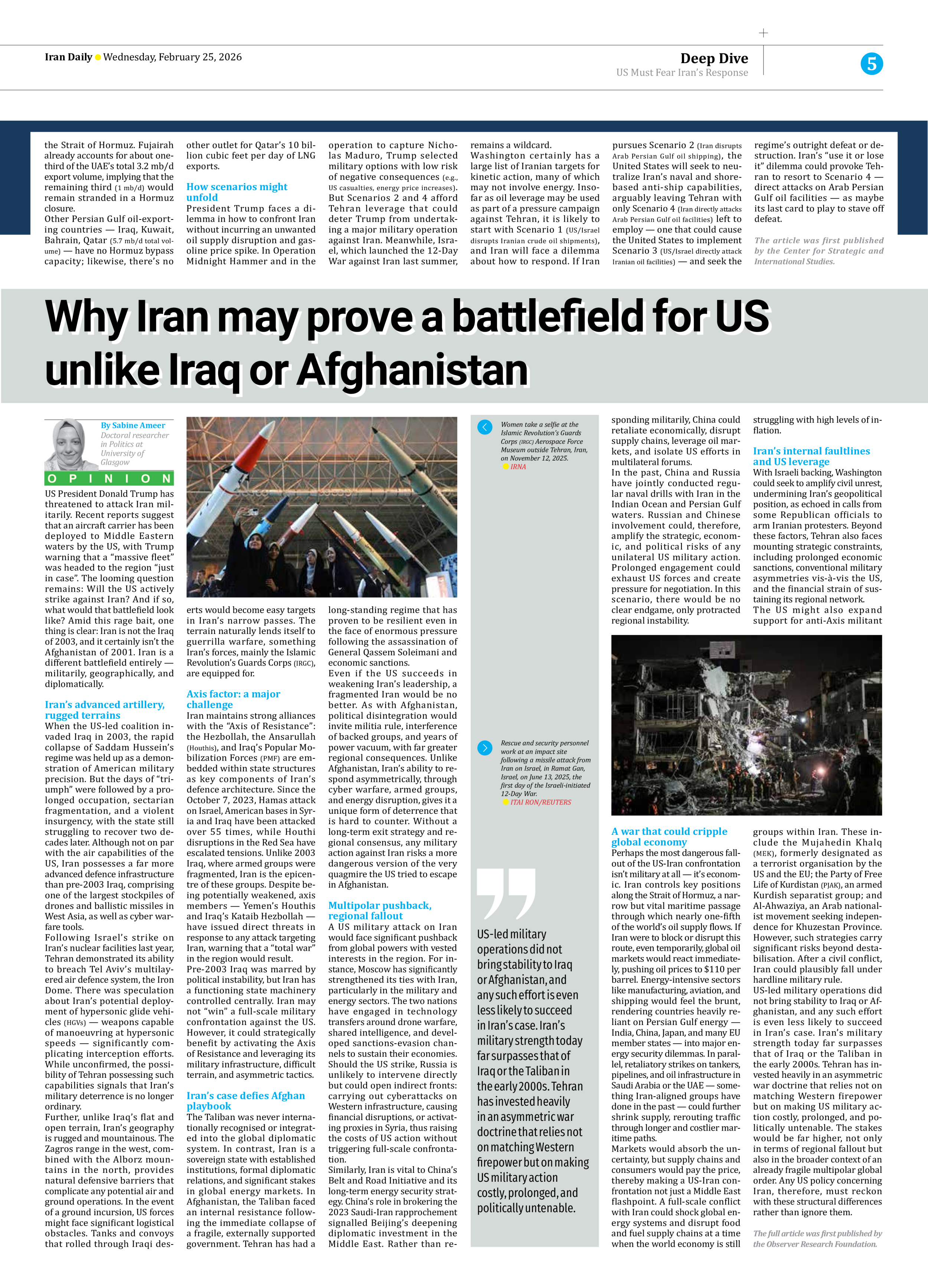
When the US-led coalition invaded Iraq in 2003, the rapid collapse of Saddam Hussein’s regime was held up as a demonstration of American military precision. But the days of “triumph” were followed by a prolonged occupation, sectarian fragmentation, and a violent insurgency, with the state still struggling to recover two decades later. Although not on par with the air capabilities of the US, Iran possesses a far more advanced defence infrastructure than pre-2003 Iraq, comprising one of the largest stockpiles of drones and ballistic missiles in West Asia, as well as cyber warfare tools.
Following Israel’s strike on Iran’s nuclear facilities last year, Tehran demonstrated its ability to breach Tel Aviv’s multilayered air defence system, the Iron Dome. There was speculation about Iran’s potential deployment of hypersonic glide vehicles (HGVs) — weapons capable of manoeuvring at hypersonic speeds — significantly complicating interception efforts. While unconfirmed, the possibility of Tehran possessing such capabilities signals that Iran’s military deterrence is no longer ordinary.
Further, unlike Iraq’s flat and open terrain, Iran’s geography is rugged and mountainous. The Zagros range in the west, combined with the Alborz mountains in the north, provides natural defensive barriers that complicate any potential air and ground operations. In the event of a ground incursion, US forces might face significant logistical obstacles. Tanks and convoys that rolled through Iraqi deserts would become easy targets in Iran’s narrow passes. The terrain naturally lends itself to guerrilla warfare, something Iran’s forces, mainly the Islamic Revolution’s Guards Corps (IRGC), are equipped for.
Axis factor: a major challenge
Iran maintains strong alliances with the “Axis of Resistance”: the Hezbollah, the Ansarullah (Houthis), and Iraq’s Popular Mobilization Forces (PMF) are embedded within state structures as key components of Iran’s defence architecture. Since the October 7, 2023, Hamas attack on Israel, American bases in Syria and Iraq have been attacked over 55 times, while Houthi disruptions in the Red Sea have escalated tensions. Unlike 2003 Iraq, where armed groups were fragmented, Iran is the epicentre of these groups. Despite being potentially weakened, axis members — Yemen’s Houthis and Iraq’s Kataib Hezbollah — have issued direct threats in response to any attack targeting Iran, warning that a “total war” in the region would result.
Pre-2003 Iraq was marred by political instability, but Iran has a functioning state machinery controlled centrally. Iran may not “win” a full-scale military confrontation against the US. However, it could strategically benefit by activating the Axis of Resistance and leveraging its military infrastructure, difficult terrain, and asymmetric tactics.
Iran’s case defies Afghan playbook
The Taliban was never internationally recognised or integrated into the global diplomatic system. In contrast, Iran is a sovereign state with established institutions, formal diplomatic relations, and significant stakes in global energy markets. In Afghanistan, the Taliban faced an internal resistance following the immediate collapse of a fragile, externally supported government. Tehran has had a long-standing regime that has proven to be resilient even in the face of enormous pressure following the assassination of General Qassem Soleimani and economic sanctions.
Even if the US succeeds in weakening Iran’s leadership, a fragmented Iran would be no better. As with Afghanistan, political disintegration would invite militia rule, interference of backed groups, and years of power vacuum, with far greater regional consequences. Unlike Afghanistan, Iran’s ability to respond asymmetrically, through cyber warfare, armed groups, and energy disruption, gives it a unique form of deterrence that is hard to counter. Without a long-term exit strategy and regional consensus, any military action against Iran risks a more dangerous version of the very quagmire the US tried to escape in Afghanistan.
Multipolar pushback, regional fallout
A US military attack on Iran would face significant pushback from global powers with vested interests in the region. For instance, Moscow has significantly strengthened its ties with Iran, particularly in the military and energy sectors. The two nations have engaged in technology transfers around drone warfare, shared intelligence, and developed sanctions-evasion channels to sustain their economies. Should the US strike, Russia is unlikely to intervene directly but could open indirect fronts: carrying out cyberattacks on Western infrastructure, causing financial disruptions, or activating proxies in Syria, thus raising the costs of US action without triggering full-scale confrontation.
Similarly, Iran is vital to China’s Belt and Road Initiative and its long-term energy security strategy. China’s role in brokering the 2023 Saudi-Iran rapprochement signalled Beijing’s deepening diplomatic investment in the Middle East. Rather than responding militarily, China could retaliate economically, disrupt supply chains, leverage oil markets, and isolate US efforts in multilateral forums.
In the past, China and Russia have jointly conducted regular naval drills with Iran in the Indian Ocean and Persian Gulf waters. Russian and Chinese involvement could, therefore, amplify the strategic, economic, and political risks of any unilateral US military action. Prolonged engagement could exhaust US forces and create pressure for negotiation. In this scenario, there would be no clear endgame, only protracted regional instability.
A war that could cripple global economy
Perhaps the most dangerous fallout of the US-Iran confrontation isn’t military at all — it’s economic. Iran controls key positions along the Strait of Hormuz, a narrow but vital maritime passage through which nearly one-fifth of the world’s oil supply flows. If Iran were to block or disrupt this route, even temporarily, global oil markets would react immediately, pushing oil prices to $110 per barrel. Energy-intensive sectors like manufacturing, aviation, and shipping would feel the brunt, rendering countries heavily reliant on Persian Gulf energy — India, China, Japan, and many EU member states — into major energy security dilemmas. In parallel, retaliatory strikes on tankers, pipelines, and oil infrastructure in Saudi Arabia or the UAE — something Iran-aligned groups have done in the past — could further shrink supply, rerouting traffic through longer and costlier maritime paths.
Markets would absorb the uncertainty, but supply chains and consumers would pay the price, thereby making a US-Iran confrontation not just a Middle East flashpoint. A full-scale conflict with Iran could shock global energy systems and disrupt food and fuel supply chains at a time when the world economy is still struggling with high levels of inflation.
Iran’s internal faultlines and US leverage
With Israeli backing, Washington could seek to amplify civil unrest, undermining Iran’s geopolitical position, as echoed in calls from some Republican officials to arm Iranian protesters. Beyond these factors, Tehran also faces mounting strategic constraints, including prolonged economic sanctions, conventional military asymmetries vis-à-vis the US, and the financial strain of sustaining its regional network.
The US might also expand support for anti-Axis militant groups within Iran. These include the Mujahedin Khalq (MEK), formerly designated as a terrorist organisation by the US and the EU; the Party of Free Life of Kurdistan (PJAK), an armed Kurdish separatist group; and Al-Ahwaziya, an Arab nationalist movement seeking independence for Khuzestan Province. However, such strategies carry significant risks beyond destabilisation. After a civil conflict, Iran could plausibly fall under hardline military rule.
US-led military operations did not bring stability to Iraq or Afghanistan, and any such effort is even less likely to succeed in Iran’s case. Iran’s military strength today far surpasses that of Iraq or the Taliban in the early 2000s. Tehran has invested heavily in an asymmetric war doctrine that relies not on matching Western firepower but on making US military action costly, prolonged, and politically untenable. The stakes would be far higher, not only in terms of regional fallout but also in the broader context of an already fragile multipolar global order. Any US policy concerning Iran, therefore, must reckon with these structural differences rather than ignore them.
The full article was first published by the Observer Research Foundation.