







Iran, Azerbaijan ink multifaceted MoU during joint economic commission
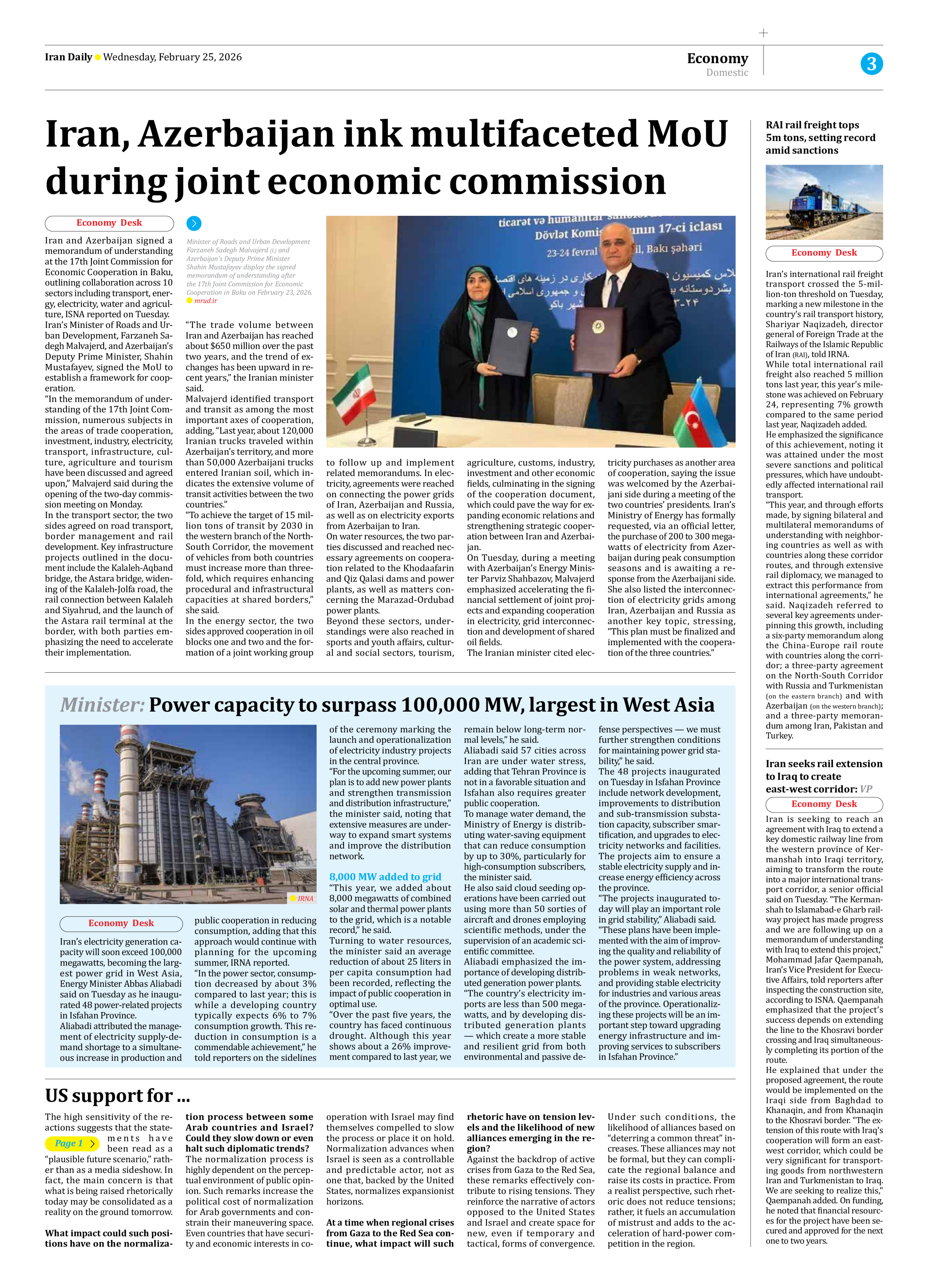
Iran and Azerbaijan signed a memorandum of understanding at the 17th Joint Commission for Economic Cooperation in Baku, outlining collaboration across 10 sectors including transport, energy, electricity, water and agriculture, ISNA reported on Tuesday.
Iran’s Minister of Roads and Urban Development, Farzaneh Sadegh Malvajerd, and Azerbaijan’s Deputy Prime Minister, Shahin Mustafayev, signed the MoU to establish a framework for cooperation.
“In the memorandum of understanding of the 17th Joint Commission, numerous subjects in the areas of trade cooperation, investment, industry, electricity, transport, infrastructure, culture, agriculture and tourism have been discussed and agreed upon,” Malvajerd said during the opening of the two-day commission meeting on Monday.
In the transport sector, the two sides agreed on road transport, border management and rail development. Key infrastructure projects outlined in the document include the Kalaleh-Aqband bridge, the Astara bridge, widening of the Kalaleh-Jolfa road, the rail connection between Kalaleh and Siyahrud, and the launch of the Astara rail terminal at the border, with both parties emphasizing the need to accelerate their implementation.
“The trade volume between Iran and Azerbaijan has reached about $650 million over the past two years, and the trend of exchanges has been upward in recent years,” the Iranian minister said.
Malvajerd identified transport and transit as among the most important axes of cooperation, adding, “Last year, about 120,000 Iranian trucks traveled within Azerbaijan’s territory, and more than 50,000 Azerbaijani trucks entered Iranian soil, which indicates the extensive volume of transit activities between the two countries.”
“To achieve the target of 15 million tons of transit by 2030 in the western branch of the North-South Corridor, the movement of vehicles from both countries must increase more than threefold, which requires enhancing procedural and infrastructural capacities at shared borders,” she said.
In the energy sector, the two sides approved cooperation in oil blocks one and two and the formation of a joint working group to follow up and implement related memorandums. In electricity, agreements were reached on connecting the power grids of Iran, Azerbaijan and Russia, as well as on electricity exports from Azerbaijan to Iran.
On water resources, the two parties discussed and reached necessary agreements on cooperation related to the Khodaafarin and Qiz Qalasi dams and power plants, as well as matters concerning the Marazad-Ordubad power plants.
Beyond these sectors, understandings were also reached in sports and youth affairs, cultural and social sectors, tourism, agriculture, customs, industry, investment and other economic fields, culminating in the signing of the cooperation document, which could pave the way for expanding economic relations and strengthening strategic cooperation between Iran and Azerbaijan.
On Tuesday, during a meeting with Azerbaijan’s Energy Minister Parviz Shahbazov, Malvajerd emphasized accelerating the financial settlement of joint projects and expanding cooperation in electricity, grid interconnection and development of shared oil fields.
The Iranian minister cited electricity purchases as another area of cooperation, saying the issue was welcomed by the Azerbaijani side during a meeting of the two countries’ presidents. Iran’s Ministry of Energy has formally requested, via an official letter, the purchase of 200 to 300 megawatts of electricity from Azerbaijan during peak consumption seasons and is awaiting a response from the Azerbaijani side.
She also listed the interconnection of electricity grids among Iran, Azerbaijan and Russia as another key topic, stressing, “This plan must be finalized and implemented with the cooperation of the three countries.”